The WKB approximation describes a wave whose local wavelength changes slowly compared with one wavelength. For the one-dimensional stationary Schrödinger equation, put . In a classically allowed region,The phase is the classical action divided by . The amplitude varies as so that a single travelling component has constant probability current. A useful local validity condition is .
For , write . The wave instead has growing and decaying components proportional to . At a simple turning point, vanishes and neither local WKB expression is valid. Linearizing the potential gives an Airy-function solution that connects the two sides and supplies the turning-point phase shift. It is not legitimate to carry the divergent WKB amplitude straight through the turning point.[ref]
Topics in Quantum Mechanics by David Tong. §2.2, semiclassical expansion and linear-potential matching
A useful application is tunnelling through a smooth opaque barrier. With turning points , the leading transmission probability isThe exponent is twice the forbidden-region action in units of , because transmission is a probability rather than a wave amplitude. For an ideal rectangular barrier of height and width , the same leading exponential is ; matching at the abrupt edges supplies an additional prefactor.
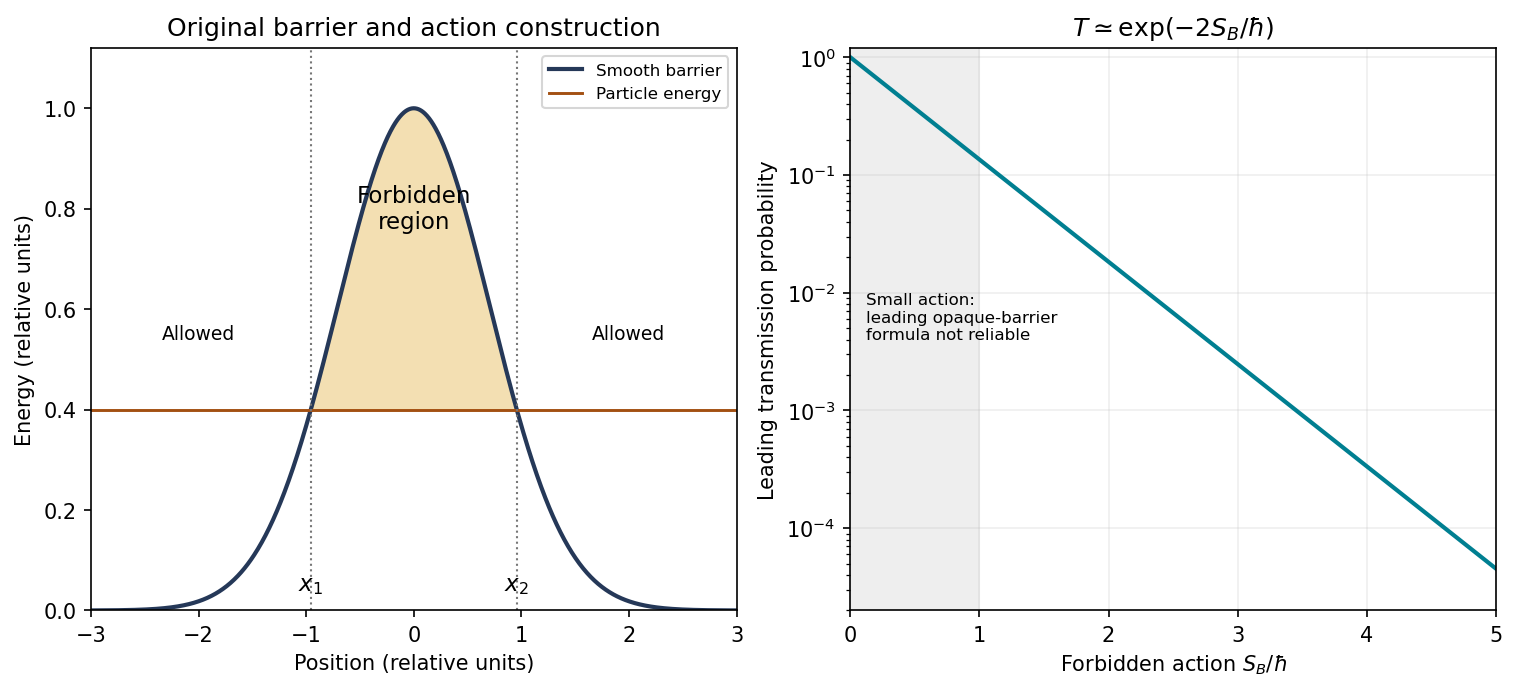
Original smooth-barrier construction and leading WKB transmission exponent; the shaded interval is classically forbidden
. Details. 
For a bound state between two smooth turning points, the related WKB quantization rule is . In a harmonic potential the integral equals , recovering . This exact agreement of energies for the harmonic oscillator does not make WKB wavefunctions uniformly exact near its turning points.
Articles by others on the same topic
There are currently no matching articles.