Original paper: Public original PDF, physical pages 390–393; question pages 391–393.
The open shell contains one electron, so and . For a less-than-half-filled shell, Hund's rules select the smaller total angular momentum, , giving the free-ion ground level . The Landé g-factor isIn a magnetic field weak compared with the spin-orbit splitting, the electronic Zeeman shifts are , for . Thus six equally spaced magnetic substates appear. At , the adjacent-level spacing isThe complete lowest-to-highest multiplet spread is five spacings,Giving both quantities removes the ambiguity in the word splitting. This is the free-ion, weak-field result; no crystal-field doublet or hyperfine structure is specified.
Hermiticity supplies the reverse matrix elements, also equal to the real number . In an orthonormal basis for the degenerate eigenspace, the perturbation iswhere is the all-ones matrix. Its symmetric vector has eigenvalue . Every vector whose components sum to zero has eigenvalue ; that subspace has dimension two. For example, and form an orthonormal basis for it.
The first-order energies are thereforeThe trace of the shifts is , agreeing with the zero diagonal. The ordering depends on the sign of ; the formula does not assume that the symmetric state is the lowest. Diagonalizing the perturbation inside the degenerate space is essential: the original diagonal entries alone would incorrectly predict no splitting.
Using a spherical Bohr-radius volume for the atom, the calculations below give a cutoff electromagnetic vacuum energy density of about , compared with a hydrogen binding-energy density of about . The cutoff vacuum estimate is about times larger. Alternative reasonable definitions of atomic volume change this ratio by a factor of a few, not the main order-of-magnitude conclusion.
The cutoff result is a bare zero-point mode sum. It is not a classical radiation bath incident on the atom, nor a calculation of an observable absolute vacuum energy without a subtraction or renormalization prescription.
In a large periodic quantization volume , one wavevector state occupies in wavevector space. There are two transverse photon polarizations, and each oscillator contributes . A lower wavelength cutoff corresponds to , so the energy density isFor ,The factor two is polarization, not an extra independent count of positive and negative frequencies. The continuum wavevector integral already counts independent travelling-wave modes in the usual field quantization convention. The quartic cutoff dependence also shows why an assumed shortest wavelength is crucial.
Take the hydrogen ground-state binding-energy magnitude as , and use as its characteristic radius. A definite volume convention isIt givesA quantum atom has no sharp outer surface. If instead its characteristic volume is taken as , the estimate is and the ratio is about . Both conventions place the two densities roughly three orders of magnitude apart at order-of-magnitude accuracy. The comparison uses the magnitude of the binding energy, not its negative sign relative to ionization.
The WKB approximation describes a wave whose local wavelength changes slowly compared with one wavelength. For the one-dimensional stationary Schrödinger equation, put . In a classically allowed region,The phase is the classical action divided by . The amplitude varies as so that a single travelling component has constant probability current. A useful local validity condition is .
For , write . The wave instead has growing and decaying components proportional to . At a simple turning point, vanishes and neither local WKB expression is valid. Linearizing the potential gives an Airy-function solution that connects the two sides and supplies the turning-point phase shift. It is not legitimate to carry the divergent WKB amplitude straight through the turning point.[ref]
Topics in Quantum Mechanics by David Tong. §2.2, semiclassical expansion and linear-potential matching
A useful application is tunnelling through a smooth opaque barrier. With turning points , the leading transmission probability isThe exponent is twice the forbidden-region action in units of , because transmission is a probability rather than a wave amplitude. For an ideal rectangular barrier of height and width , the same leading exponential is ; matching at the abrupt edges supplies an additional prefactor.
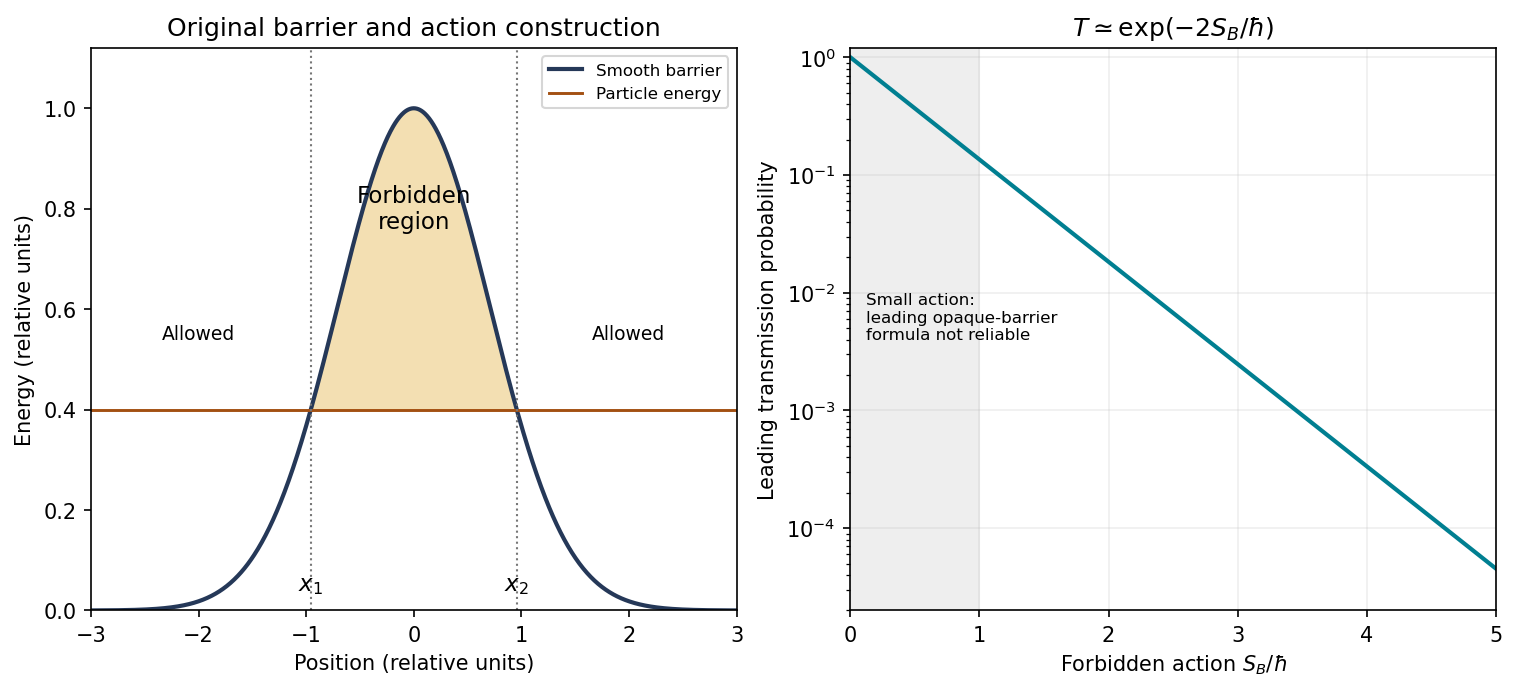
Original smooth-barrier construction and leading WKB transmission exponent; the shaded interval is classically forbidden
. Details. 
For a bound state between two smooth turning points, the related WKB quantization rule is . In a harmonic potential the integral equals , recovering . This exact agreement of energies for the harmonic oscillator does not make WKB wavefunctions uniformly exact near its turning points.
Stimulated emission adds a photon to an already occupied radiation mode; spontaneous emission can occur when that mode initially contains no photons. In the electric-dipole approximation the atom-field interaction is . Quantizing the radiation field makes the emission matrix element into a mode with occupation proportional toThis photon occupation enhancement of emission makes the emission rate into that mode proportional to : the part proportional to is stimulated and the remaining part is spontaneous. Absorption is proportional to . The photon energy is the atomic energy difference, up to any specified recoil or line broadening.
The stimulated contribution preferentially populates the stimulating mode, including its propagation direction and polarization; it provides optical gain. Spontaneous photons populate the available modes according to the transition's dipole matrix elements and radiation environment. They are not universally isotropic. An excited bare atom with the field vacuum is not an eigenstate of the fully coupled Hamiltonian, which resolves the apparent paradox of a nominally stationary excited state radiating.[ref]
Topics in Quantum Mechanics by David Tong. §4.3.2, why the electromagnetic field must be included to describe spontaneous decay
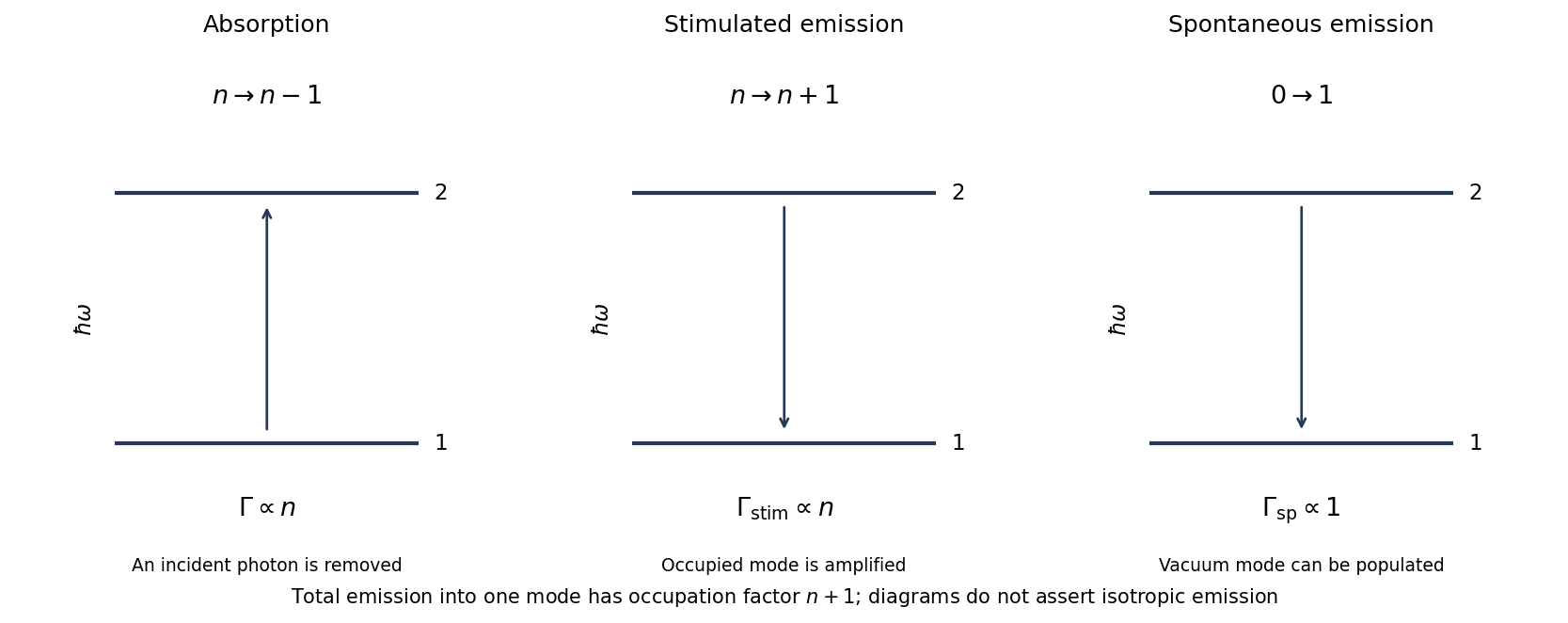
Original two-level transition diagrams and the versus occupation factors for photon absorption and emission
. Details. 
For lower and upper levels 1 and 2, with radiation spectral energy density per unit ordinary frequency, the rates areThermal detailed balance with the Planck spectrum givesThe statistical weights here are level degeneracies, not Landé g-factors. A definition of multiplying intensity or angular-frequency density would change the normalization factors.
For a specified free-space electric-dipole transition, summing radiation modes givesAppropriate sums over final magnetic substates and averages over initial substates are needed for an unresolved degenerate level. The radiative lifetime is only when this is the sole decay channel. In a laser, net stimulated gain requires , as well as sufficient gain to overcome cavity loss; population inversion alone does not specify the lasing threshold.
Fermi's golden rule converts a weak transition matrix element and the available density of final states into a transition rate. For a static perturbation and a continuum,When the matrix element is nearly constant on the energy shell, this becomes . The energy delta function is to be integrated, rather than interpreted as a finite rate to one exactly resonant discrete level. The observation time must resolve a smooth final-state continuum while remaining short enough that first-order depletion is small. A periodically driven perturbation instead gives the corresponding absorption and emission energy shells.
For elastic scattering from a weak localized potential , use box-normalized free states . ThenThe number of final states is . With , the density per energy and solid angle is . Dividing the resulting golden-rule rate by the incident single-particle flux givesThis is the golden-rule derivation of the Born cross-section. For the elastic problem , so the first Born scattering amplitude and cross-section areThe box volume cancels, as a physical cross-section must. The minus sign is fixed by the outgoing-wave scattering convention; the golden-rule rate alone determines only the modulus.
For example, has , hence , with . Replacing the exact scattering state by the incident plane wave is the essential Born approximation. It can fail for strong scattering, low-energy resonances and situations requiring repeated scattering; a small perturbation and a suitable continuum are separate conditions.[ref]
Spin and spatial exchange symmetry. Write the normalized spin singlet and triplet states asThe singlet is antisymmetric under exchange and has total spin zero; the triplet is symmetric and has total spin one. For orthogonal orbitals defineIdentical spin one-half particles are fermions, so the complete state must be antisymmetric. Thus is allowed, and is allowed for each triplet component. The spatially symmetric same-orbital states also require the singlet. A same-orbital triplet vanishes by the Pauli exclusion principle.
These products give a spin-adapted basis. More generally the physical state can be writtenA superposition of the singlet and triplet sectors need not factor into one spatial function times one spin function. Factorization holds for a definite-spin sector, as used in the subsequent model. If the original normalized orbitals are not orthogonal, the corresponding normalization is ; the remainder of this calculation uses the stipulated orthogonal orbitals.
Integral matrix elements and positivity. Let and denote the localized spatial orbitals. With fixed proton positions, the one-electron electronic operator isThe proton-proton repulsion is a separate common nuclear energy. The requested one-electron and direct two-electron elements areSince ,Likewise,The integrand is nonnegative and is positive on a set of nonzero measure. This is the repulsion cost of double occupancy; the coincidence singularity is integrable for ordinary smooth localized orbitals.
One electron on each center. Suppress the normalized singlet spin factor and use . For each of the spatial products and , the one-body sum has expectation . The cross terms vanish because a one-body hop leaves an orthogonal spectator orbital. The interaction contribution is the direct integral plus the exchange integral, both neglected in the model. ConsequentlyThis state has no same-center double occupancy, but remains an exchange-symmetric spatial superposition rather than assigning a distinguishable electron permanently to each proton.
Two electrons in the bonding orbital. The normalized one-electron bonding orbital is . The trial spatial state is , whose one-body expectation isExpanding the product gives . The total probability of double occupancy is therefore . Keeping only on-site Coulomb repulsion gives the intended interaction truncation,and the interaction expectation is . HenceThis truncation must be stated. In particular, mixed Coulomb elements such as do not vanish merely by orbital orthogonality or inversion symmetry. The printed list does not explicitly name them. If they are retained and are equal and real by site symmetry, their contribution to is ; the requested expression uses their neglect along with the other off-site interaction terms. No numerical value of is supplied or invented.
Energy comparison and the bond. Put with and . ThenThe straight line starts at and crosses zero at . The purely bonding-orbital trial state is better for , while the singly occupied covalent trial state is better for .
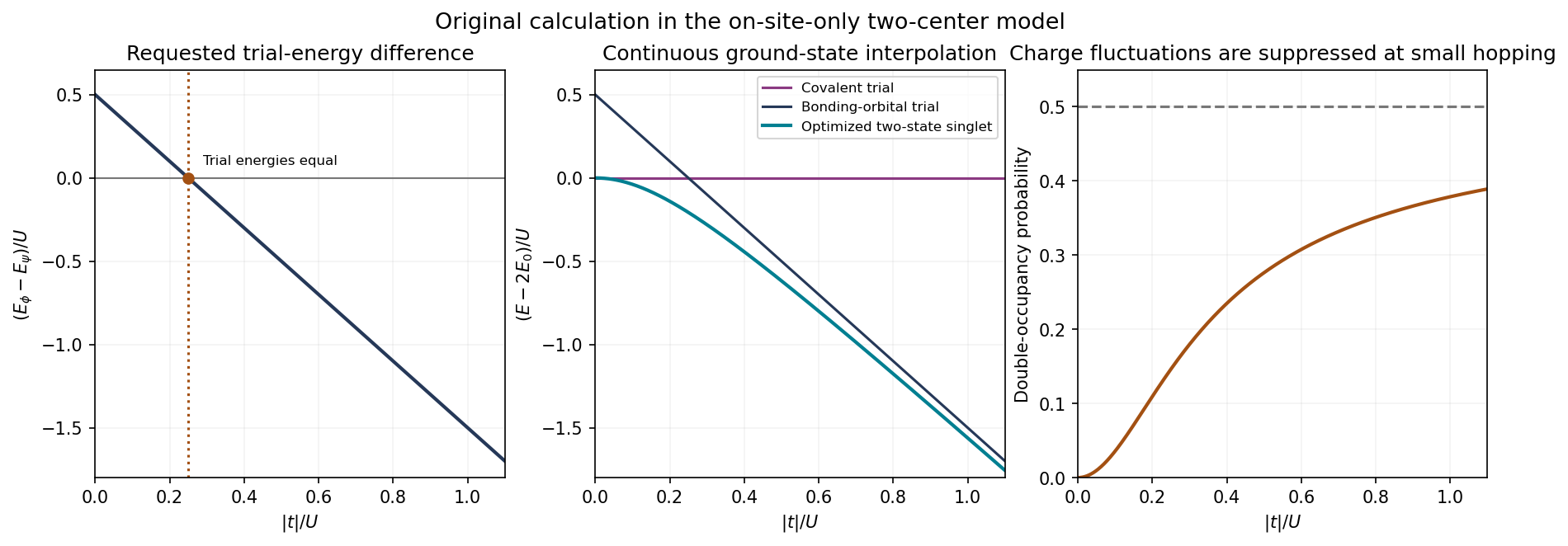
Original two-site singlet calculation: trial-energy comparison, continuous optimized energy and double-occupancy crossover in the stated on-site model
. Details. 
For localized orbitals of approximately fixed atomic size, the hopping magnitude decreases rapidly, typically exponentially times a polynomial, as the proton separation grows. The on-site integral remains of atomic Coulomb scale and tends to the isolated-orbital value; it does not decay as the intersite repulsion . If the orbitals themselves are allowed to relax, also changes, so no universal monotonic law for follows from the data.
At small , electron correlation suppresses the ionic configurations and , favoring a singlet with roughly one electron on each center. A single doubly occupied bonding orbital has an artificial finite ionic weight even as the centers separate. At large , delocalization gains enough kinetic energy that the bonding-orbital description becomes useful and charge fluctuations are substantial.
The crossing of two restricted trial energies is not a sharp transition of the actual two-site ground state. To see this without adding empirical data, include both and the symmetric ionic state . This two-site Hubbard dimer reduces toIts ground state is , with and . The ionic probability isIt changes smoothly from zero to . At large separation, the electronic lowering is to leading order and vanishes as hopping vanishes. An absolute molecular binding curve would additionally require , the nuclear repulsion and the neglected intersite terms; this simplified comparison alone does not determine an equilibrium bond length.
Uniform system and dispersion. A plane wave reduces the differential Hamiltonian to a two-by-two matrix acting on its spinor:The Pauli anticommutation relations imply . Choosing a spinor in one of its eigenspaces therefore givesAn arbitrary constant spinor multiplying a plane wave is not necessarily an energy eigenstate; it must be an eigenvector of this matrix. For example, for the upper branch and , one can useaway from the coordinate singularity , where another normalized eigenvector chart is used.
For the usual convention, the massless branches are . For nonzero , the two branches have a gap and are quadratic near :Changing the sign of does not change these energies. It reverses the out-of-plane spin polarization of a given band at the origin. The plots for equal positive and negative mass magnitudes therefore have identical dispersion curves, despite their different spinors.
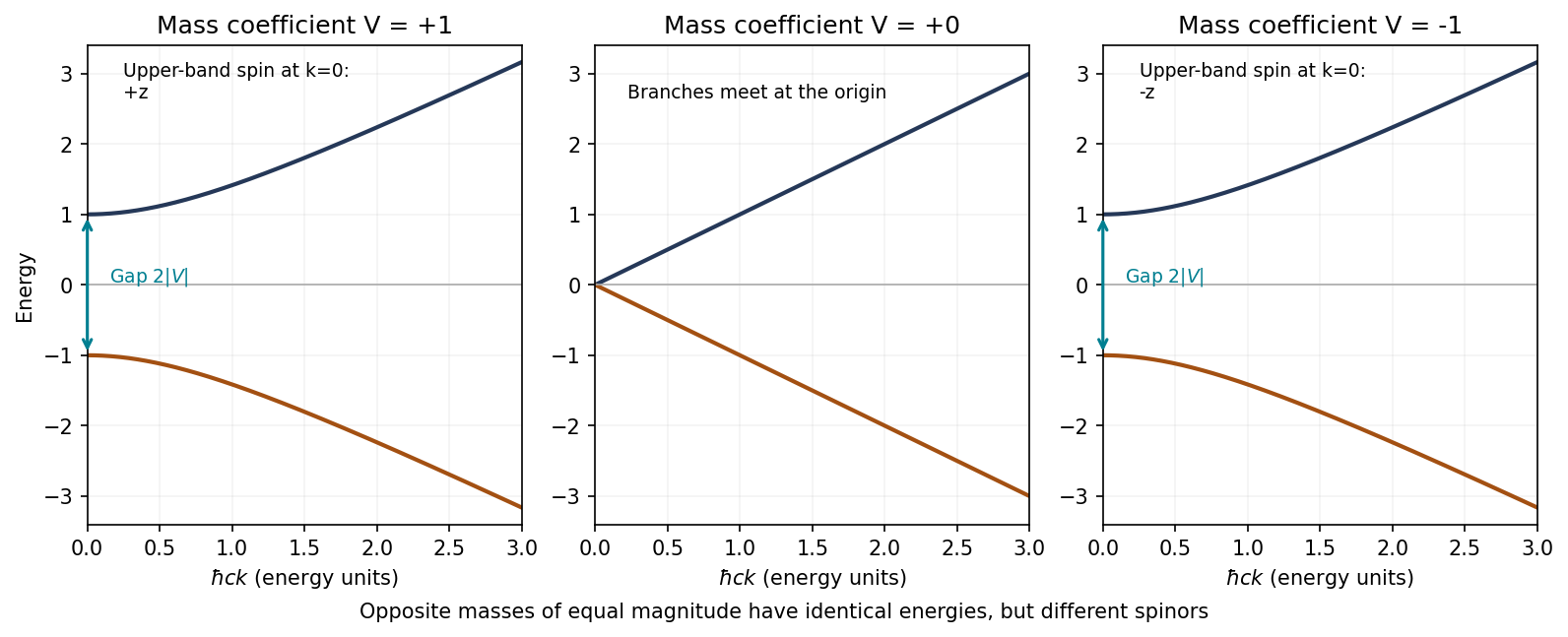
Original calculated massive and massless two-dimensional Dirac dispersions; equal and opposite masses share energies but reverse the band spin at zero momentum
. Details. 
Spin direction in the massless case. For put . The normalized eigenspinors can be chosen asDirect multiplication gives , and . Since the Pauli matrices represent physical spin in this question,The spin is parallel to momentum on the positive-energy branch and antiparallel on the negative-energy branch. Thus the branch-independent statement is collinearity; the printed parallel claim needs the positive-branch qualification. At , the Hamiltonian is zero and spin is not fixed by a wavevector direction.
Mass-domain-wall eigenstate. Assume for the stated normalizable wall state and writeThen , , and . Applying the full operator givesThe transverse derivative and mass terms cancel pointwise. Hence the specified state is an eigenstate with .
For a step mass above the interface and below it,The Localization length at a step Dirac mass wall sets the two exponential tails. The amplitude is continuous, peaks at the interface and decays on both sides, with generally unequal decay lengths. The probability density decays with lengths . A normalized transverse function is when multiplying the unit spinor . The longitudinal plane wave can independently be box-normalized. A step in allows a step in ; the first-order Dirac equation does not impose continuity of that derivative.
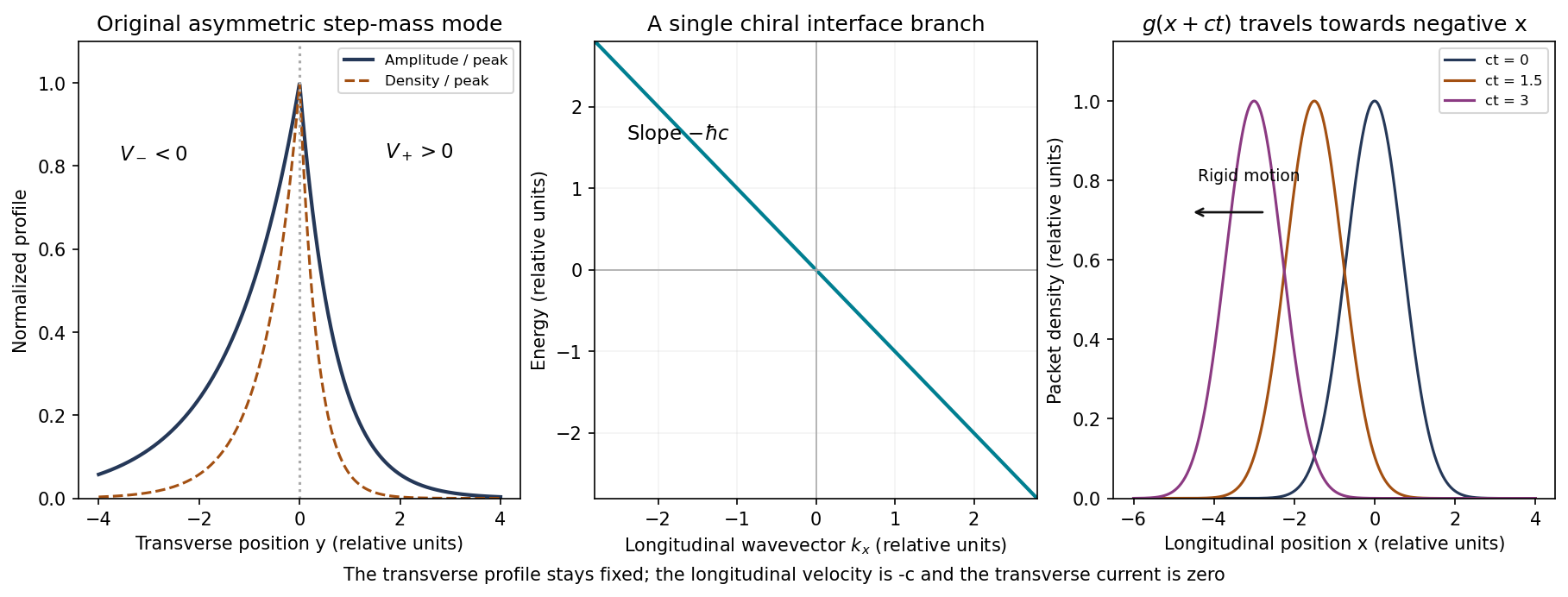
Original mass-wall solution: asymmetric exponential confinement, the chiral energy branch and rigid longitudinal translation of a localized packet
. Details. 
Propagation. The interface dispersion is the straight lineEvery component on this branch travels in the negative direction. A packet has the formThis dispersionless chiral interface wavepacket therefore translates rigidly with speed in that direction, without dispersion in this exactly linear model. It remains confined in ; there is no free transverse group velocity, because the bound-state family is not labelled by a transverse travelling-wave momentum.
The continuity equation gives the current components and . This explicitly confirms absence of probability transport away from the interface. For the step-mass case the profile is normalizable because its tails have positive decay constants and . A general sign-changing profile also requires ; nonzero asymptotic masses suffice, whereas signs alone do not guarantee confinement if their integrated magnitudes grow too slowly. If , the supplied exponential instead grows at infinity; a normalizable state requires the opposite spinor and envelope sign. Reversing the wall orientation also reverses the propagation chirality.
Articles by others on the same topic
There are currently no matching articles.