The WKB approximation describes a wave whose local wavelength changes slowly compared with one wavelength. For the one-dimensional stationary Schrödinger equation, put . In a classically allowed region,The phase is the classical action divided by . The amplitude varies as so that a single travelling component has constant probability current. A useful local validity condition is .
For , write . The wave instead has growing and decaying components proportional to . At a simple turning point, vanishes and neither local WKB expression is valid. Linearizing the potential gives an Airy-function solution that connects the two sides and supplies the turning-point phase shift. It is not legitimate to carry the divergent WKB amplitude straight through the turning point.[ref]
Topics in Quantum Mechanics by David Tong. §2.2, semiclassical expansion and linear-potential matching
A useful application is tunnelling through a smooth opaque barrier. With turning points , the leading transmission probability isThe exponent is twice the forbidden-region action in units of , because transmission is a probability rather than a wave amplitude. For an ideal rectangular barrier of height and width , the same leading exponential is ; matching at the abrupt edges supplies an additional prefactor.
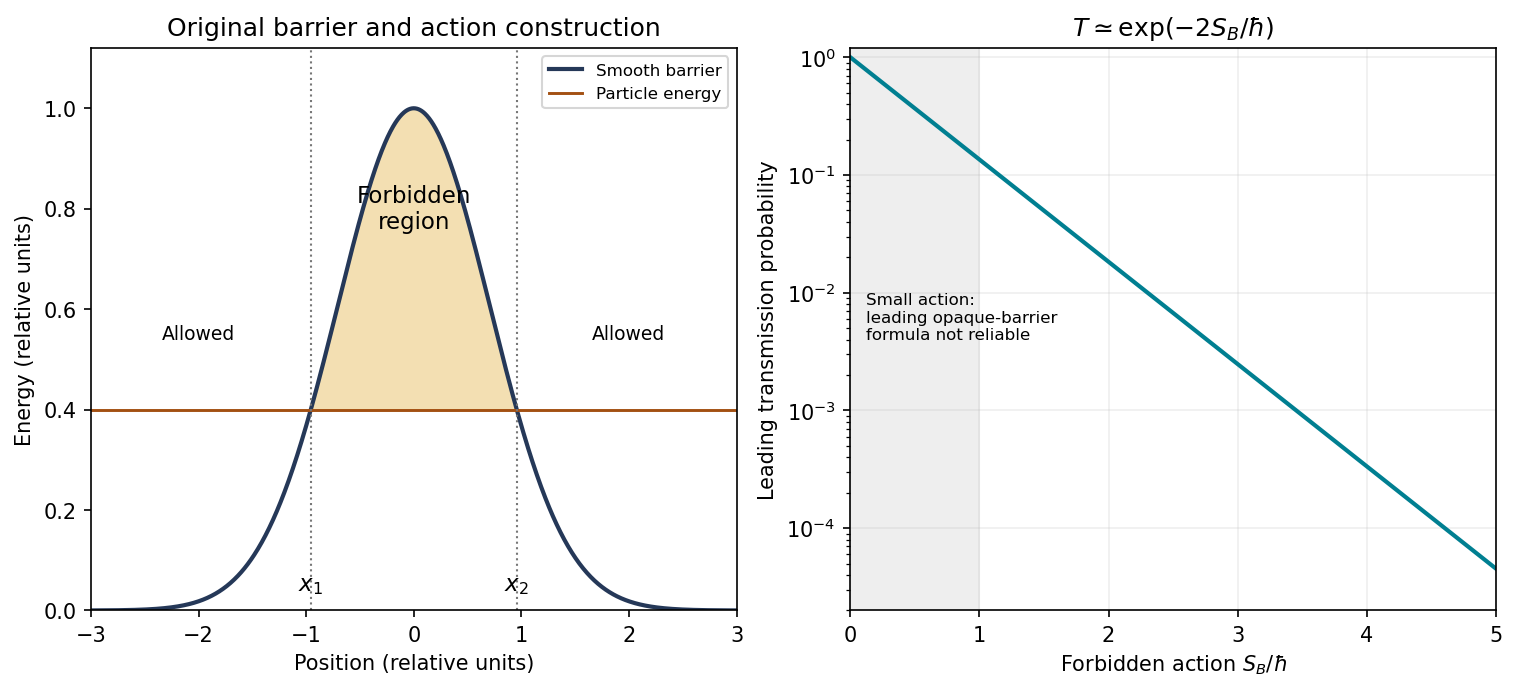
Original smooth-barrier construction and leading WKB transmission exponent; the shaded interval is classically forbidden
. Details. 
For a bound state between two smooth turning points, the related WKB quantization rule is . In a harmonic potential the integral equals , recovering . This exact agreement of energies for the harmonic oscillator does not make WKB wavefunctions uniformly exact near its turning points.
Stimulated emission adds a photon to an already occupied radiation mode; spontaneous emission can occur when that mode initially contains no photons. In the electric-dipole approximation the atom-field interaction is . Quantizing the radiation field makes the emission matrix element into a mode with occupation proportional toThis photon occupation enhancement of emission makes the emission rate into that mode proportional to : the part proportional to is stimulated and the remaining part is spontaneous. Absorption is proportional to . The photon energy is the atomic energy difference, up to any specified recoil or line broadening.
The stimulated contribution preferentially populates the stimulating mode, including its propagation direction and polarization; it provides optical gain. Spontaneous photons populate the available modes according to the transition's dipole matrix elements and radiation environment. They are not universally isotropic. An excited bare atom with the field vacuum is not an eigenstate of the fully coupled Hamiltonian, which resolves the apparent paradox of a nominally stationary excited state radiating.[ref]
Topics in Quantum Mechanics by David Tong. §4.3.2, why the electromagnetic field must be included to describe spontaneous decay
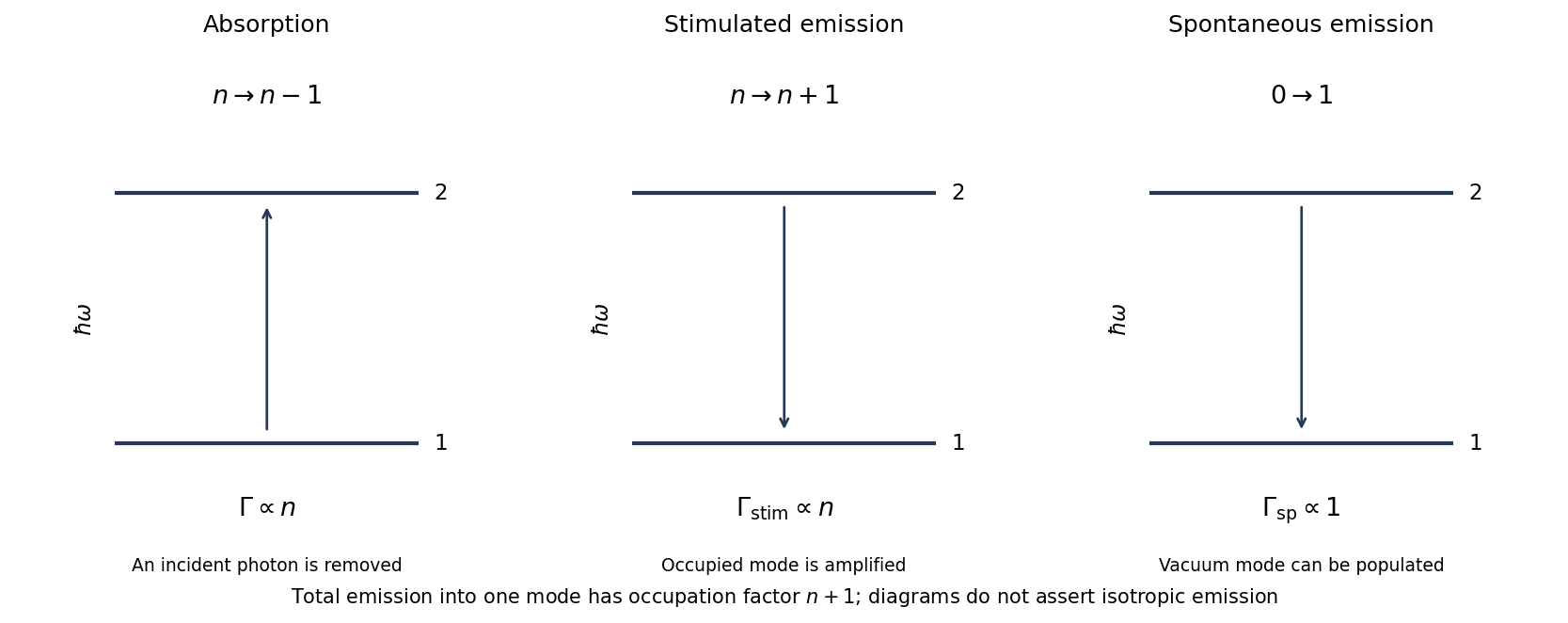
Original two-level transition diagrams and the versus occupation factors for photon absorption and emission
. Details. 
For lower and upper levels 1 and 2, with radiation spectral energy density per unit ordinary frequency, the rates areThermal detailed balance with the Planck spectrum givesThe statistical weights here are level degeneracies, not Landé g-factors. A definition of multiplying intensity or angular-frequency density would change the normalization factors.
For a specified free-space electric-dipole transition, summing radiation modes givesAppropriate sums over final magnetic substates and averages over initial substates are needed for an unresolved degenerate level. The radiative lifetime is only when this is the sole decay channel. In a laser, net stimulated gain requires , as well as sufficient gain to overcome cavity loss; population inversion alone does not specify the lasing threshold.
Fermi's golden rule converts a weak transition matrix element and the available density of final states into a transition rate. For a static perturbation and a continuum,When the matrix element is nearly constant on the energy shell, this becomes . The energy delta function is to be integrated, rather than interpreted as a finite rate to one exactly resonant discrete level. The observation time must resolve a smooth final-state continuum while remaining short enough that first-order depletion is small. A periodically driven perturbation instead gives the corresponding absorption and emission energy shells.
For elastic scattering from a weak localized potential , use box-normalized free states . ThenThe number of final states is . With , the density per energy and solid angle is . Dividing the resulting golden-rule rate by the incident single-particle flux givesThis is the golden-rule derivation of the Born cross-section. For the elastic problem , so the first Born scattering amplitude and cross-section areThe box volume cancels, as a physical cross-section must. The minus sign is fixed by the outgoing-wave scattering convention; the golden-rule rate alone determines only the modulus.
For example, has , hence , with . Replacing the exact scattering state by the incident plane wave is the essential Born approximation. It can fail for strong scattering, low-energy resonances and situations requiring repeated scattering; a small perturbation and a suitable continuum are separate conditions.[ref]
Articles by others on the same topic
There are currently no matching articles.