For the quantum harmonic oscillator, the canonical commutation relation gives and . Inverting the definition of the annihilation operator givesWith normalized energy eigenstates and consistent phases, and . Their orthogonality therefore givesMore generally, , the oscillator electric-dipole selection rule out of the ground state.
To derive the transition amplitude, insert the expansion in stationary energy eigenstates into the Schrödinger equation with . The derivatives of the explicit phases cancel the terms. Projection onto leaves the exact coefficient equationsThe initial conditions are and . To first order in the perturbation, replace the amplitudes on the right by these initial values. Since , integration gives time-dependent perturbation theory in the formThis neglects depletion and higher-order transitions; it is justified when the total transition probability is small. Here , so there is also no first-order diagonal amplitude change from this particular perturbation.
For the exponential electric field, the electric-dipole interaction is , with . Only couples directly to the initial state, andThe Born rule givesThe real part makes the lower-limit contribution vanish. ThusSet and . The dimensionless form is , increasing monotonically from zero to one, with half the asymptotic value at . A sufficient weak-field condition for the entire curve is .
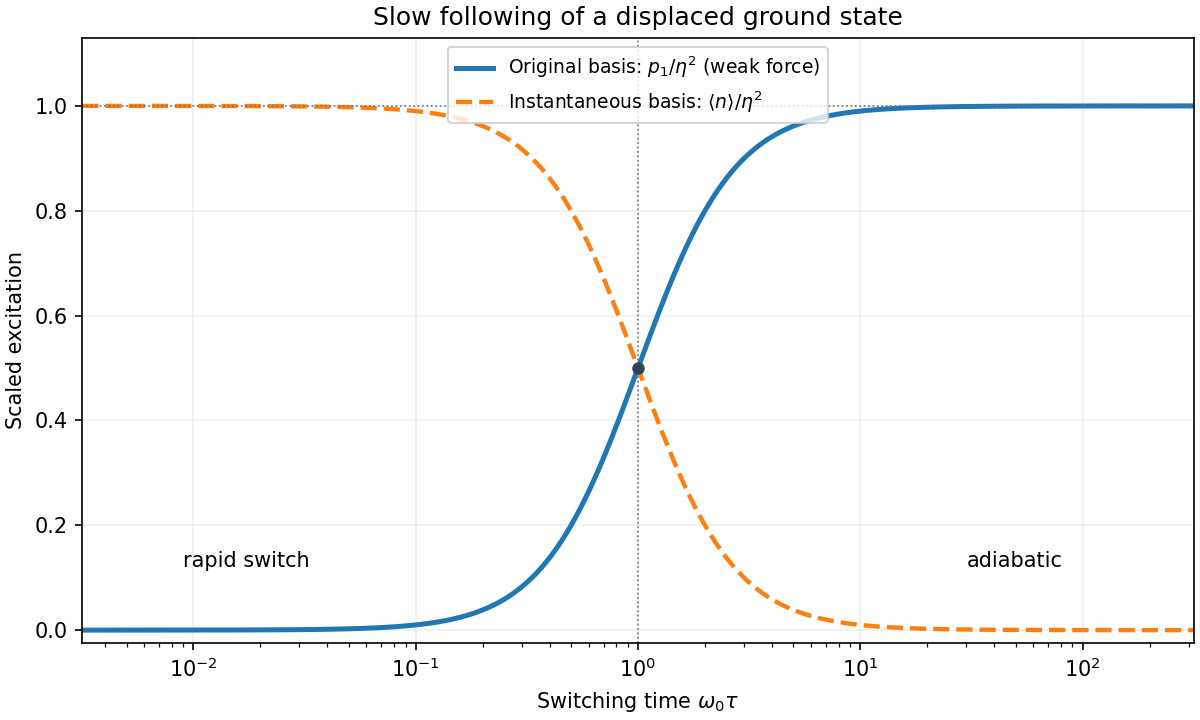

For , the force has acted for too little time to appreciably change the state at the instant of measurement. The short-time amplitude is approximately , soFor , instead,The nonzero slow-switch limit is a probability in the original basis. It does not contradict the adiabatic theorem. At the instantaneous oscillator is displaced by :Its ground state is in the original basis. Adiabatic following therefore predicts exactly the finite original-basis limit found above.
The exponential switch-on of a driven quantum oscillator also permits an exact check. A linear force preserves a coherent state, with original-basis displacement . Thus the exact original-basis probability is , whose weak-field limit is the expression above. In the instantaneous displaced basis the mean excitation is instead and does tend to zero for slow switching. The two bases measure different notions of excitation.
Articles by others on the same topic
There are currently no matching articles.