For the quantum harmonic oscillator, the canonical commutation relation gives and . Inverting the definition of the annihilation operator givesWith normalized energy eigenstates and consistent phases, and . Their orthogonality therefore givesMore generally, , the oscillator electric-dipole selection rule out of the ground state.
To derive the transition amplitude, insert the expansion in stationary energy eigenstates into the Schrödinger equation with . The derivatives of the explicit phases cancel the terms. Projection onto leaves the exact coefficient equationsThe initial conditions are and . To first order in the perturbation, replace the amplitudes on the right by these initial values. Since , integration gives time-dependent perturbation theory in the formThis neglects depletion and higher-order transitions; it is justified when the total transition probability is small. Here , so there is also no first-order diagonal amplitude change from this particular perturbation.
For the exponential electric field, the electric-dipole interaction is , with . Only couples directly to the initial state, andThe Born rule givesThe real part makes the lower-limit contribution vanish. ThusSet and . The dimensionless form is , increasing monotonically from zero to one, with half the asymptotic value at . A sufficient weak-field condition for the entire curve is .
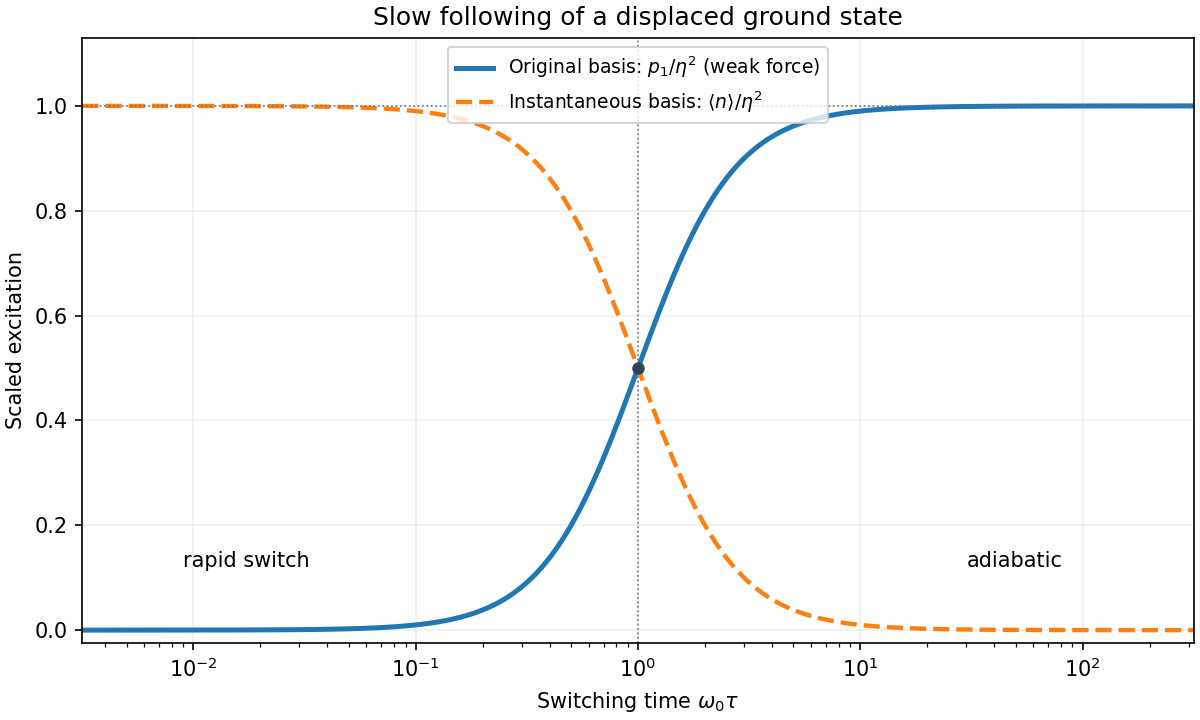
For , the force has acted for too little time to appreciably change the state at the instant of measurement. The short-time amplitude is approximately , soFor , instead,The nonzero slow-switch limit is a probability in the original basis. It does not contradict the adiabatic theorem. At the instantaneous oscillator is displaced by :Its ground state is in the original basis. Adiabatic following therefore predicts exactly the finite original-basis limit found above.
The exponential switch-on of a driven quantum oscillator also permits an exact check. A linear force preserves a coherent state, with original-basis displacement . Thus the exact original-basis probability is , whose weak-field limit is the expression above. In the instantaneous displaced basis the mean excitation is instead and does tend to zero for slow switching. The two bases measure different notions of excitation.
Take a normalized spin one-half state in the eigenbasis. Since , direct multiplication of the Pauli matrices givesSubstitution of the half-angle parametrization givesThus and are precisely the polar and azimuthal angles of the mean spin. Two complex coefficients contain four real parameters; normalization removes one and an unobservable common quantum phase removes another. The resulting pure states form the Bloch sphere. One may choose real and nonnegative away from the patch where . At the poles the azimuth is redundant. The length should not be confused with .
For a spatial plane wave, becomes , so the Hamiltonian operator reduces to the Weyl Hamiltonian matrixDefine and . The matrixsatisfies by the angle-addition identities. Consequently the displayed spinor is an energy eigenstate for either or , with respective energies and , for . Equivalently, at each fixed nonzero wavevector the two branches areIf , the two energy labels exchange; the ordered eigenvalues are . Taking sets the convention in the sketches. An orthogonal spinor obeys and supplies the other branch at .
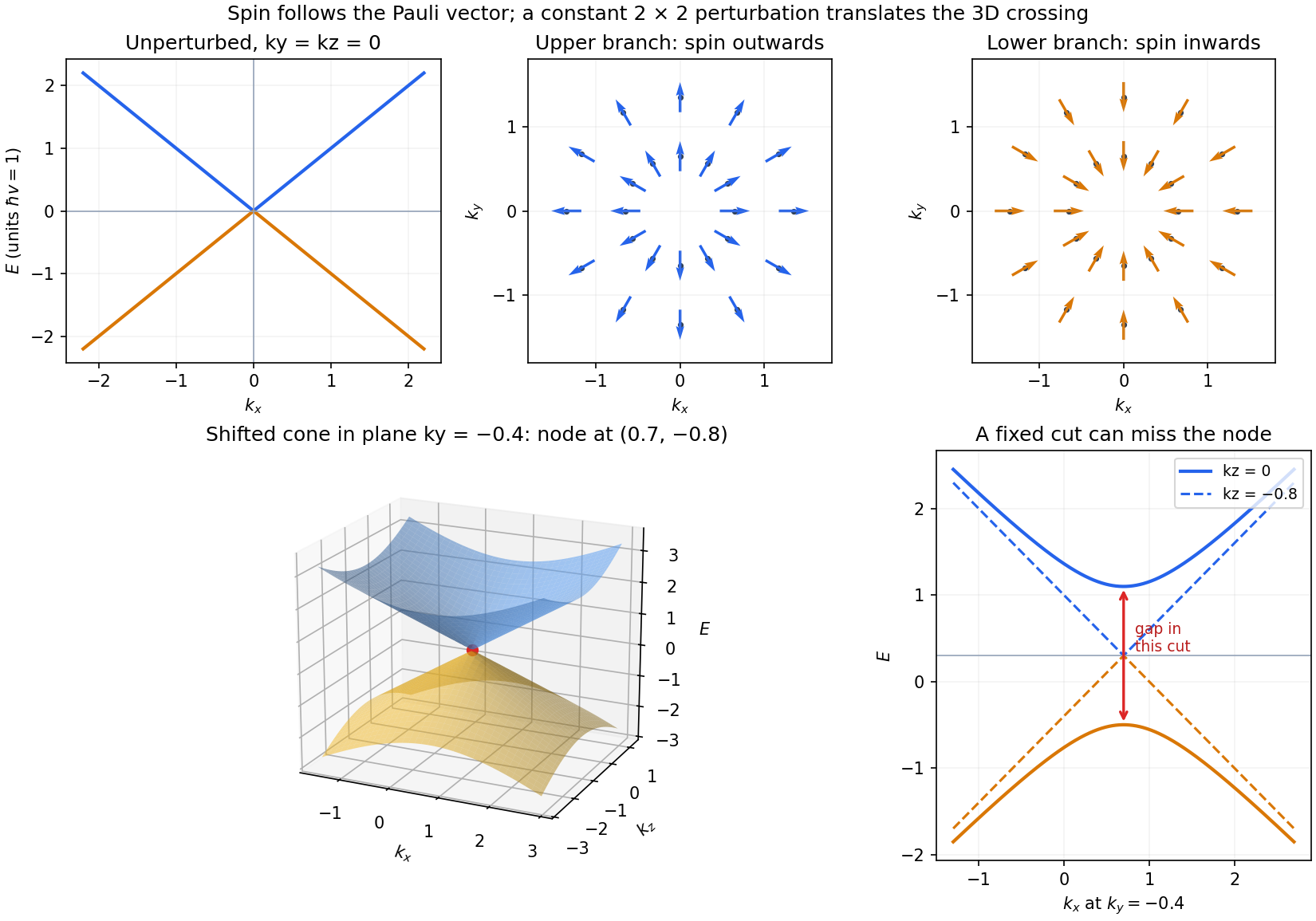
The Pauli matrix multiplication law independently gives . The dispersion relation is therefore a pair of cones touching at zero energy and momentum; a signed straight-line cut has upper and lower branches . In the plane, , and the upper-branch mean spin points radially outwards, the lower-branch spin radially inwards. This is spin-momentum locking, not a tangential spin texture. At the touching point the two states are degenerate and the spin direction is not selected by the Hamiltonian operator.
Now let a spatially constant perturbation have matrix , with real. The Hermitian two-by-two matrix in the Pauli basis decomposition follows explicitly fromwhere , , , and are real. Equivalently, and . The four matrices are linearly independent under the trace inner product and span the four-dimensional real vector space of Hermitian two-by-two matrices.
Spatial constancy means the perturbation does not mix different wavevectors, so each momentum sector can still be diagonalized independently. Write . The full matrix and its exact eigenvalues areThis constant matrix perturbation of a Weyl Hamiltonian translates the cone toIn three-dimensional momentum space the energy bands still touch; the perturbation produces no full spectral gap. The new branch spin directions are parallel and antiparallel to , so their radial texture is centered on the shifted point.
A restricted cut must be distinguished from the full dispersion relation. In the fixed plane , the energies are , with minimum branch separation . This plane misses the crossing if . Along any line through the dispersion relation still crosses linearly. Thus a sketch of a gapped fixed-plane cut alone would not describe the gapless three-dimensional Hamiltonian operator. The cone after a general perturbation is also no longer a function of about the old origin alone.
For physical spin ladder operators, . Operators at distinct sites commute. Expanding the two products cancels their cross terms and givesAdding the remaining component provesFor spin one-half, , , and raising an up spin or lowering a down spin gives zero. These formulas restore the physical factors implicit in the dimensionless ladder hint.
Let abbreviate the state with the only down spin at site , keeping for the fully up state. If lies on neither end of bond , that bond contains two up spins. The ladder terms vanish, while gives . ThusFor a down spin at , the product is instead , and moves it to with amplitude . For a down spin at , the other ladder product moves it back. ThereforeEvery bond in is aligned, so summing its bond energies givesThis is indeed a ground-state energy: a pair of spin-one-half particles has eigenvalues and , so each ferromagnetic bond is bounded below by , simultaneously attained by the fully aligned state. The isotropic Heisenberg model has a whole maximum-total-spin ground multiplet, not a unique all-up ground state.
In the single-excitation subspace, only the two bonds adjacent to the down spin differ from the aligned background. Their diagonal energy increase is , and each neighboring hop has amplitude . Hence, with periodic site indices,This is an exact finite-dimensional hopping problem. Choose the active one-site translation convention . A periodic plane-wave coefficient pattern requires , soThere are independent such wavevectors, for example one set of consecutive integers in a Brillouin zone. The normalized one-magnon Bloch states on a ring are . Reindexing with the periodic coefficient condition gives and hence .
There is a logical qualification to the condition stated in the paper. On an -site ring already holds for every state. In particular, the finite sum written with an arbitrary real also returns to itself after translations; that condition alone does not quantize . The displayed allowed values are the ones for which the ansatz is a single one-site translation eigenstate, equivalently a consistently periodic plane wave. This is the additional condition needed for the subsequent energy-eigenstate argument. Other values generally describe superpositions of the allowed momentum modes.
Apply the hopping Hamiltonian operator and shift the summation index using periodic boundary condition. The coefficients from and are respectively and times the original coefficient. Thusand the nearest-neighbour ferromagnetic magnon dispersion isThe unnormalized state in the question has the same energy. Distinct allowed momenta are orthogonal, since over one set of representatives.
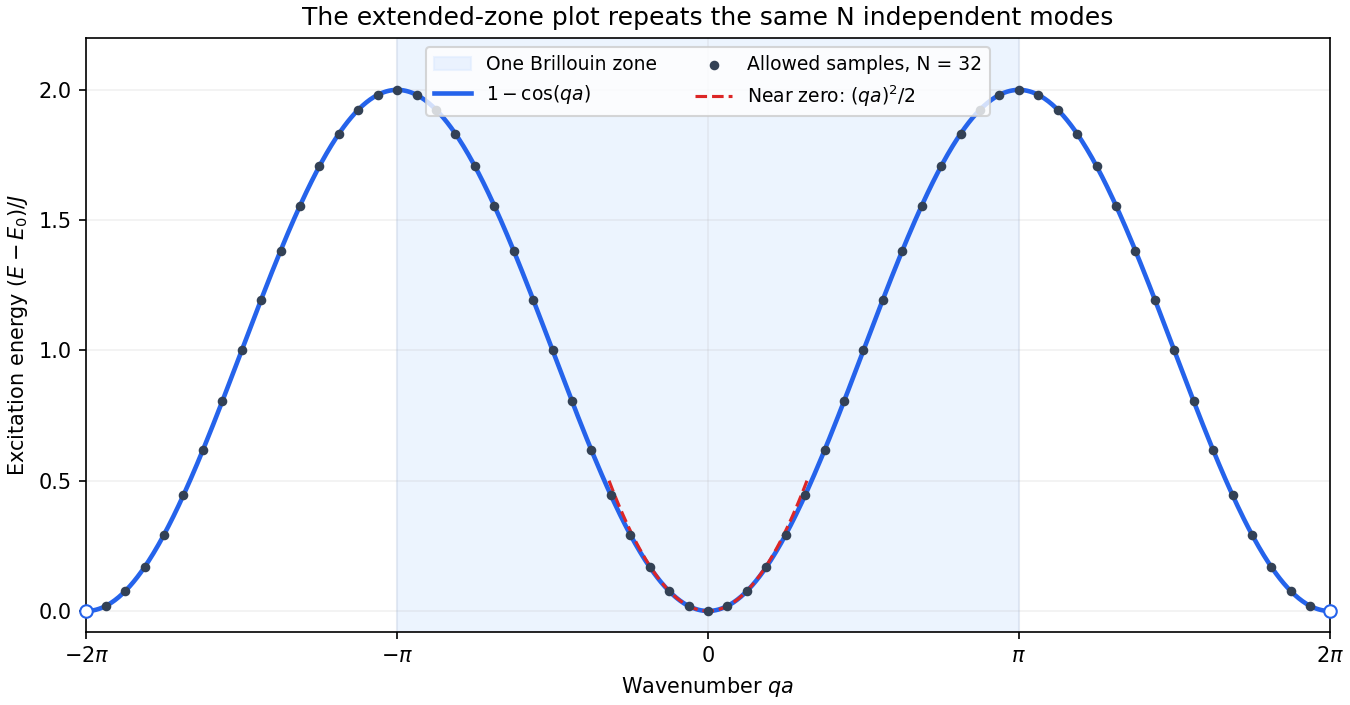


For large the sampled wavevectors become dense, and the requested sketch is the periodic curve over . It has a zero at and tends to the equivalent zero at either open endpoint; maxima occur at . Near any equivalent zero,using measured from that zero. The low-momentum ferromagnetic magnon is quadratic, with group velocity . The state is proportional to the total spin lowering operator acting on , so it belongs to the same ground multiplet and has exactly zero excitation energy. Extending the plot beyond one reciprocal period repeats states rather than adding new independent modes. The lattice spacing is the nearest-neighbor chord length specified in the paper; is the translation length in this lattice description, not necessarily the continuous circumference of a circular arrangement.
Articles by others on the same topic
There are currently no matching articles.