Use the electronic weak-field Zeeman splitting model, neglecting hyperfine structure. The Landé g-factor is for and for . The shift of an absorption frequency is thereforeHere the magnetic field is weak relative to spin-orbit coupling, so remains a useful quantum number, but the spectral line widths are small enough to resolve its magnetic substates.
For linear polarization parallel to , the optical electric field has only the field-axis component. The electric-dipole selection rule is . Its two allowed transitions are , givingFor propagation perpendicular to with linear polarization also perpendicular to , the optical electric field is an equal-amplitude combination of the two field-axis circular components. It drives transitions with . These connect and , givingThus each orientation selects two lines, with twice the separation in the perpendicular-polarization case. Neither pair has an unshifted central component. This is polarization-selective Zeeman splitting of an alkali D1 line, an anomalous Zeeman effect rather than a normal orbital triplet.
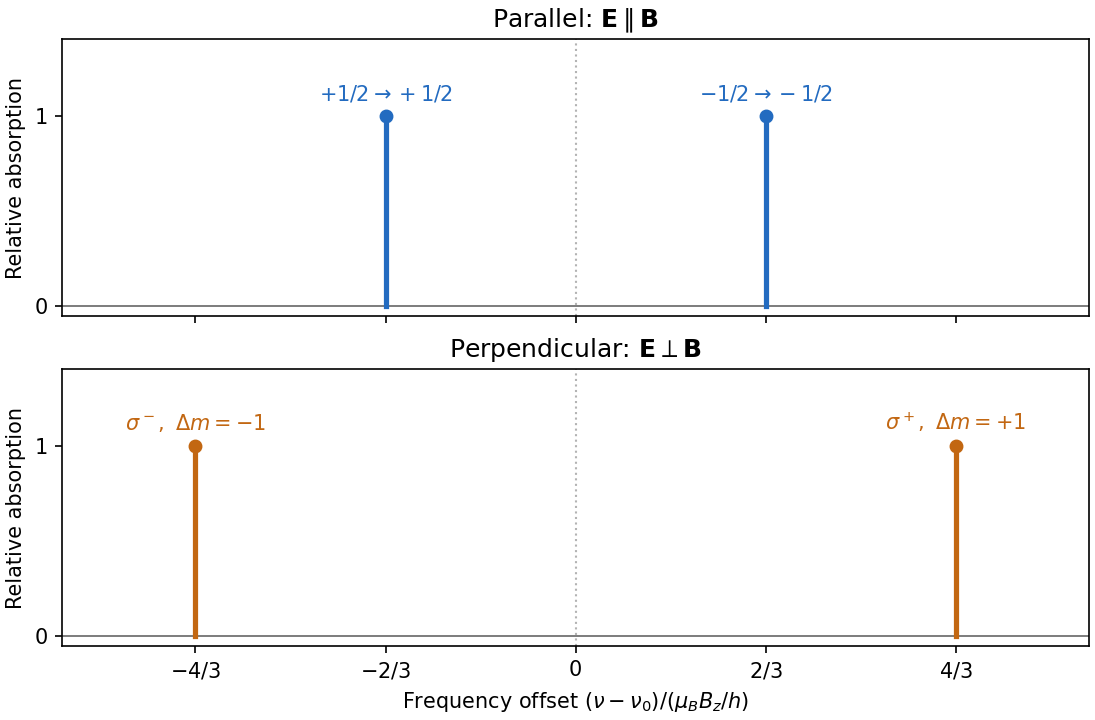
Polarization selects two different sodium D1 Zeeman doublets
. Original electronic-level prediction in units . Equal heights within each pair illustrate an initially unpolarized lower level and a weak probe; optical pumping can alter populations and hence strengths. Hyperfine structure is omitted, as in the stated electronic -level model. Details.
Articles by others on the same topic
There are currently no matching articles.