The closed and subshells contribute zero total orbital angular momentum and spin, so only the two electrons matter. The first of Hund's rules maximizes their total spin, giving . The Pauli exclusion principle then requires an antisymmetric spatial wavefunction. Two parallel-spin electrons cannot occupy the same orbital: the greatest possible orbital projection is , so the maximal allowed within this triplet is .
The ground term is therefore , in term symbol notation . Since the subshell contains fewer than half of its six possible electrons, the third of Hund's rules places the smallest lowest. Addition of angular momentum gives , in that energy order within the ground term. ThusThese are the fine structure partners of the same electronic term, with magnetic multiplicities , rather than different principal-shell excitations. The ordering agrees with the tabulated lowest neutral-carbon levels.[ref]
https://physics.nist.gov/PhysRefData/Handbook/Tables/carbontable5.htm. NIST, Energy Levels of Neutral Carbon, lowest three entries
Let be the spontaneous emission coefficient, and let and be the absorption and stimulated emission rates per atom under the radiation spectral energy density at resonance. Because the two levels are nondegenerate, the Einstein coefficients satisfy .
The radiative balance in a nondegenerate two-level atom isThe total spontaneous and stimulated emission rates are and . Dividing the balance equation by givesThis presumes nonzero drive and upper-level population, and no other population-transfer mechanism. It does not require a thermal Boltzmann distribution. In this closed driven two-level system, spontaneous decay keeps ; arbitrarily intense driving approaches equal populations, rather than producing a population inversion.
Use the electronic weak-field Zeeman splitting model, neglecting hyperfine structure. The Landé g-factor is for and for . The shift of an absorption frequency is thereforeHere the magnetic field is weak relative to spin-orbit coupling, so remains a useful quantum number, but the spectral line widths are small enough to resolve its magnetic substates.
For linear polarization parallel to , the optical electric field has only the field-axis component. The electric-dipole selection rule is . Its two allowed transitions are , givingFor propagation perpendicular to with linear polarization also perpendicular to , the optical electric field is an equal-amplitude combination of the two field-axis circular components. It drives transitions with . These connect and , givingThus each orientation selects two lines, with twice the separation in the perpendicular-polarization case. Neither pair has an unshifted central component. This is polarization-selective Zeeman splitting of an alkali D1 line, an anomalous Zeeman effect rather than a normal orbital triplet.
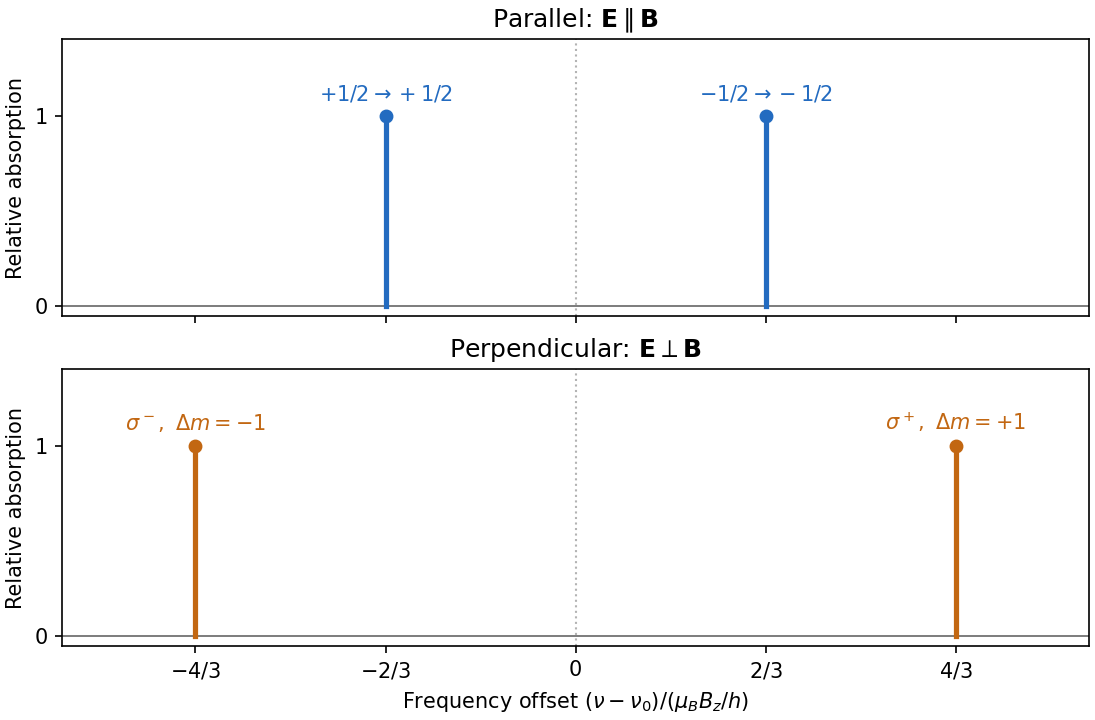
Polarization selects two different sodium D1 Zeeman doublets
. Original electronic-level prediction in units . Equal heights within each pair illustrate an initially unpolarized lower level and a weak probe; optical pumping can alter populations and hence strengths. Hyperfine structure is omitted, as in the stated electronic -level model. Details.
Articles by others on the same topic
There are currently no matching articles.