Because at , the factor cancels from the ratio. Write and . The exact answer isAt high temperature, . Expanding the hyperbolic tangent givesThe displayed leading expression is the ratio of classical Boltzmann factors for potential energy and . Indeed the classical canonical ensemble givesThe momentum Gaussian integral is independent of and cancels in the ratio. This is the classical phase-space limit of the thermal kernel. Here , with the Boltzmann constant; the associated classical position variance is . At fixed , ultimately tends to one as temperature tends to infinity, while its width grows.
At low temperature, . Now , so at fixed Unlike the classical high-temperature expression, this limiting width remains nonzero at zero temperature, reflecting the ground state of the quantum harmonic oscillator.
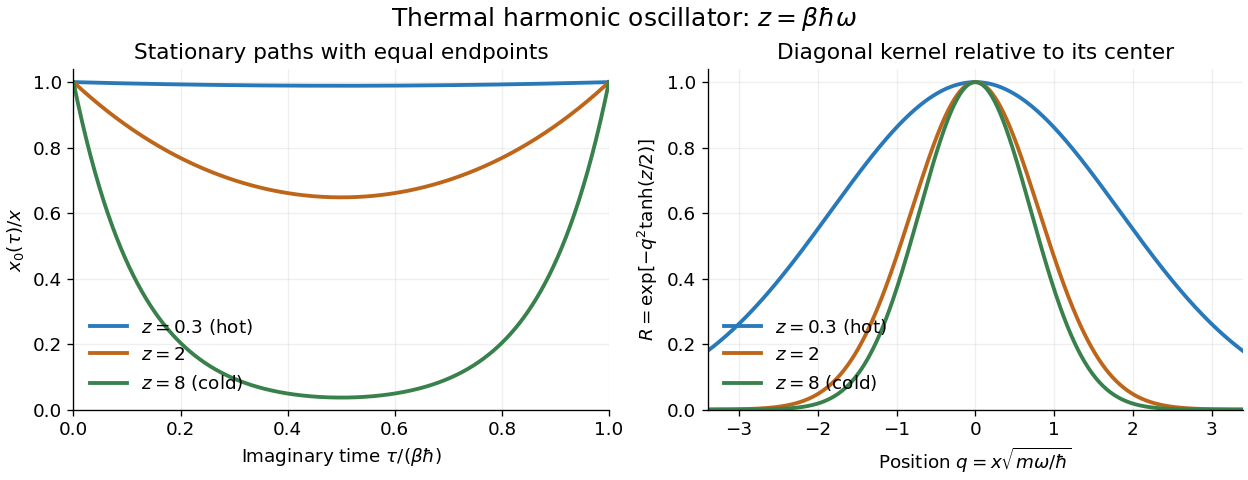
Imaginary-time stationary paths and the crossover of the diagonal thermal kernel
. Original plots of the equal-endpoint Euclidean oscillator path and the diagonal thermal kernel of a quantum harmonic oscillator, divided by its value at zero. Increasing lowers the temperature: the path spends more of its interior near zero, and the ratio approaches the finite-width ground state profile. Details.
Articles by others on the same topic
There are currently no matching articles.