Source PDF: mmathphys.physics.ox.ac.uk/sites/g/files/vzsiac2991/files/mmathphys/documents/media/aqt_path_integrals_and_many-particle_physics.pdf
Put , the interval of imaginary time, and assume . For a variation with , the first variation of the Euclidean action isThe boundary term vanishes. The fundamental lemma of the calculus of variations therefore gives the Euler-Lagrange equationIts sign differs from the real-time harmonic oscillator equation because the Euclidean action contains positive kinetic energy and positive potential energy. The general solution is . Applying the two endpoint conditions gives and . Equivalently, the equal-endpoint Euclidean oscillator path isThis form displays reflection about the midpoint and satisfies both endpoints immediately. On this path,Thus the Euclidean action reduces to a boundary term. Since and ,The positive quadratic form is the second variation, so this stationary path is the unique minimum, rather than merely an arbitrary stationary point.
After the shift , the endpoint values of are both zero. Expanding the Euclidean action givesBy integration by parts, the cross term isThe first term vanishes by the homogeneous Dirichlet boundary conditions, and the second by the Euler-Lagrange equation. The translation has unit Jacobian determinant in the time-sliced configuration-space path integral, so . Consequently classical-path factorization of a quadratic path integral is exact here:All dependence on the common endpoint lies inThe endpoint domain and the integrand defining are the same for every . This is a zero-endpoint Gaussian path integral; the canonical partition function instead integrates the entire diagonal kernel over . The final sentence of the printed part omits from its exponential: the physical Boltzmann factor has the dimensionless exponent .
An optional normalization check uses the Dirichlet oscillator fluctuation determinant. Its eigenvalues are , . Relative to the free-particle Gaussian path integral, the hyperbolic-sine infinite product givesThus . Integrating the resulting diagonal thermal kernel of a quantum harmonic oscillator by a Gaussian integral yields , including the zero-point energy.
Because at , the factor cancels from the ratio. Write and . The exact answer isAt high temperature, . Expanding the hyperbolic tangent givesThe displayed leading expression is the ratio of classical Boltzmann factors for potential energy and . Indeed the classical canonical ensemble givesThe momentum Gaussian integral is independent of and cancels in the ratio. This is the classical phase-space limit of the thermal kernel. Here , with the Boltzmann constant; the associated classical position variance is . At fixed , ultimately tends to one as temperature tends to infinity, while its width grows.
At low temperature, . Now , so at fixed Unlike the classical high-temperature expression, this limiting width remains nonzero at zero temperature, reflecting the ground state of the quantum harmonic oscillator.
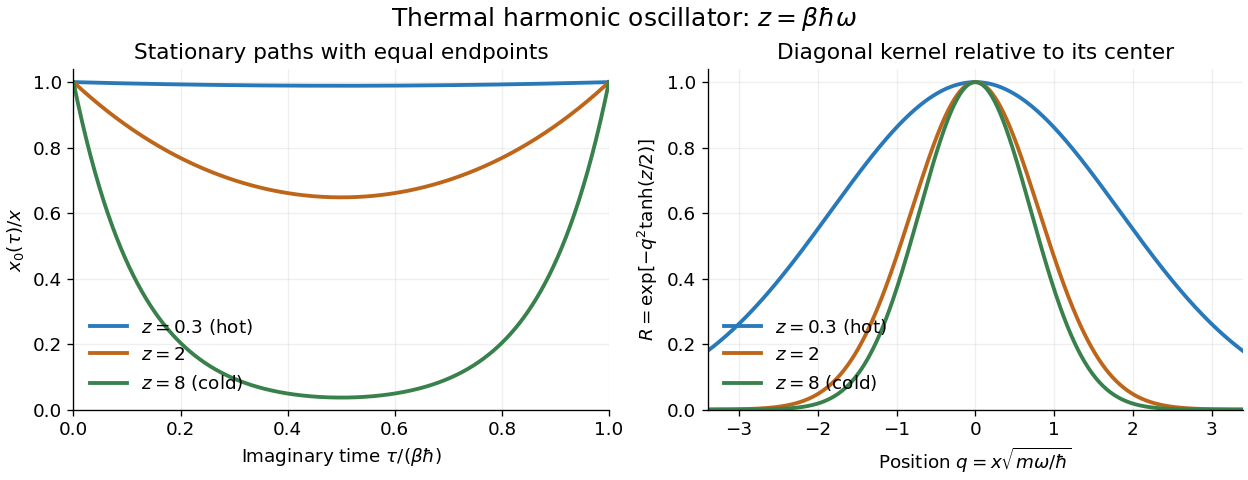
Imaginary-time stationary paths and the crossover of the diagonal thermal kernel
. Original plots of the equal-endpoint Euclidean oscillator path and the diagonal thermal kernel of a quantum harmonic oscillator, divided by its value at zero. Increasing lowers the temperature: the path spends more of its interior near zero, and the ratio approaches the finite-width ground state profile. Details.
Insert the complete orthonormal basis of energy eigenstates on either side of the Boltzmann factor. The spectral theorem givesAt low temperature, the gap suppresses excited energy eigenstates. The harmonic oscillator eigenfunction of the ground state isThereforeThe common zero-point energy factor cancels. Dividing the kernel by its trace would give the position probability density of the canonical ensemble; at zero temperature this tends to , whose variance is . Thus zero temperature projects onto the ground state and retains its quantum spread, rather than concentrating at the minimum of the classical potential energy.
There is also a check on the first correction. With , the first excited harmonic oscillator eigenfunction satisfies and . Hence the spectral theorem gives , in agreement with part (c).
Let be the box volume. The number operator is the sum of the occupation numbers of all momentum eigenstates, including the zero mode:In the Fourier series for the contact interaction, the two creation operators supply phase and the two annihilation operators supply . Fourier orthogonality with periodic boundary conditions givesThe four normalization factors together contribute , leaving the momentum-space contact-interaction HamiltonianThe Kronecker delta enforces momentum conservation. An equivalent expression that resolves the momentum transfer isBoth are already in normal ordering; no extra commutator constant is introduced.
Taking the Hermitian adjoint gives . For nonzero wavevectors, the canonical commutation relations implyWhen the Kronecker delta is nonzero, , so the hyperbolic Pythagorean identity givesFor the two annihilation operators, the only potentially nonzero terms areHere implies equal magnitudes and hence equal , because depends only on . ThusThe corresponding commutators of two creation operators vanish by the Hermitian adjoint. This verifies that the Bogoliubov transformation preserves the full bosonic canonical commutation relations.
Normalize the specified state by and write . Its zero mode is a coherent state, so any normally ordered product of zero-mode creation operators and annihilation operators can be evaluated using and . In particular , rather than , which would apply to a zero-mode number state.
Sort the momentum-space contact-interaction Hamiltonian by its number of zero-mode factors. Four such factors give . Three zero-mode factors and one nonzero momentum violate momentum conservation, so no such term survives. With two zero-mode factors there are three possibilities:
- Two zero-mode creation operators leave the opposite-momentum pair .
- Two zero-mode annihilation operators leave .
- One zero-mode factor on each side leaves . Choosing which of the two creation operators and which of the two annihilation operators are zero gives four placements.
The sums over include both members of each opposite-momentum pair, consistently with the overall factor . Terms with one zero-mode factor contain three nonzero-mode factors; their expected values vanish in the centered multimode squeezed vacuum. Indeed each is linear in , and an odd product has zero vacuum expectation value. Terms with no zero-mode factors are independent of at fixed . ThereforeTo evaluate these vacuum expectation values, use the inverse Bogoliubov transformation and its Hermitian adjoint:Since , the only nonzero two-factor vacuum expectation value is . The bosonic squeezed-vacuum contractions are consequentlyIn particular the three requested quantities are , and , respectively. The minus sign in the pair vacuum expectation values comes from the inverse Bogoliubov transformation and is essential to lowering the interaction energy. Substitution yields
The coherent state in the zero mode has mean occupation number . The other occupation numbers follow from part (c), giving exactlyImpose the fixed mean particle number by choosingHere is the quantum depletion of a Bose condensate. The approximation requires , so remains positive and macroscopically large. The specified coherent state and multimode squeezed vacuum are not exact eigenstates of the total number operator; in this variational construction is their prescribed mean particle number.
Write . Substituting into the retained part of the interaction energy before truncating givesThe last two terms quadratic in have no explicit large- factor when the Bogoliubov transformation parameters are held fixed, and are discarded along with the nonzero-mode quartic contribution already omitted in part (c). This is the same truncation that underlies the number-conserving Bogoliubov quadratic Hamiltonian. Thus, defining the physical number density correctly as ,Replacing by at the outset would give the wrong coefficient : expanding the leading condensate interaction energy supplies the necessary subtraction.
The printed definition is an error. In three dimensions the contact interaction coupling has units of energy times volume, so does not even have units of energy. There is a direct counterexample with no depletion: when , the specified coherent state has exactly . In fixed length and energy units, , and give , whereas the printed with gives . The requested formula and the minimization in part (e) hold with .
Put for and , using . Since the zero mode has zero kinetic energy, the exact kinetic energy in this trial state isTogether with part (d), the fixed-mean-number Bogoliubov variational energy isFor repulsive contact interaction, , each . Using the double-angle hyperbolic-function identities,soThe stationary point therefore satisfiesThis is a minimum, not just a vanishing derivative. Define the positive Bogoliubov quasiparticle dispersionAt the displayed solution , and . HenceThe hyperbolic cosine has its unique minimum at zero, proving global minimization of each retained term. Treating equal-magnitude wavevectors together simply multiplies the same function by their multiplicity. At a fixed ultraviolet cutoff, the resulting energy change from isIndeed . More directly, for small positive ,The pair vacuum expectation value lowers the interaction energy at first order in , whereas the nonzero occupation number and its kinetic energy cost start at second order. The two-mode squeezed vacuum admixes opposite-momentum pairs into the condensate, introducing spatial correlations that reduce the chance of two bosons coinciding. These correlations lower repulsive contact interaction enough to outweigh the added kinetic energy. A small quantum depletion of a Bose condensate can therefore lower the energy below the uncorrelated condensate value.
Two qualifications delimit this result. First, the paper does not state the sign of . More generally a finite stable minimum exists only when for every retained nonzero mode; repulsion ensures this. For example, with in some mode, tends to as , so an unconditional minimum claim for arbitrary is false. Also the formula minimizes the truncated Bogoliubov theory energy, not the exact quartic Hamiltonian including its discarded terms, and it must remain in the regime of small quantum depletion of a Bose condensate.
Second, a three-dimensional unregulated contact interaction cannot give a finite absolute beyond-leading-order ground-state energy by this bare sum. For large , , whose three-dimensional sum has an ultraviolet divergence. A finite ultraviolet cutoff, or renormalization of a three-dimensional dilute-gas contact coupling matched to a physical scattering length, is needed. This does not alter the modewise minimization or the finite-cutoff lowering mechanism just derived.
Articles by others on the same topic
There are currently no matching articles.