A conformal map preserves oriented angles between intersecting smooth curves at each point, with a nonzero local scale factor. A sufficient criterion is that be a holomorphic function on the domain and that everywhere there. Its first-order action then multiplies every tangent direction by the same nonzero complex number, combining a rotation and a dilation. A conformal bijection additionally requires injectivity and surjectivity onto the target.
For in the given half-strip,Thus and . Conversely every such has a unique argument in and unique radius in , giving , . HenceThe complex exponential is injective on , and its derivative never vanishes.
On , use the Joukowski map with a sign change,Sinceit maps into the upper half-plane. To prove injectivity, givesBoth moduli are below one, so and .
For surjectivity, take any in the upper half-plane and solve . The two roots have product one. Neither can lie on the unit circle, since there is real. Exactly one root therefore has modulus below one. For this root, the displayed imaginary-part identity forces , so it belongs to . Finally has no zero in . This proves the Joukowski map from the upper half-disc to the upper half-plane is a conformal bijection.
Composing gives the required conformal mapIts derivative is nonzero on , since the zeros of the complex sine are the real integer multiples of .
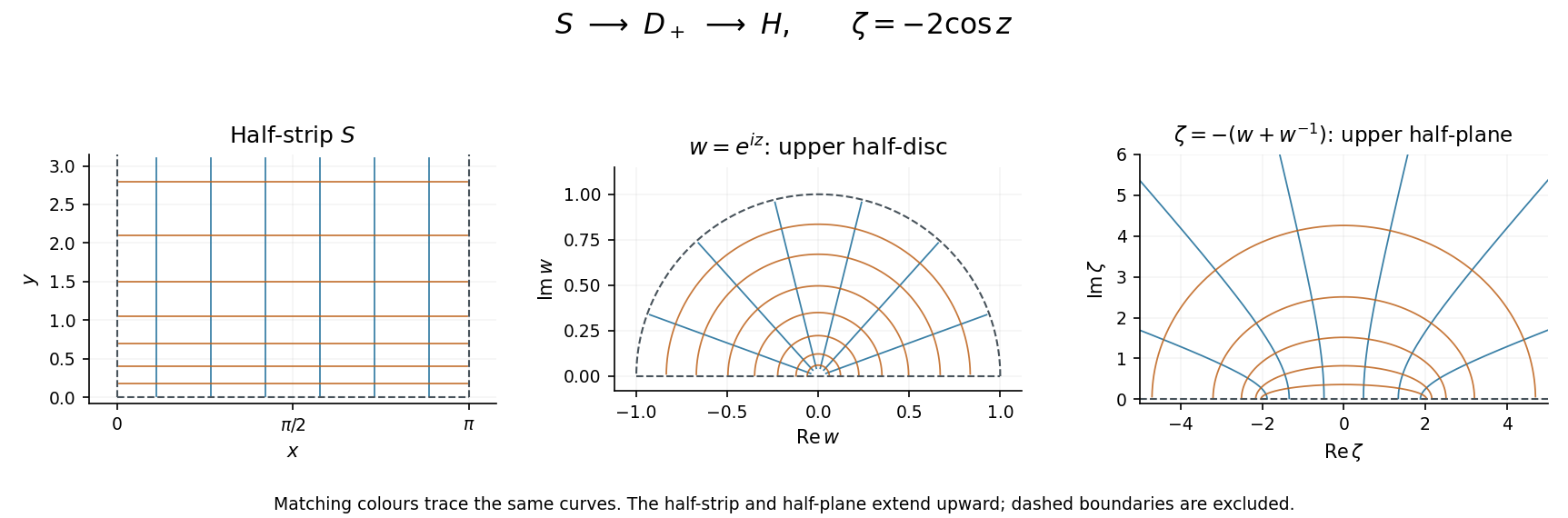
The half-strip maps to the upper half-disc by the complex exponential and then to the upper half-plane by a Joukowski map. Matching colours follow curves through both maps.
Details. 
Articles by others on the same topic
There are currently no matching articles.