For , the discriminant is , so the equation is an elliptic partial differential equation, already in the canonical Laplace equation form .
For , the discriminant is , so it is a hyperbolic partial differential equation, the wave equation . Introduce characteristic coordinatesThen and , givingOn , the discriminant vanishes and the principal part has rank one; the degenerate parabolic type is . This is an interface line, rather than an open parabolic subdomain. ThusThis is a mixed-type partial differential equation. The classification concerns the principal part and remains meaningful even though the coefficient jumps at the interface.
In the lower triangular region, the characteristic coordinates obey . Integrating the canonical wave equation givesOn the right characteristic edge, and , so its prescribed value gives . On the left edge, and , giving . At the common vertex the two values agree and equal zero; hence .
Adding the two edge identities and subtracting this vertex identity determines the entire solution:The apparent freedom to add a constant to and subtract it from does not change . Every classical lower-region solution has the displayed separated form, so these two characteristic boundary traces determine it uniquely. Substitution into and into both edge values directly verifies existence.
The lower formula has a smooth continuation as a function of , and on it has trace . Its second tangential derivative iswhich vanishes at . Hence the continued lower formula satisfies the equation restricted to the interface, where the formal equation is .
Assuming the solution itself is continuous across the interface, the upper region therefore has the Dirichlet boundary value problemThe zero function satisfies these data. The maximum principle for harmonic functions, applied to both and , proves uniqueness among harmonic functions continuous on the closed rectangle. Thus is the continuous upper continuation. Satisfaction of the degenerate interface equation does not impose continuity of the normal derivative; that is the issue in part (d).
Differentiate the uniquely determined lower solution and the zero upper solution:Their one-sided traces areThey disagree, for example at , so the normal derivative is not continuous across the interface. The jump, defined as upper trace minus lower trace, is . It vanishes at the two interior points , but not identically on the interface.
This illustrates that continuous transmission need not preserve normal derivatives. In fact, at any point where these traces differ, the two-sided first derivative with respect to does not exist. The resulting function is continuous and smooth separately on each open side, but is not globally . Consequently a globally classical solution satisfying all these data cannot exist. The calculation in part (c) evaluates the smooth lower formula on the interface; it does not supply the missing cross-interface regularity.
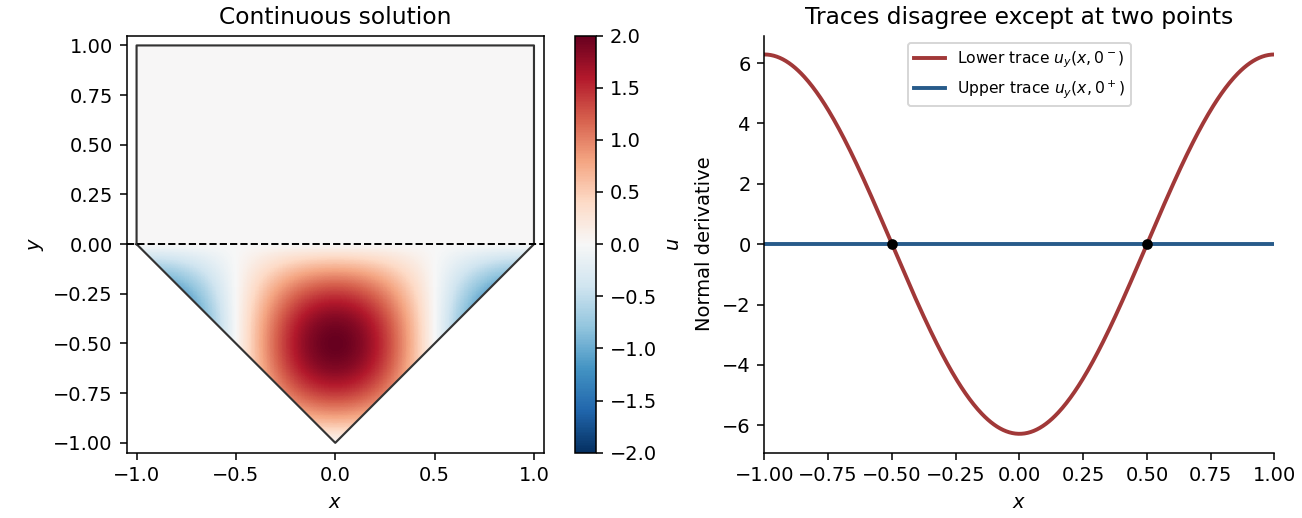
Continuous piecewise solution and unequal normal derivative traces
. Details. 
Articles by others on the same topic
There are currently no matching articles.