The Rankine-Hugoniot condition for the flux gives, for distinct states,The characteristic speed is . A causal entropy shock has characteristics entering from both sides, so , equivalentlyAn upward jump instead resolves into a rarefaction wave; the jump condition alone does not select the physical weak solution.
The upward jump at creates a rarefaction wave with , bounded by the characteristic lines and . The downward jump at zero joins the states , so part (a) gives the shock position . The intervening plateau exists exactly while , or . The fan satisfies the Inviscid Burgers equation classically and matches the constant branches continuously; the shock satisfies the Rankine-Hugoniot condition and is causal because . Its initial trace is the prescribed pulse.
At , the fan reaches the shock at . Subsequently the states immediately to its left and right are and zero, soSolving gives . Thus the continuation isValues assigned precisely at the shock do not affect the weak solution. Its speed lies strictly between the left state and zero, so it remains a causal entropy shock. The area under the triangular profile is , checking conservation of the initial mass. This is the rectangular pulse solution of the inviscid Burgers equation.
The initial condition is a period-one square wave: height one on each interval and zero on each gap , for integer . Each period has mean .
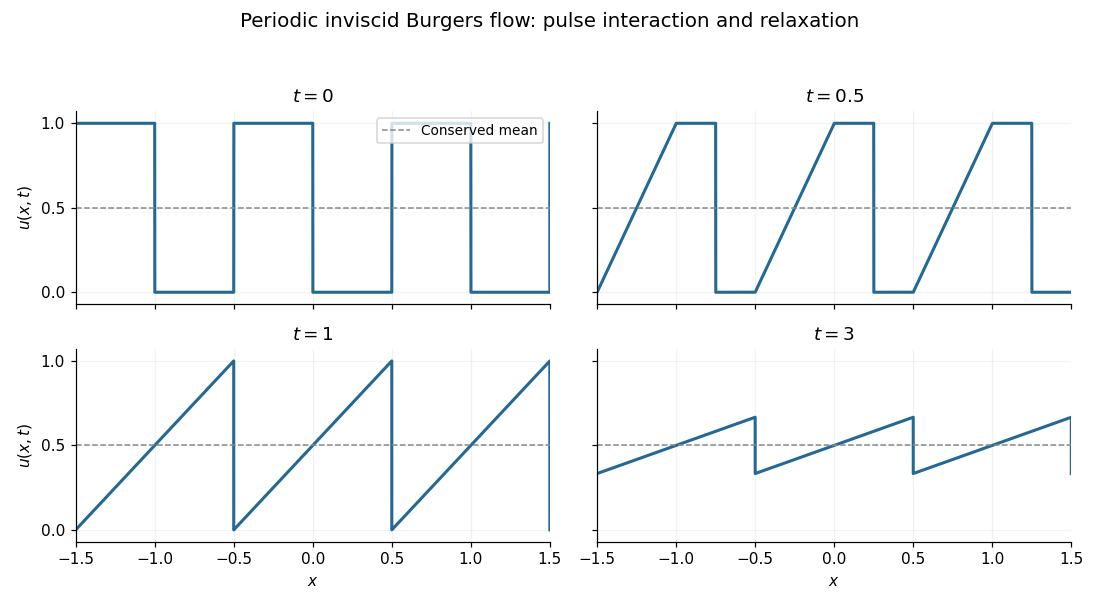

For , translated copies of the preceding pulse have disjoint interiors of support. In the cell , write . The solution isAt use the given initial function. Each fan starts at , and each shock has position . At , the plateau disappears: its left fan catches its right shock at , which is also the starting edge of the next fan. The shocks must henceforth connect two nonconstant fan branches rather than a fan to a zero interval.
Let be the shock separating the fans from and . Their traces giveThus . Between consecutive shocks, . Writing for the fractional part, the period-one solution can be expressed, with right-hand shock traces, asTo put it in the requested fixed-support sum, takeThe half-open cells partition the line, so exactly one summand contributes at each point. This is a representation of the periodic solution, not a superposition principle for arbitrary solutions of a nonlinear equation.
The left and right shock states are and ; both average to the shock speed , and the strict inequalities certify causality. The periodic square-wave relaxation for the inviscid Burgers equation has the uniform estimateThe limit is the conserved mean .
Articles by others on the same topic
There are currently no matching articles.