Source: released examination PDF, pages 224–227. Solutions follow the numbering of the 14 June 2023 Applied Partial Differential Equations paper.
The supplied positive free-space kernel satisfies , so use the same sign convention for the Dirichlet Green function. For an interior source , requireAway from , the function is harmonic, and is regular near . The method of images reflects the source in each coordinate plane, reversing its sign on each reflection. ThereforeOn either face, the terms cancel in pairs. Only the original source lies in the domain, so the other three terms are harmonic there; the required singularity and decay also follow. This is the Dirichlet Green function for a three-dimensional quarter-space. Using instead would change the sign of the kernel and the representation formula together, as in sign conventions for a Dirichlet Green function.
For the preceding sign convention, Green's second identity gives the harmonic representationprovided the far-boundary term vanishes or the bounded-solution representation applies. The face contributes nothing because . On , the outward normal is , so the remaining kernel is . Differentiating the image sum givesThus the requested constants areThe Poisson kernel of a three-dimensional quarter-space is the difference of the upper-half-space kernel and its reflection in . For bounded, suitably continuous data it produces the bounded harmonic solution, taking the prescribed traces away from the edge. Continuous data at the common edge must be compatible. Without any growth restriction at infinity, boundary values alone do not give uniqueness: a multiple of the harmonic function can be added while leaving both face values zero.
Introduce the Euler differential operator . The fourth-order spatial expression is . The moving boundary has similarity coordinate , so its two conditions giveHence and . With , substitution in the equation yieldsThis is a Cauchy-Euler equation; putting turns it into the constant-coefficient equation . Its characteristic polynomial is .
If , write . The roots are . Decay excludes the constant and growing modes, leavingThe boundary conditions force and . If , writing leaves only one decaying mode, ; then forces the zero function, which fails the derivative condition. If , the solutions are polynomials of degree at most three in , and none can both decay and satisfy .
Consequently all real self-similar solutions are the one-parameter familyThe decaying profile for a fourth-order dilation equation oscillates in logarithmic distance. No positivity condition on was imposed, so these sign changes are permitted.
The Rankine-Hugoniot condition for the flux gives, for distinct states,The characteristic speed is . A causal entropy shock has characteristics entering from both sides, so , equivalentlyAn upward jump instead resolves into a rarefaction wave; the jump condition alone does not select the physical weak solution.
The upward jump at creates a rarefaction wave with , bounded by the characteristic lines and . The downward jump at zero joins the states , so part (a) gives the shock position . The intervening plateau exists exactly while , or . The fan satisfies the Inviscid Burgers equation classically and matches the constant branches continuously; the shock satisfies the Rankine-Hugoniot condition and is causal because . Its initial trace is the prescribed pulse.
At , the fan reaches the shock at . Subsequently the states immediately to its left and right are and zero, soSolving gives . Thus the continuation isValues assigned precisely at the shock do not affect the weak solution. Its speed lies strictly between the left state and zero, so it remains a causal entropy shock. The area under the triangular profile is , checking conservation of the initial mass. This is the rectangular pulse solution of the inviscid Burgers equation.
The initial condition is a period-one square wave: height one on each interval and zero on each gap , for integer . Each period has mean .
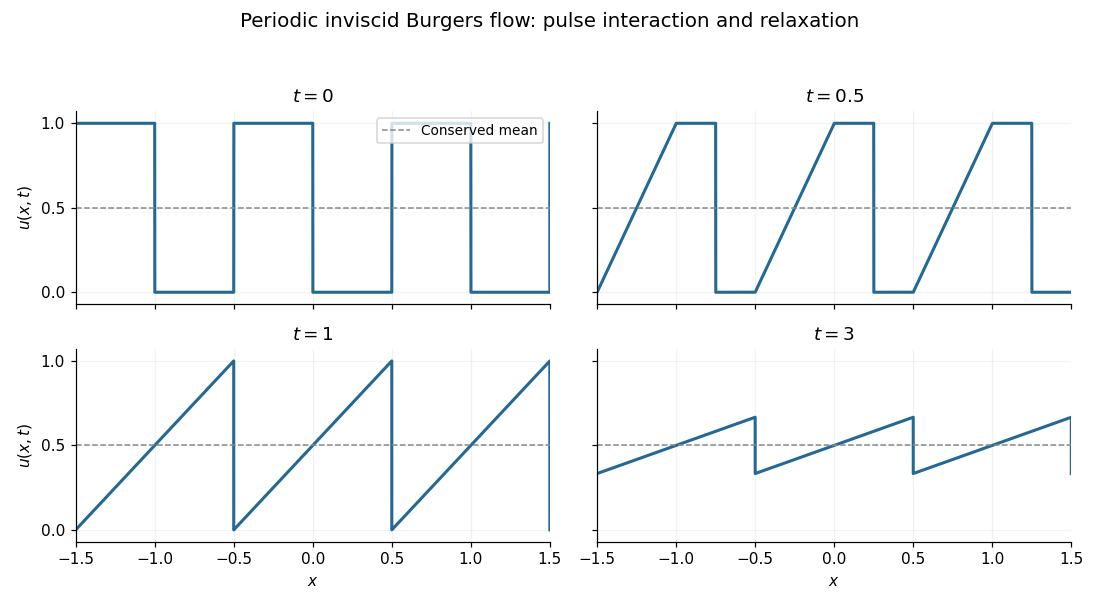

For , translated copies of the preceding pulse have disjoint interiors of support. In the cell , write . The solution isAt use the given initial function. Each fan starts at , and each shock has position . At , the plateau disappears: its left fan catches its right shock at , which is also the starting edge of the next fan. The shocks must henceforth connect two nonconstant fan branches rather than a fan to a zero interval.
Let be the shock separating the fans from and . Their traces giveThus . Between consecutive shocks, . Writing for the fractional part, the period-one solution can be expressed, with right-hand shock traces, asTo put it in the requested fixed-support sum, takeThe half-open cells partition the line, so exactly one summand contributes at each point. This is a representation of the periodic solution, not a superposition principle for arbitrary solutions of a nonlinear equation.
The left and right shock states are and ; both average to the shock speed , and the strict inequalities certify causality. The periodic square-wave relaxation for the inviscid Burgers equation has the uniform estimateThe limit is the conserved mean .
Freeze the coefficients at a point. Characteristic normals satisfy the homogeneous quadratic matrix pencil equation . In the elementary characteristic classification, two distinct real characteristic directions give a hyperbolic system, no real directions an elliptic system, and a repeated real direction the parabolic case. An identically zero determinant polynomial is a further degeneracy, not covered by that nondegenerate classification.
When is invertible, write . The finite characteristic slopes solve , orIts discriminant is positive, negative, or zero in the three cases above. For the well-posed first-order evolution meaning of hyperbolicity, real eigenvalues must also admit a complete eigenbasis: a repeated but diagonalizable pair is non-strictly hyperbolic rather than a defective parabolic system. Distinct real roots suffice for strict hyperbolicity.
For the given shallow water equations, subtracting times mass conservation from momentum conservation and dividing by gives the primitive-variable systemThe characteristic polynomial is , soThey are real and distinct whenever , proving strict hyperbolicity.
Apply the Rankine-Hugoniot conditions to the conserved variables and flux . They giveFor a genuine shock, . Eliminating yields . Taking the positive branch requested,When , the jump conditions instead force and describe a constant state; the labelled interface can then move at any speed and is not a shock. The nontrivial formulas describe a shallow-water shock into stationary unit-depth water.
For a strictly hyperbolic two-component system of conservation laws with ordered speeds , a compressive family- shock has its family characteristics entering from both sides: . The other family crosses the interface with the same sign of relative speed on both sides. These are the Lax shock admissibility conditions and give three incoming characteristic directions for two conservation laws.
In the present problem,Since , we always have . Hence a positive-speed shock of this form cannot be a family-minus shock. For a family-plus shock the remaining strict inequalities areThe first is equivalent to , or . The second is equivalent to , whose square reduces to , again equivalent to for positive . The minus speed on the right is automatically. Thus all causal inequalities hold exactly whenDepth increases behind the right-moving shock. For , the algebraic jump solution has the wrong characteristic orientation and is an inadmissible expansion shock; equality is the no-jump limit.
Articles by others on the same topic
There are currently no matching articles.