Besides , set , and . The four triangles are , , and , each of area . The nodal function is one at , zero at every other node, and affine on each triangle. The vertex conditions giveThe formulas agree on every shared edge, proving continuity.
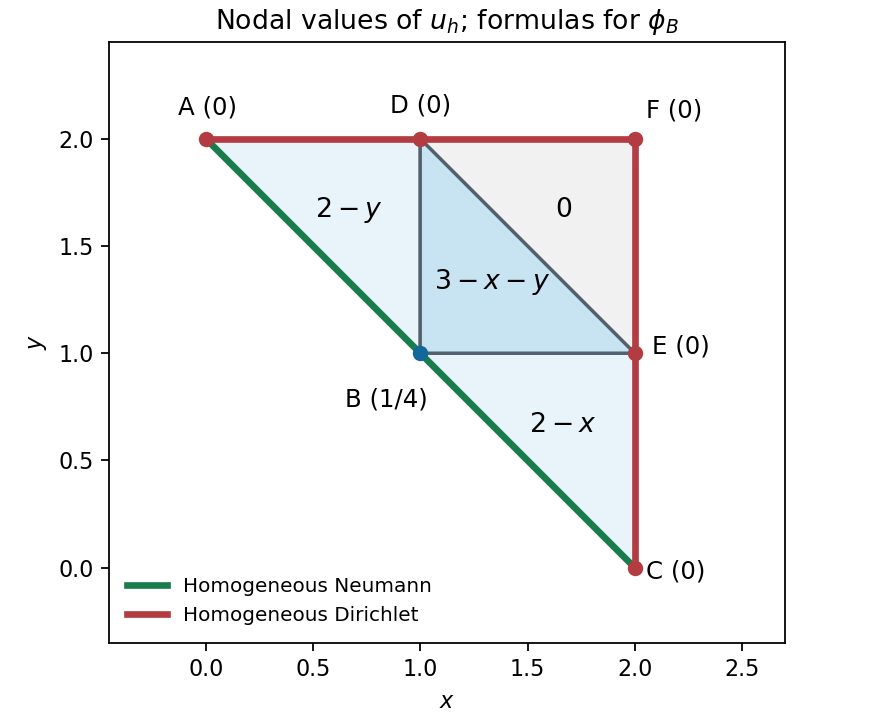

Let , with boundary values interpreted as traces. The outward unit normal on is , so the stated derivative condition is precisely . integration by parts givesThe Dirichlet boundary has positive length, so the Poincaré inequality makes the form coercive. Let be the continuous piecewise affine space on the four triangles. The finite element approximation satisfies the same identity for every .
Nodes have zero values, leaving . Although isolated endpoints have zero boundary measure, continuity along the Dirichlet edges forces the nodal values at and to vanish.
Write . On , the gradients are , and , respectively. ThusThe integral of an affine nodal function over a triangle equals its area times the mean of its three vertex values. Each supported triangle therefore contributes to , giving total . The reduced system is , and the complete nodal answer isOnly one algebraic unknown remains despite the two-dimensional domain.
Articles by others on the same topic
There are currently no matching articles.