The Sobolev space and norm areIn one dimension these functions have continuous representatives and well-defined endpoint traces. integration by parts gives the weak problem: find such that for all , whereIndeed the integration boundary term is ; substituting and gives the two positive boundary terms on the left.
If , put . Then . If , the supplied trace inequality givesThus the form is coercive in both cases. The trace theorem and boundedness of give continuity of and , and the Lax-Milgram theorem gives existence and uniqueness.
Let be the continuous piecewise linear space including both endpoint hat functions. Robin conditions are natural conditions and do not restrict the endpoint values of this space. The finite element problem is , for all . coercivity restricted to gives existence and uniqueness.
Expanding gives , whereThe stiffness contribution has diagonal at interior nodes, at endpoints, and adjacent entries . For completeness, the weighted mass contribution has interior diagonal , left endpoint diagonal , right endpoint diagonal , and adjacent entry . All more distant entries vanish. The Robin contribution adds one to each endpoint diagonal.
Symmetry follows from symmetry of the bilinear form. If , nodal independence makes nonzero, and . Thus the matrix is symmetric positive definite.
The weak equation implies in distributions, hence . Its nodal interpolant satisfiesThese follow interval by interval: the interpolation error vanishes at both endpoints, and its derivative has mean zero, so two Poincaré inequalities apply. If and are the continuity and coercivity constants, Céa's lemma givesAll constants are independent of the mesh size.
Besides , set , and . The four triangles are , , and , each of area . The nodal function is one at , zero at every other node, and affine on each triangle. The vertex conditions giveThe formulas agree on every shared edge, proving continuity.
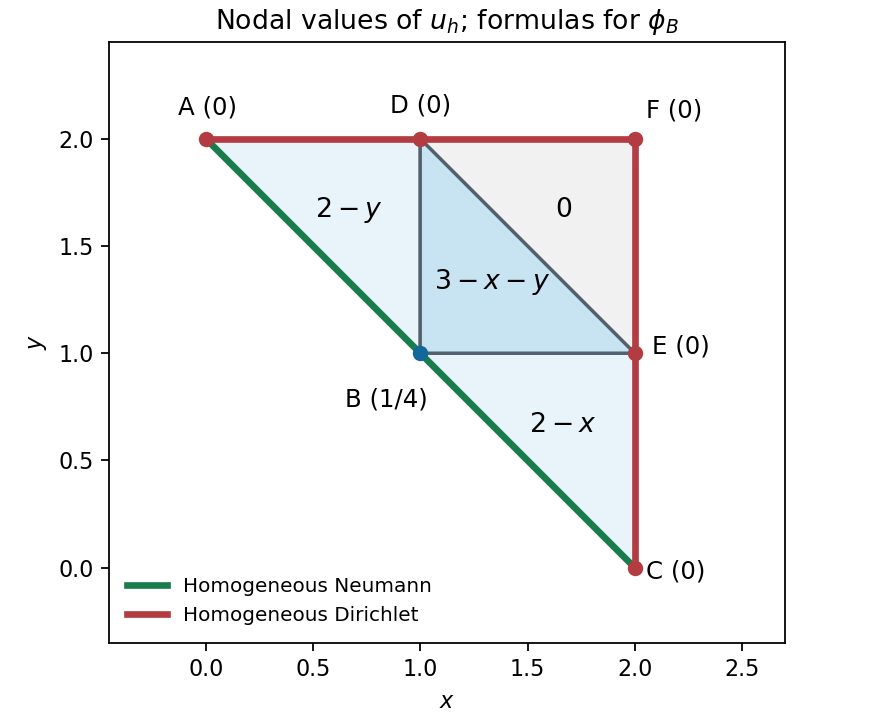

Let , with boundary values interpreted as traces. The outward unit normal on is , so the stated derivative condition is precisely . integration by parts givesThe Dirichlet boundary has positive length, so the Poincaré inequality makes the form coercive. Let be the continuous piecewise affine space on the four triangles. The finite element approximation satisfies the same identity for every .
Nodes have zero values, leaving . Although isolated endpoints have zero boundary measure, continuity along the Dirichlet edges forces the nodal values at and to vanish.
Write . On , the gradients are , and , respectively. ThusThe integral of an affine nodal function over a triangle equals its area times the mean of its three vertex values. Each supported triangle therefore contributes to , giving total . The reduced system is , and the complete nodal answer isOnly one algebraic unknown remains despite the two-dimensional domain.
Taking in the dual problem, and using , givesHence . Testing with smooth compactly supported functions identifies in distributions. Therefore and , withintegration by parts with arbitrary endpoint test values also gives the natural Neumann boundary conditions .
Put and . Galerkin orthogonality gives , so the dual identity becomesOn , is constant and is zero at both endpoints. Consequently . Defining the element residual bygivesNo derivative-jump terms survive, because this interpolation error vanishes at every mesh node. This is the mechanism of the explicit one-dimensional dual residual bound in L2.
Two interval Poincaré inequalities give : the error has zero endpoint values and its derivative has zero mean. Apply Cauchy-Schwarz inequality on each interval and then to the sum:Here . Taking and cancelling its norm, unless it is zero already, yieldsFor adaptive refinement, solve the discrete problem, compute , and stop when . Otherwise mark intervals carrying a fixed positive fraction of , bisect them, and repeat. Residual integration must be exact or have a certified upper bound if the stopping test is to certify the requested tolerance.
Use residual adaptation with a uniform-refinement safeguard, for example global bisection every second refinement, to ensure eventual termination. Discrete energy stability gives , so independently of the mesh. Thus tends to zero under the safeguard. Other iterations concentrate work where the residual is large.
Use and its continuous piecewise linear subspace . The condition at is natural, so the last hat function remains free. Set to the orthogonal projection of onto : the stated initial data need not have nodal values.
For each , find such thatThis applies Backward Euler method to diffusion and reaction together. The step bilinear form is coercive, so each step has a unique solution.
Test with and apply . The exact energy identity isThe printed identity omits the last reaction contribution while explicitly describing its last term as the seminorm. It requires the full norm instead of that seminorm. With the printed seminorm its left side equals , rather than zero. The source reaction term forces this correction.
All terms other than the difference of successive squared norms are nonnegative. ConsequentlyThe second inequality uses contractivity of the initial orthogonal projection. No restriction relates to , giving unconditional stability. The retained reaction term strengthens dissipation.
Define the mass matrix and stiffness matrix for . With coefficient vectors , the step system isThe matrices are symmetric, and for nonzero , proving positive definiteness.
Articles by others on the same topic
There are currently no matching articles.