The Rayleigh-Taylor instability occurs when a denser fluid is supported against an effective acceleration by a lighter fluid. Let density occupy the upper half-space, density the lower half-space and gravity point downward. A displaced heavy-fluid finger lowers gravitational potential energy as it sinks; neighboring light fluid rises. For incompressible inviscid half-spaces without surface tension, a disturbance hasThe density ratio in this expression is the Atwood number. With the density ordering reversed, and the interface supports stable gravity-wave oscillations in this ideal model.
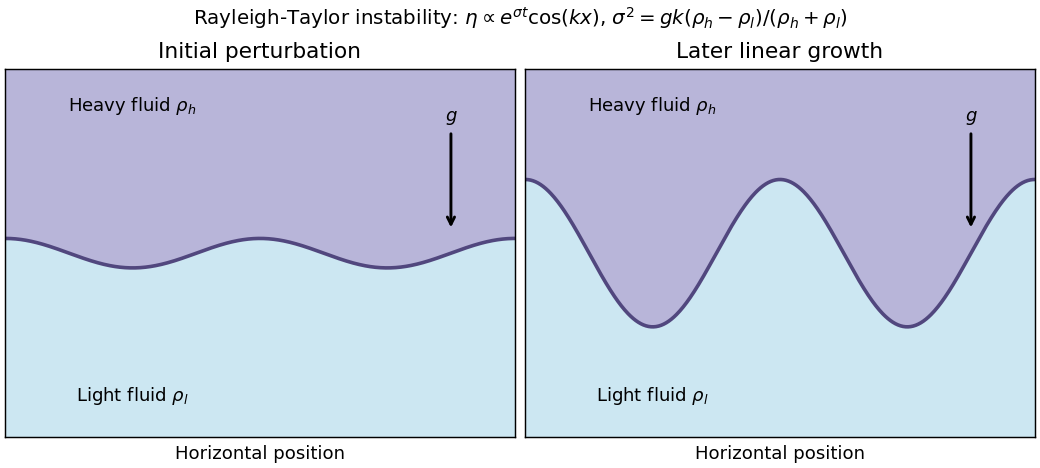

Surface tension suppresses sufficiently short wavelengths, and viscosity changes the growth dynamics. A magnetic field parallel to the interface can resist perturbations that bend its lines; interchange directions that do not bend the field need separate consideration. In astrophysics, effective deceleration can make dense ejecta or a swept-up shell supported by a lower-density hot interior unstable. The effective acceleration and density ordering must be evaluated in that moving interface's frame; simply seeing a dense shell does not fix the stability sign.
Articles by others on the same topic
There are currently no matching articles.