The equation describes small plane-wave perturbations of a uniform, stationary plasma in ideal magnetohydrodynamics, with propagation parallel to the background magnetic field. The nonzero field defines ; is the sound speed for the assumed thermodynamic closure. Neglect viscosity, electrical resistivity, gravity and microscopic dispersive effects. A uniform background flow would instead introduce its Doppler-shifted frequency.
Decompose . The displayed matrix equation then becomesThus there are two independent transverse Alfvén wave polarizations with , restored by magnetic tension, and a longitudinal acoustic mode with , restored by pressure. The transverse modes have no first-order density compression; a strictly longitudinal displacement along the field does not bend it. These are the parallel-propagating ideal magnetohydrodynamic wave branches. In the general oblique problem, fast and slow magnetosonic modes mix compression and magnetic response; their parallel limits coincide with the faster and slower of these speeds. If , all three velocity polarizations share the same frequency magnitude. The velocity equation alone does not enumerate nonpropagating entropy perturbations.
Take positive to mean net cooling per unit mass. At fixed pressure for an ideal gas of unchanged composition, , so with . At thermal equilibrium, . Because expansion work is included at fixed pressure, the perturbed temperature obeysThis isobaric stability criterion for density-dependent power-law cooling gives stability for and instability for . For optically thin bremsstrahlung, , soA slightly cooler parcel becomes denser and cools faster; a slightly hotter parcel has reduced cooling and heats further. The conclusion assumes the sound-crossing time is short enough to maintain nearly common pressure, with conduction and other stabilizing processes omitted.
Using a center-to-edge sound-crossing time and the pressureless uniform-sphere free-fall time of a uniform sphere , equality givesOn scales larger than this estimate, pressure information cannot cross the region before its gravitational dynamical evolution. It therefore identifies the order of the Jeans length and separates gravity-dominated from pressure-supported behavior in the simple comparison. It is not an exact normal-mode stability calculation: with the standard Jeans wavelength , this radius is . Using the diameter rather than the radius as the crossing distance changes the numerical coefficient. Boundary conditions, density structure, turbulence and magnetic support also matter for an actual cloud.
A stellar wind removes mass and carries energy and angular momentum from a star into its surroundings. Hot gas can escape through thermal pressure; radiation transfers momentum through continuum or spectral-line absorption, and radiation acting on dust can drive surrounding gas. Magnetic stresses can extract rotational energy and angular momentum. These mechanisms have different dependencies on heating, opacity, stellar luminosity and field geometry.
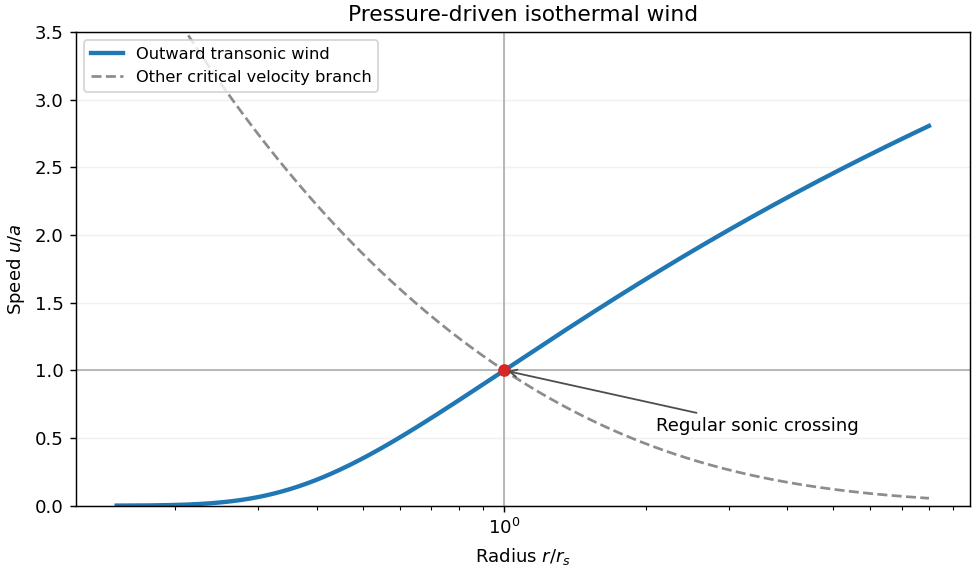
For a steady spherical isothermal pressure-driven model, mass conservation gives . With and constant isothermal sound speed , the radial Euler equation becomes the Parker wind equationA smooth transonic flow solution crosses at . Its inner subsonic atmosphere connects to a supersonic outflow; continuing heat input is needed to keep that expanding wind isothermal. Other boundary pressures can select a breeze rather than this escaping branch, and the mass-loss rate needs boundary/heating information. A polytropic outflow instead converts finite enthalpy into escape energy and has a different terminal budget.
The solar wind supplies a nearby plasma example. Spectral-line Doppler shifts and profiles diagnose more distant winds; blueshifted absorption against stellar light indicates material moving toward the observer. Inference of a mass-loss rate additionally needs density, ionization, geometry and velocity information, rather than a line shift alone.
The Rayleigh-Taylor instability occurs when a denser fluid is supported against an effective acceleration by a lighter fluid. Let density occupy the upper half-space, density the lower half-space and gravity point downward. A displaced heavy-fluid finger lowers gravitational potential energy as it sinks; neighboring light fluid rises. For incompressible inviscid half-spaces without surface tension, a disturbance hasThe density ratio in this expression is the Atwood number. With the density ordering reversed, and the interface supports stable gravity-wave oscillations in this ideal model.
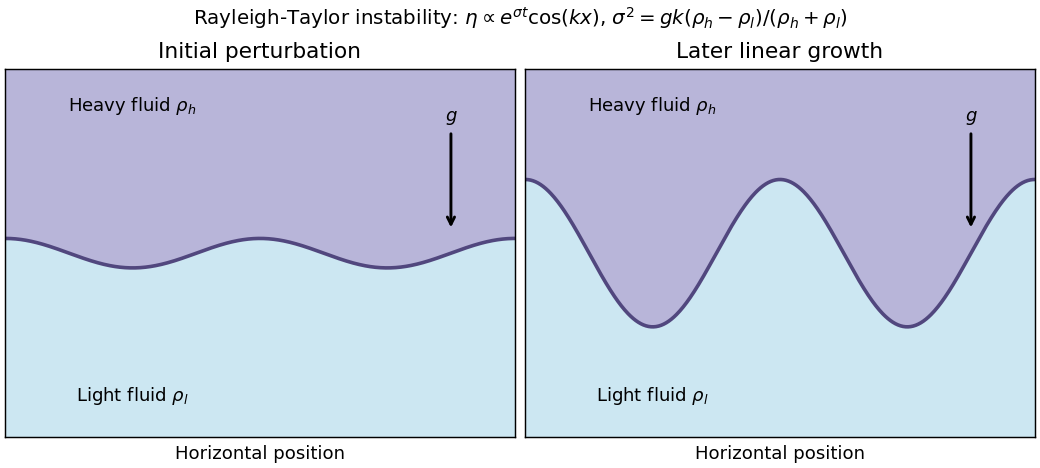
Surface tension suppresses sufficiently short wavelengths, and viscosity changes the growth dynamics. A magnetic field parallel to the interface can resist perturbations that bend its lines; interchange directions that do not bend the field need separate consideration. In astrophysics, effective deceleration can make dense ejecta or a swept-up shell supported by a lower-density hot interior unstable. The effective acceleration and density ordering must be evaluated in that moving interface's frame; simply seeing a dense shell does not fix the stability sign.
For a steady inviscid barotropic fluid in a conservative gravitational potential, define . Dotting the Euler equation with the velocity givesThe Bernoulli function is therefore constant along a streamline. It balances kinetic energy, pressure work or enthalpy, and gravitational potential energy per unit mass. Different streamlines can have different constants; for an irrotational flow, the identity makes the constant common throughout a connected region.
For an incompressible fluid, up to a constant, giving . For a constant-entropy perfect-gas streamline, . Together with mass conservation, this explains conversion of enthalpy into kinetic energy in a nozzle and the need to include gravity in an escaping wind. Viscous losses, heating and entropy production require their corresponding energy balance. Across an adiabatic shock the total stagnation enthalpy can still be conserved, but the upstream isentropic pressure-density law cannot simply be continued through the entropy jump.
Interstellar shocks arise when relative flow is supersonic: stellar winds, supernova ejecta, colliding clouds and gas moving through strong disturbances can drive them. Neighboring compressive characteristics steepen or a fast flow encounters material it cannot decelerate through upstream sound communication. A thin dissipative front then converts directed kinetic energy into thermal energy and increases entropy.
Integrate mass, normal momentum and total energy conservation through a planar steady shock in its rest frame. With no mass source, negligible external impulse across the thin layer and no radiative energy loss, their normal fluxes are respectivelyFor a perfect gas of constant adiabatic index, . Equality of the fluxes on the two sides yields the three Rankine-Hugoniot conditions in the question. Adiabatic means no energy escapes this control volume; it does not make the shock isentropic.
In the strong-shock limit, let and neglect . Momentum conservation gives . Substitution into energy conservation givesThe nontrivial compressive root isThe root describes no shock. A monatomic gas has the familiar compression four.
For identical colliding clouds in their center-of-momentum frame, reflection symmetry fixes the contact plane and the uniform compressed material on either side at rest. The unshocked clouds still approach at speeds ; their supersonic upstream flow has not received a smooth pressure adjustment ahead of the shock. Let the right shock move to the right at speed . In its own frame the upstream and downstream normal speed magnitudes are and . The same shock compression ratio therefore givesThis is the shock speed in a symmetric cloud collision. For , the shocks move outward at , not at the upstream speed or the relative cloud speed . As a check, the post-shock pressure is ; in the monatomic case , giving specific internal energy , exactly the initial bulk kinetic energy per unit cloud mass when brought to rest.
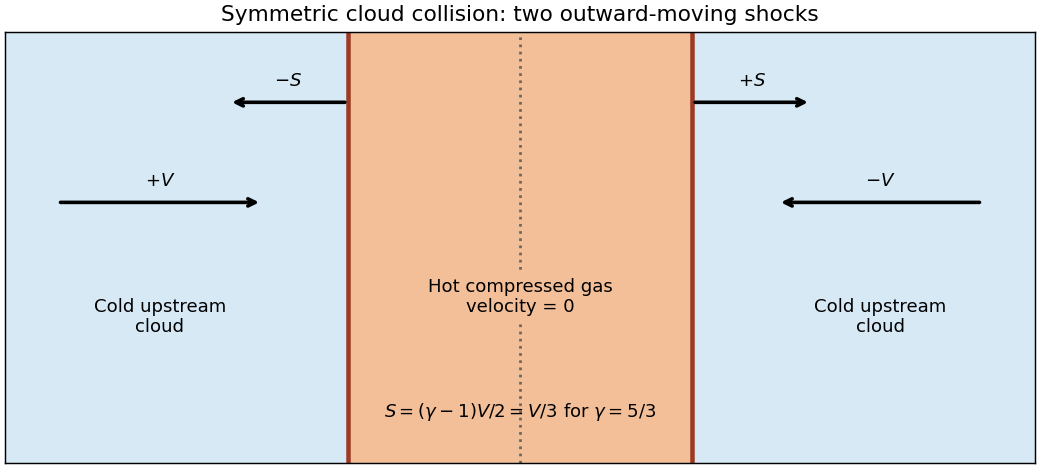


When a shock reaches a cloud's rear boundary, its supply of cold upstream gas ends. If the surrounding pressure is low, the hot compressed gas expands outward and a rarefaction travels back into it, converting thermal energy into motion and cooling the gas. A sustained uniform stationary shocked region is no longer the solution. Interaction with an appreciable exterior medium can instead drive another outward disturbance; the boundary pressure determines that part of the evolution. The stated adiabatic model provides no radiative mechanism that would keep a permanently cold dense sheet at the contact.
Follow a fluid element with position satisfying . The chain rule gives the material derivativeApply Newton's second law to a material element of volume and mass . The net pressure force is , and gravity gives . Dividing by the element mass, neglecting viscosity and using the chain rule componentwise gives the Euler equation
For a static spherical isothermal gas, and . Trial density gives enclosed mass , soThis is the singular isothermal sphere. Its central density diverges, although the enclosed mass tends to zero linearly and its total mass inside a finite radius is finite. It is not the finite-central-density regular isothermal solution.
Truncate at with boundary pressure . Then and , givingThe external medium is being treated as a prescribed pressure boundary; its own gravitational field is excluded from the cloud self-energy calculation.
For a monatomic perfect gas, the equilibrium is isothermal but the internal-energy relation still uses its adiabatic index :The gravitational self-energy follows by assembling shells:Both integrals remain finite at the singular center. ConsequentlyThe pressure-confined singular isothermal gas sphere therefore satisfies the virial theorem including the work of the confining surface pressure. One can see its origin directly by integrating : integration by parts gives , whose surface term is . An isolated vacuum-boundary version would omit that term and could not truncate this same positive-temperature isothermal profile at finite radius. The equality expresses equilibrium force and energy balance, rather than proving dynamical stability.
Articles by others on the same topic
There are currently no matching articles.