A stellar wind removes mass and carries energy and angular momentum from a star into its surroundings. Hot gas can escape through thermal pressure; radiation transfers momentum through continuum or spectral-line absorption, and radiation acting on dust can drive surrounding gas. Magnetic stresses can extract rotational energy and angular momentum. These mechanisms have different dependencies on heating, opacity, stellar luminosity and field geometry.
For a steady spherical isothermal pressure-driven model, mass conservation gives . With and constant isothermal sound speed , the radial Euler equation becomes the Parker wind equationA smooth transonic flow solution crosses at . Its inner subsonic atmosphere connects to a supersonic outflow; continuing heat input is needed to keep that expanding wind isothermal. Other boundary pressures can select a breeze rather than this escaping branch, and the mass-loss rate needs boundary/heating information. A polytropic outflow instead converts finite enthalpy into escape energy and has a different terminal budget.
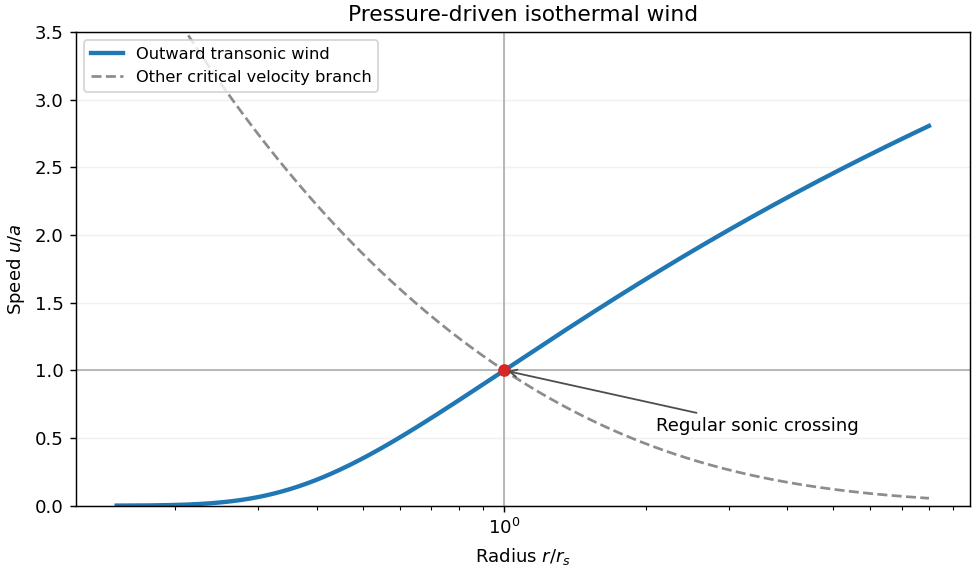
The solar wind supplies a nearby plasma example. Spectral-line Doppler shifts and profiles diagnose more distant winds; blueshifted absorption against stellar light indicates material moving toward the observer. Inference of a mass-loss rate additionally needs density, ionization, geometry and velocity information, rather than a line shift alone.
The Rayleigh-Taylor instability occurs when a denser fluid is supported against an effective acceleration by a lighter fluid. Let density occupy the upper half-space, density the lower half-space and gravity point downward. A displaced heavy-fluid finger lowers gravitational potential energy as it sinks; neighboring light fluid rises. For incompressible inviscid half-spaces without surface tension, a disturbance hasThe density ratio in this expression is the Atwood number. With the density ordering reversed, and the interface supports stable gravity-wave oscillations in this ideal model.
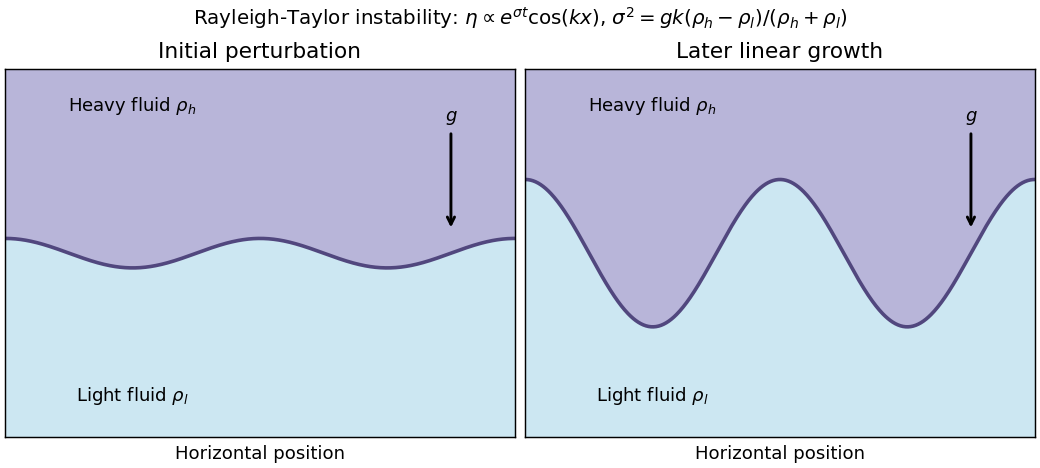


Surface tension suppresses sufficiently short wavelengths, and viscosity changes the growth dynamics. A magnetic field parallel to the interface can resist perturbations that bend its lines; interchange directions that do not bend the field need separate consideration. In astrophysics, effective deceleration can make dense ejecta or a swept-up shell supported by a lower-density hot interior unstable. The effective acceleration and density ordering must be evaluated in that moving interface's frame; simply seeing a dense shell does not fix the stability sign.
For a steady inviscid barotropic fluid in a conservative gravitational potential, define . Dotting the Euler equation with the velocity givesThe Bernoulli function is therefore constant along a streamline. It balances kinetic energy, pressure work or enthalpy, and gravitational potential energy per unit mass. Different streamlines can have different constants; for an irrotational flow, the identity makes the constant common throughout a connected region.
For an incompressible fluid, up to a constant, giving . For a constant-entropy perfect-gas streamline, . Together with mass conservation, this explains conversion of enthalpy into kinetic energy in a nozzle and the need to include gravity in an escaping wind. Viscous losses, heating and entropy production require their corresponding energy balance. Across an adiabatic shock the total stagnation enthalpy can still be conserved, but the upstream isentropic pressure-density law cannot simply be continued through the entropy jump.
Articles by others on the same topic
There are currently no matching articles.