The background and the Jeans prescription. For a resting fluid, and continuity is automatic. The remaining hydrostatic equilibrium equations areAn infinite uniform static medium with constant and would require by force balance, but then its Laplacian would vanish, contradicting the Poisson equation. An isolated static uniform background is therefore not an exact equilibrium of this system.
The Jeans swindle suppresses the gravitational field of the uniform background and retains only the field sourced by perturbations. Formally it replaces the source by in the perturbation problem. This can be regarded as a specified compensating background or a local idealization; it does not prove that the original infinite isolated medium can be static.
Linearized equations. Put , , , and . For uniform , neglect products of perturbations. Continuity givesThe advective acceleration is quadratic, and the background pressure gradient vanishes, so the Euler equation becomesWith the Jeans prescription and constant sound speed, the gravitational and pressure closures areThe density correction to multiplying is second order and is consistently omitted.
The longitudinal dispersion relation. Differentiate continuity in time and substitute the divergence of the linearized Euler equation:For a plane wave proportional to , and . ThereforeThe physical Jeans length isSince has units inverse square seconds, has units and metres. This is the compressive density branch of the Jeans instability; transverse velocity disturbances have no pressure or gravity restoring force in this static nonrotating model and are neutral at linear order.
Which scales grow. For , or wavelength , and one temporal solution grows exponentially. The static Jeans growth-rate spectrum isIts derivative is negative for , so longer wavelengths grow faster. The supremum is as : there is no selected finite fastest wavelength in this infinite-medium calculation. The exactly uniform density change is not an ordinary finite-potential Fourier perturbation with the fixed background subtraction. In a finite cloud, boundaries set the longest allowed scale.
For , the density perturbation oscillates as a stable acoustic wave. At the linear equation is , so the mode is marginal rather than exponentially growing.
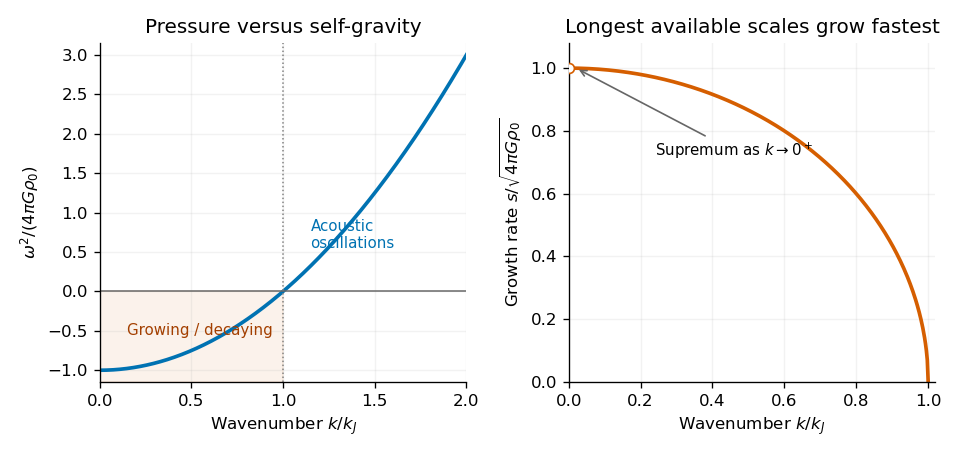
Original calculated Jeans dispersion and growth-rate curves; only wavelengths longer than the Jeans length grow, with faster growth toward the longest available scales
. Details. 
Comparing acoustic and gravitational times. A sound-crossing estimate for a region of size is . Self-gravitational acceleration scales as , so collapse over a distance takes . Equating these scales giveswhich agrees with the Jeans length up to its numerical factor . This is the physical competition between pressure communication and gravitational contraction.
The constants can be checked using the free-fall time of a uniform sphere. For a pressureless shell initially at radius , enclosing fixed mass , energy conservation gives . Thuswhere . Consequently the Jeans length and gravitational time conventions satisfyThey agree as characteristic scales, not as identical exact times. Alternatively, using the length gives , exactly the gravitational inverse frequency entering the dispersion relation. The actual growth time of a marginal Jeans mode is infinite because pressure and gravity cancel there; it should not be confused with a pressureless free-fall time.
Articles by others on the same topic
There are currently no matching articles.