Take positive to mean net removal of thermal energy per unit mass. The isobaric thermal stability of a heated ideal gas depends on the density change accompanying a temperature disturbance. For an ideal gas of fixed composition, , so constant pressure gives . Therefore the net cooling can be writtenwhere is constant for this pressure. At thermal equilibrium , .
The first law of thermodynamics at constant pressure includes the expansion work, so the relevant heat capacity is the specific heat capacity at constant pressure, , rather than the constant-volume value. Linearizing its temperature equation givesHenceFor optically thin Bremsstrahlung, , soA hotter parcel expands and becomes less dense. Its cooling per unit mass, proportional to at fixed pressure, decreases while its cosmic ray heating stays fixed, making it hotter still. A colder, denser parcel cools faster and runs away in the opposite direction. Here has units and units , so is an inverse time. The conclusion assumes the disturbance remains close to pressure equilibrium and neglects heat conduction and changes of composition. The relevant is the temperature exponent in the supplied cooling law.
Use the nonrelativistic moving-conductor Ohm law in the formThe Maxwell equations give Faraday's law of induction, . For a nonmagnetic conductor with constant permeability , the quasistatic Ampere-Maxwell law gives . This step neglects displacement current, requiring it to be small compared with conduction current; nonrelativistic velocity alone is not the complete justification.
For spatially uniform scalar electrical conductivity ,Apply the identity and Gauss's law for magnetism, . The resistive induction equation isThe first term transports and deforms the magnetic field with the moving fluid; the second diffuses it. The magnetic diffusivity has units , so both terms have units tesla per second. No assumption of incompressible flow was needed. If varies spatially, the conductivity-gradient term in magnetic induction, , must also be retained.
For a plane-parallel slab, all equilibrium quantities depend only on height . The vertical hydrostatic equilibrium equation and the Poisson equation for Newtonian gravity areWith the polytropic equation of state and constant ,In the gas interior, where , divide by and differentiate once:ConsequentlyThe coefficient has units inverse square metres. The index-one plane-parallel polytrope illustrates the resulting structure: symmetry about gives , with . A slab bounded by vacuum ends at its first zero, ; the negative continuation of the cosine is not physical mass density.
Supersonic communication. A point source moving at speed outruns its small acoustic waves. After a time , the source has moved , while a disturbance emitted at its old position has radius . The envelope of these spherical wavefronts is the Mach cone, with half-angle satisfyingInformation is restricted to the downstream cone, so upstream gas cannot smoothly anticipate a supersonic obstacle. Finite compressions can also steepen because their characteristics converge. Such disturbances form a shock wave, across which the fluid variables change rapidly. A perfectly uniform supersonic flow need not contain a shock: the cone expresses the communication constraint, while a disturbance or compression supplies the reason for a discontinuity.
Conserved fluxes. Work in the shock frame, take velocities normal to the front, and integrate the conservation laws through a thin steady control volume of unit area. Mass conservation gives constant flux , soThe normal momentum flux is the advected part plus the pressure stress . With negligible body-force impulse across the thin front,For an ideal gas with constant adiabatic index , the specific internal energy is . The energy flux iswhere is the specific enthalpy. No radiation or other heat flux escapes in this adiabatic shock model. Conservation of the energy flux, divided by the nonzero mass flux, givesThese are the Rankine-Hugoniot conditions for a perfect gas. The shock is adiabatic but irreversible: its entropy increases, so an isentropic relation cannot be imposed across the discontinuity.
Strong-shock compression. Put and neglect and the upstream enthalpy compared with and . Momentum conservation gives . Substitute this into energy conservation:ThusThe root describes no shock. The compressive branch of the Strong-shock Rankine-Hugoniot conditions isIt also gives . A monatomic gas has , hence .
The finite slab in its initial rest frame. Denote the shock's lab speed by . The upstream gas is initially stationary, so and the downstream shock-frame speed is . Transforming to the initial slab frame givesThis is planar shock compression of a finite slab. In the uniform post-shock approximation, breakout occurs at . The original front face has then moved , while the shock reaches the originally stationary far face at , leaving thickness . Equivalently, the fixed mass per area becomes . The result assumes a maintained approximately constant shock speed and no important boundary rarefaction during the crossing; an unconfined finite cloud need not remain uniformly compressed.
Escape estimate and the sound-speed convention. Let be the slab mass, its binding-energy magnitude in the star's field, and its initial internal energy. Treat the potential as nearly uniform across the slab. For the bulk-ballistic escape estimate, requireThe Mach-number convention in shock unbinding estimates matters here. With the usual upstream adiabatic sound speed, , define . ThenIf instead the shock speed is normalized by the isothermal sound speed, , then andThe original PDF's “around five” is consistent with the latter convention or an order-of-magnitude sound-speed estimate. It is not the exact coefficient obtained with the conventional adiabatic Mach number and the stated bulk kinetic-energy criterion. Here if the potential is zero at infinity; using negative gravitational energy directly on the right would be incorrect. Subsequent conversion of shock-generated internal energy to expansion, external pressure, or radiative losses would change the physical escape threshold, so this numerical factor is not universal.
Following a parcel. Let be a fluid pathline, with . The multivariable chain rule gives the material derivative,The first term measures change at fixed position; the advection term accounts for the parcel moving through spatial gradients. The derivative is also called the Lagrangian derivative.
The forces on a parcel. A material volume has mass . The pressure forces on its boundary sum to , while the gravitational acceleration is . Newton's second law therefore gives the Euler equations for an inviscid fluid,This neglects viscosity and other body forces. The left side is the parcel's acceleration, not just the time derivative at a fixed spatial location.
Bernoulli conservation. The claimed streamline result needs steady flow and a barotropic fluid, , or an equivalent enthalpy relation along each isentropic streamline. These hypotheses are necessary; the unsteady Euler equation alone does not imply the stated conservation law. Define the barotropic enthalpy functionDot the steady Euler equation with , using . This givesThus the Bernoulli function isEvery term has units of energy per mass, . Different streamlines can have different constants.
The spherical accretion equation. Write the inward speed as , so the velocity vector is and the positive mass accretion rate isAssume a prescribed central potential and negligible gas self-gravity. The steady radial Euler equation isFor a barotropic equation of state, , with . Eliminate the density derivative to obtainA smooth sonic point requires the right side to vanish where , henceFor a nonisothermal gas this is an implicit relation involving the local sound speed. In the isothermal case is constant and this is the Bondi sonic point.
The isothermal integral. For , choose the enthalpy reference so that . The reservoir is at rest at infinity and , making its Bernoulli constant zero. ThusorThe logarithm has a dimensionless argument. Constant temperature during compression generally requires heat removal, so this is Isothermal Bondi accretion, rather than adiabatic accretion with .
The critical accretion rate. Select the smooth reservoir-connected transonic branch. Evaluate the last relation at and :Mass conservation then gives the isothermal Bondi accretion rate,The units are . Equivalently , with .
The inner-boundary selection of isothermal Bondi flow is important: a standard absorbing accretor inside the sonic radius selects this critical solution. The steady equations and alone also admit subcritical subsonic branches supported by a different inner boundary; they do not by themselves fix a unique rate. The usual answer presumes transonic capture.
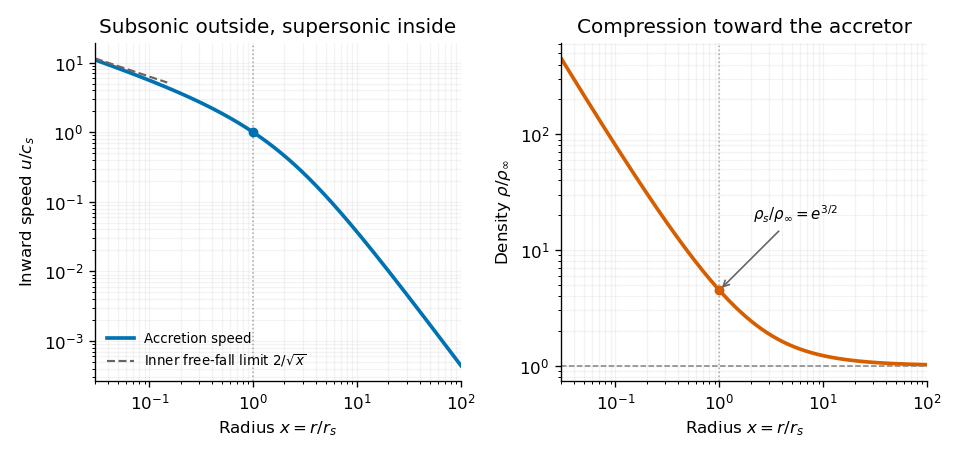
Original numerical transonic isothermal accretion profiles, normalized by the sonic radius and outer density; the speed becomes supersonic inside the sonic point
. Details. 
The background and the Jeans prescription. For a resting fluid, and continuity is automatic. The remaining hydrostatic equilibrium equations areAn infinite uniform static medium with constant and would require by force balance, but then its Laplacian would vanish, contradicting the Poisson equation. An isolated static uniform background is therefore not an exact equilibrium of this system.
The Jeans swindle suppresses the gravitational field of the uniform background and retains only the field sourced by perturbations. Formally it replaces the source by in the perturbation problem. This can be regarded as a specified compensating background or a local idealization; it does not prove that the original infinite isolated medium can be static.
Linearized equations. Put , , , and . For uniform , neglect products of perturbations. Continuity givesThe advective acceleration is quadratic, and the background pressure gradient vanishes, so the Euler equation becomesWith the Jeans prescription and constant sound speed, the gravitational and pressure closures areThe density correction to multiplying is second order and is consistently omitted.
The longitudinal dispersion relation. Differentiate continuity in time and substitute the divergence of the linearized Euler equation:For a plane wave proportional to , and . ThereforeThe physical Jeans length isSince has units inverse square seconds, has units and metres. This is the compressive density branch of the Jeans instability; transverse velocity disturbances have no pressure or gravity restoring force in this static nonrotating model and are neutral at linear order.
Which scales grow. For , or wavelength , and one temporal solution grows exponentially. The static Jeans growth-rate spectrum isIts derivative is negative for , so longer wavelengths grow faster. The supremum is as : there is no selected finite fastest wavelength in this infinite-medium calculation. The exactly uniform density change is not an ordinary finite-potential Fourier perturbation with the fixed background subtraction. In a finite cloud, boundaries set the longest allowed scale.
For , the density perturbation oscillates as a stable acoustic wave. At the linear equation is , so the mode is marginal rather than exponentially growing.
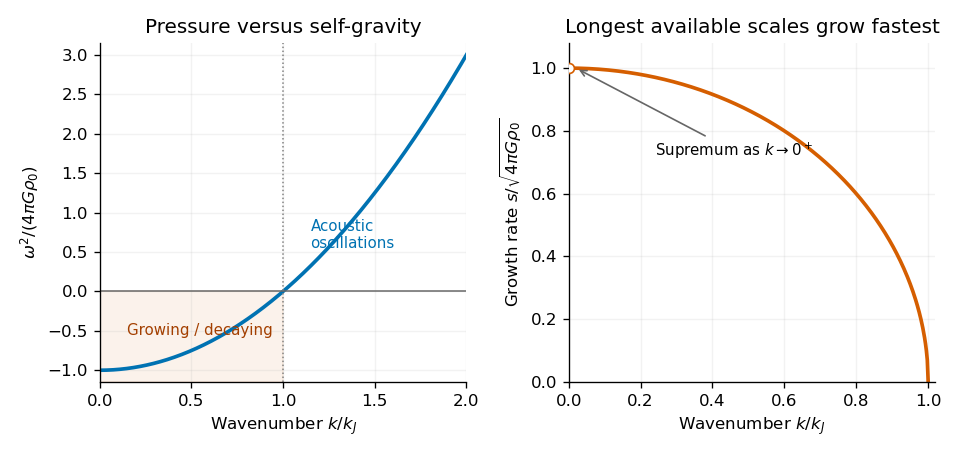
Original calculated Jeans dispersion and growth-rate curves; only wavelengths longer than the Jeans length grow, with faster growth toward the longest available scales
. Details. 
Comparing acoustic and gravitational times. A sound-crossing estimate for a region of size is . Self-gravitational acceleration scales as , so collapse over a distance takes . Equating these scales giveswhich agrees with the Jeans length up to its numerical factor . This is the physical competition between pressure communication and gravitational contraction.
The constants can be checked using the free-fall time of a uniform sphere. For a pressureless shell initially at radius , enclosing fixed mass , energy conservation gives . Thuswhere . Consequently the Jeans length and gravitational time conventions satisfyThey agree as characteristic scales, not as identical exact times. Alternatively, using the length gives , exactly the gravitational inverse frequency entering the dispersion relation. The actual growth time of a marginal Jeans mode is infinite because pressure and gravity cancel there; it should not be confused with a pressureless free-fall time.
Articles by others on the same topic
There are currently no matching articles.