For a hydrostatic, stably stratified atmosphere, define isentropic mass density and relative vertical vorticity evaluated on an isentrope, . Then isentropic potential vorticity isIt is the hydrostatic isentropic form of dry Ertel potential vorticity, . For inviscid, adiabatic motion with fixed composition and conservative body forces, , so parcels carry their PV along isentropes. Stable stratification makes the coordinate transformation well defined.
Heating and friction spoil simple material conservation. More explicitly, with and nonconservative force per mass ,Thus the distribution is especially useful away from strongly diabatic clouds and frictional boundary layers. Explaining a velocity field by potential-vorticity inversion additionally requires an appropriate balanced-flow approximation and boundary information; a PV value alone does not specify the entire flow. [ref]
Fundamentals of Atmosphere-Ocean Dynamics by Michael Edgeworth McIntyre. PartII§12, Ertel conservation, isentropic form and qualified invertibility
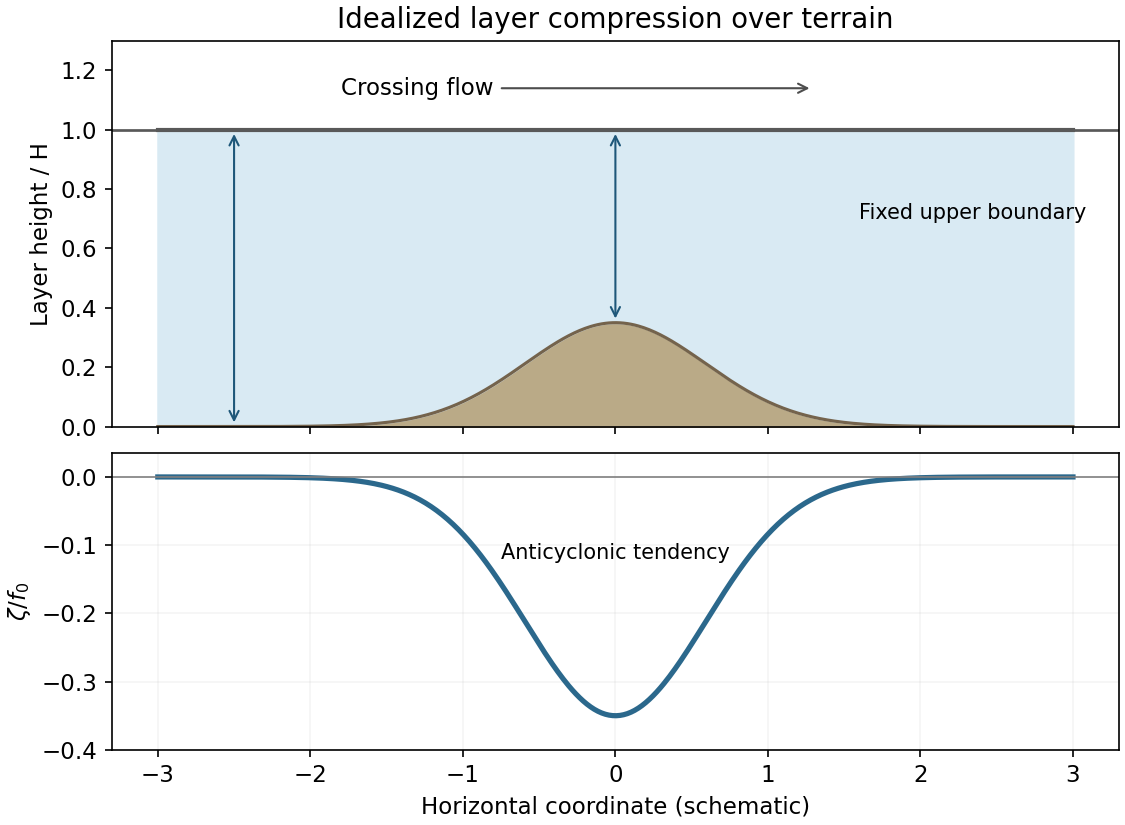
In an idealized crossing flow, take a layer between a mountain and an approximately fixed upper boundary. If its upstream depth is H and the terrain height is , climbing reduces its depth to . Conservation of shallow-water potential vorticity givesAt nearly fixed northern latitude, with negligible upstream relative vorticity, : compression produces an anticyclonic tendency. For an eastward flow this corresponds to a rightward/equatorward turning tendency. On the descending side, re-expansion restores cyclonic vorticity relative to that compressed state. Meridional displacement also changes f and participates in the balance.
The corresponding mountain-crossing isentropic PV balance uses rather than geometric depth: reduced isentropic mass thickness requires reduced absolute vorticity, and increased thickness the reverse. The geometric cartoon assumes an upper boundary that does not simply rise with the terrain. A real mountain can displace isentropes, block low-level flow or generate a downstream Rossby-wave pattern; friction and latent heating can change PV. Thus the local compression sign is a model tendency, not a universal map of every orographic circulation.
In the usual lower-tropospheric seasonal land-heating vorticity tendency, summer land is warmer than the adjacent ocean: the heated layer deepens, favouring stretching and a cyclonic thermal-low tendency in the Northern Hemisphere. In winter, colder land favours a shallow stable layer and an anticyclonic thermal-high tendency. In a column model conserving at fixed f,so deepening and shallowing give the stated signs.
This is a conditional layer picture, not an assertion that heating conserves dry isentropic PV. In the isentropic expression, replace h by ; an isolated temperature contrast does not specify that mass thickness. Diabatic heating, changes in stratification and increased surface drag over land alter the PV budget. The coastal vorticity tendency from variable surface drag illustrates another complication: the curl of a horizontal drag is , whose coastal contribution depends on wind and coastline orientation. Vorticity can also differ with height. Without those profiles one cannot assign a universal sign to the full circulation solely from the season; the summer-low/winter-high tendency is the standard idealization.
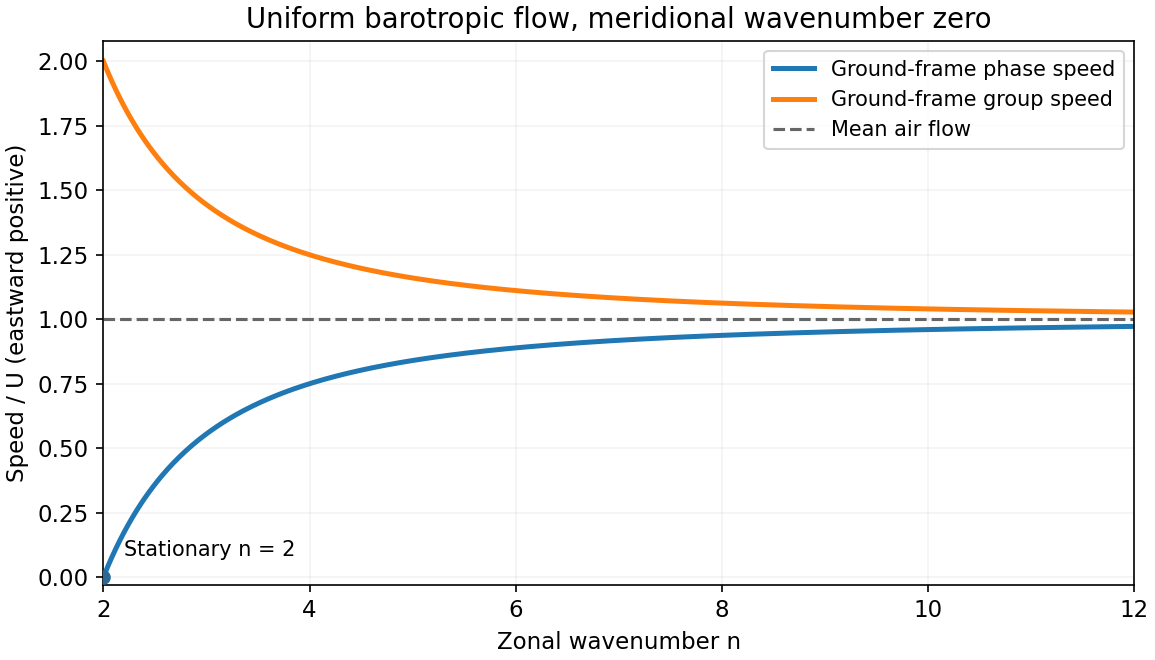
Use a locally uniform eastward barotropic current on a beta plane. For horizontal wavevector , the Barotropic Rossby wave dispersion relation isThe stationary zonal-wavenumber-two Rossby-wave condition is therefore . For the usual assumption ,Here is supplied; is an explicitly identified external nominal rotation constant, not an invented historical handbook value. [ref]
IERS Conventions (2010) by International Earth Rotation and Reference Systems Service. Table1.2,printedp18/physicalPDFp19, nominal angular velocity
The number assumes no meridional structure; a nonzero l or finite deformation radius changes the required speed. Zonal wavenumber alone does not fix those additional parameters.For a shorter zonal disturbance with integer and , the shorter Rossby-wave propagation inside a stationary long wave hasIts intrinsic phase motion is westward relative to the air, but both the weather pattern and its packet move eastward relative to the ground. Packet energy propagates downstream faster than the phase, giving Rossby-wave downstream development: downstream systems can amplify as upstream systems decay. Disturbances also superpose and interfere. In the strictly linear uniform-flow model they do not directly scatter from one another; finite-amplitude eddies can exchange momentum and heat and modify the background. Their detailed nonlinear interaction requires amplitudes and geometry, not just a wavenumber. [ref]
Fundamentals of Atmosphere-Ocean Dynamics by Michael Edgeworth McIntyre. Rossby-wave phase/group propagation and wave–mean-flow interaction


Articles by others on the same topic
There are currently no matching articles.