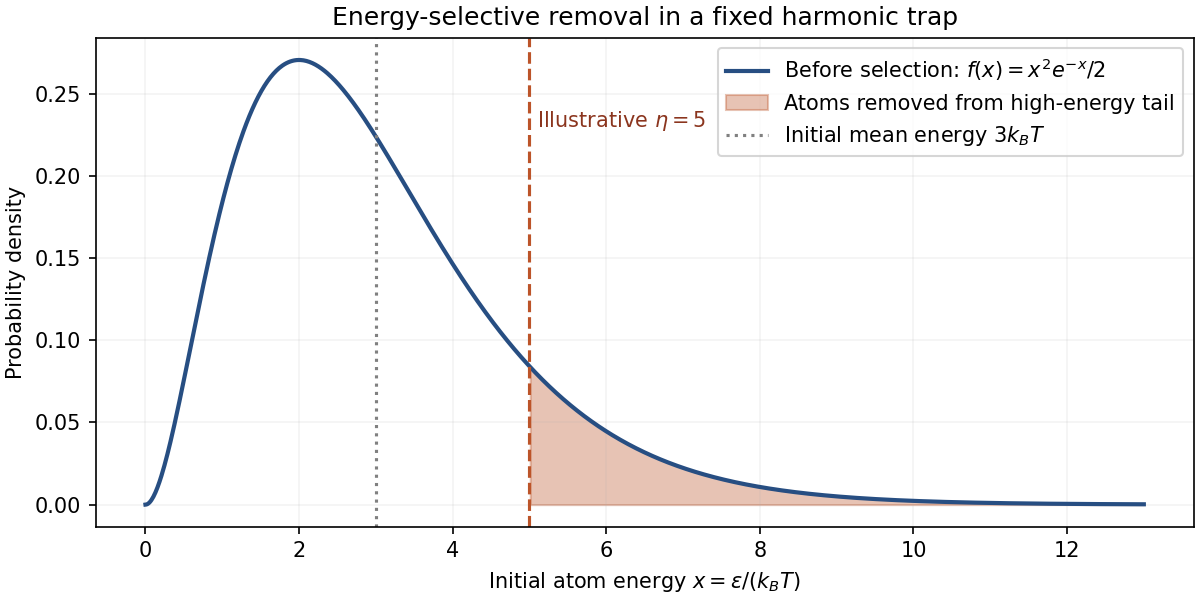
evaporative cooling removes atoms selectively from the high-energy tail of a trapped gas. The remaining sample has less energy per atom; elastic collisions then redistribute energy and restore a thermal distribution at lower temperature. Random atom loss would generally remove average energy and would not provide the same cooling mechanism. Repeated energy selection and rethermalization, rather than one removal event, is the essential cycle.
Using the evaporation truncation parameter , let the escape threshold be . As the gas cools, a fixed threshold is populated by fewer atoms, so evaporation stalls. In forced evaporative cooling the threshold is lowered during the sequence. In a magnetic trap, a radiofrequency evaporation knife flips trapped weak-field-seeking atoms into untrapped spin states where the Zeeman splitting matches the photon energy. Energetic atoms reach that resonance surface; sweeping the radiofrequency lowers the energy knife. In an optical dipole trap, lowering the trap depth offers a different implementation, although it usually also weakens confinement.
A simple evaporative cooling energy balance shows when atom loss is useful. For a classical gas in a three-dimensional harmonic trap of fixed frequencies, equipartition gives , counting both kinetic and potential energy. Suppose escaping atoms remove average energy , with a distribution-dependent excess above the threshold. For ,Thus preferential removal cools when the removed energy exceeds . More stringently, cooling must raise the phase-space density of an atomic gas, not merely lower the temperature:For this harmonic-trap phase-space density, with fixed geometric-mean trap frequency , . Therefore phase-space density rises during atom loss if . The numerical factors here belong to the stated harmonic-trap model, not every evaporative apparatus.

There must be enough elastic collisions to repopulate the tail: should exceed damaging loss and heating rates, and the ramp should allow rethermalization. Increasing density can improve elastic collisions but also enhances inelastic and three-body losses. Very rapid removal can leave a nonequilibrium cloud; very slow removal exposes it to background-gas losses. Lowering an optical trap can reduce density and collision rate, so a falling temperature is not by itself evidence of efficient evaporation.
The dilute-gas condensation experiments made this tradeoff concrete. Eric A. Cornell and Carl Wieman's account explains how selective escape and contraction of a trapped cloud raise phase-space density, while the need for rapid two-body equilibration and slow three-body loss restricts usable density. It also describes expansion imaging as an experimental diagnostic.[ref]
Nobel Lecture: Bose-Einstein condensation in a dilute gas, the first 70 years and some recent experiments by Eric A. Cornell and Carl Wieman. pp. 876–878, equilibration, selective escape and imaging of expanded clouds
Useful controls compare different knife ramps and hold times, measure both atom number and expansion temperature, and check trap-frequency calibration. Pure adiabatic expansion can cool without increasing phase-space density. Successful evaporation pays an atom-number cost to increase the remaining gas's phase-space occupancy. Articles by others on the same topic
There are currently no matching articles.