Original source: Released original, physical PDF pages 779–782. All three questions and every essay option are covered.
Take the field along and write , with Bohr magneton . The printed Hamiltonian uses dimensionless angular-momentum operators, with eigenvalues and ; physical angular momenta carry an additional . Thus and are energies. Assume the usual positive spin-orbit interaction coefficient . Reversing its sign reverses the zero-field ordering but not the state count.
An electron has . addition of angular momentum givesThe coupled angular-momentum state count can be checked directly. The product basis contains states. The coupled basis containsCoupling therefore reorganizes the states rather than creating or losing them. There is no hyperfine multiplicity because .
Use to obtainThe two spin-orbit interaction energies are and . In a weak field, project the Zeeman effect onto a fixed multiplet:This is the first-order energy formula, not a statement that has no matrix elements between different values. For a common and a conventional choice of relative phase, its complete coupled-basis block isThe inter-multiplet Zeeman coupling terms give second-order weak-field corrections because the two spin-orbit interaction multiplets are already separated.
In the strong-field basis the Zeeman part is diagonal, . WriteIts diagonal matrix elements are . Its off-diagonal matrix elements connect to with coefficientand the reverse spin change has replaced by in the corresponding ladder coefficient. These terms preserve but mix the two product states. To first order in , the energy correction is simply .
For the P state, . Measured relative to its gross-structure centroid, the six low-field levels areThus the upper quartet starts at with slopes in a plot against ; the lower doublet starts at with slopes . Their zero-field separation is .
At high field all six product-state energies, retaining the term linear in , areThe two zero-slope levels have different and no mutual matrix element, so their first-order degeneracy does not require an additional degenerate perturbation. At finite field they split at order .
An exact interpolation makes the requested whole-field sketch unambiguous. The stretched levels areFor , use product states and . Their Hamiltonian block issoThese energies reduce to the quartet and doublet at zero field and to the six strong-field expressions above. Within a fixed , the nonzero off-diagonal element prevents a crossing of the two branches. Levels in different sectors can cross without hybridizing. For the S state, and the spin-orbit interaction term vanishes, leavingthroughout this Hamiltonian's range of validity.
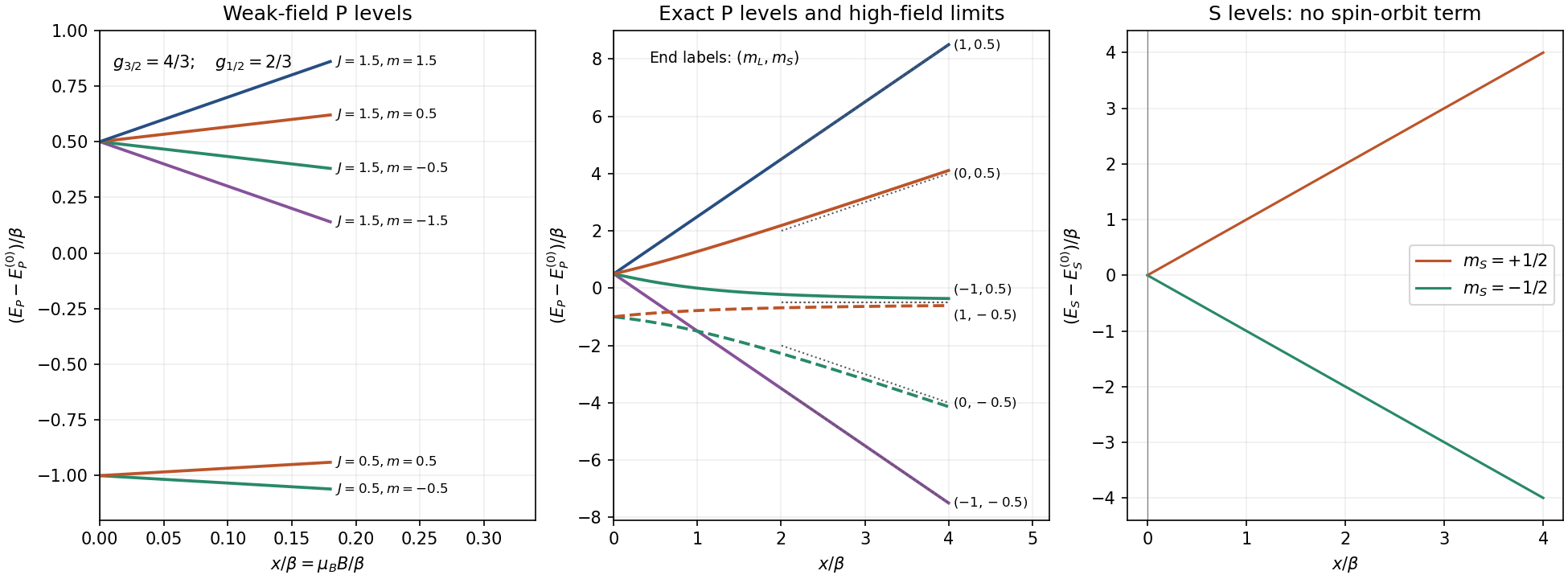

For electric dipole transitions at low field, and apply, with the usual exclusion of . Each P state has opposite parity to the S state. The transition has four allowed sublevel pairs. For , the two stretched upper states each have one destination and the other two each have two, giving six. Hence there are 10 allowed state-to-state channels at weak nonzero field. Relative to the two zero-field transition energies, their Zeeman shifts are
In the decoupled high-field limit, an electric dipole acts on orbital coordinates, so . Each of the six P product states connects to the S state with the same spin and . Thus there are 6 allowed channels in the limiting product-state description. Their photon energies areThis Paschen-Back transition-channel count is not the count of distinct frequencies: to first order in the two channels coincide, giving 5 distinct frequencies, with shifts . If the residual spin-orbit interaction splitting is unresolved there are the three usual orbital Zeeman groups.
The apparent loss of four channels is a change in eigenstate mixing, not a change in Hilbert-space dimension. At finite large field, four weak spin-forbidden Paschen-Back lines arise from small opposite-spin admixtures, with intensities vanishing as . A generic finite-field calculation therefore retains ten nonzero channels; six carry finite strength in the complete-decoupling limit. Observation direction and polarization select which of these channels a detector actually receives.
evaporative cooling removes atoms selectively from the high-energy tail of a trapped gas. The remaining sample has less energy per atom; elastic collisions then redistribute energy and restore a thermal distribution at lower temperature. Random atom loss would generally remove average energy and would not provide the same cooling mechanism. Repeated energy selection and rethermalization, rather than one removal event, is the essential cycle.
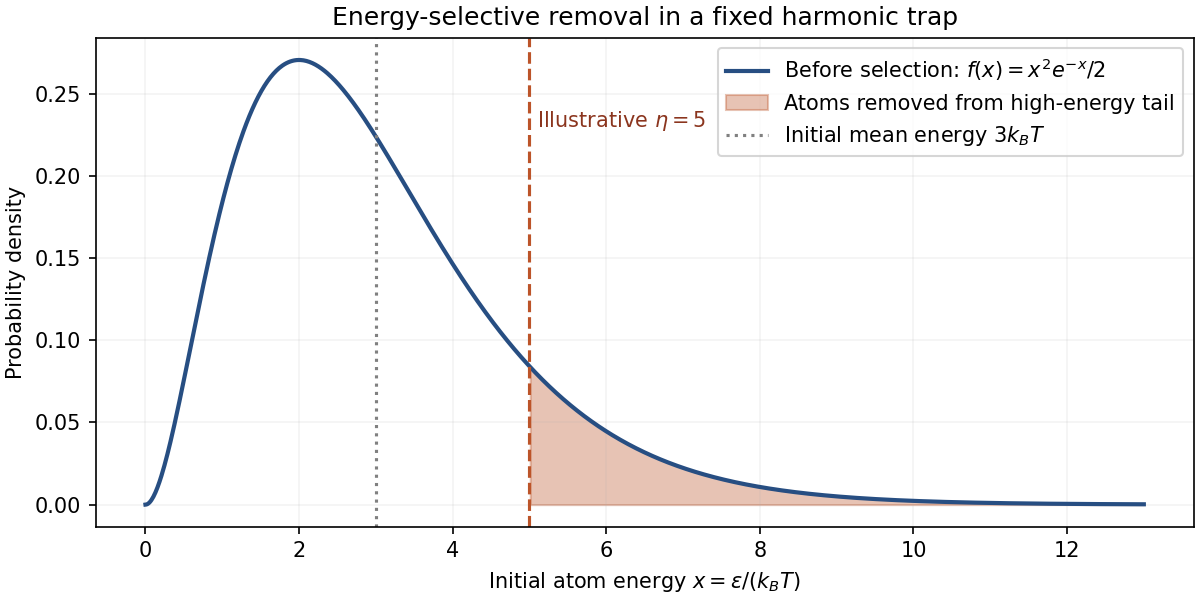
Using the evaporation truncation parameter , let the escape threshold be . As the gas cools, a fixed threshold is populated by fewer atoms, so evaporation stalls. In forced evaporative cooling the threshold is lowered during the sequence. In a magnetic trap, a radiofrequency evaporation knife flips trapped weak-field-seeking atoms into untrapped spin states where the Zeeman splitting matches the photon energy. Energetic atoms reach that resonance surface; sweeping the radiofrequency lowers the energy knife. In an optical dipole trap, lowering the trap depth offers a different implementation, although it usually also weakens confinement.
A simple evaporative cooling energy balance shows when atom loss is useful. For a classical gas in a three-dimensional harmonic trap of fixed frequencies, equipartition gives , counting both kinetic and potential energy. Suppose escaping atoms remove average energy , with a distribution-dependent excess above the threshold. For ,Thus preferential removal cools when the removed energy exceeds . More stringently, cooling must raise the phase-space density of an atomic gas, not merely lower the temperature:For this harmonic-trap phase-space density, with fixed geometric-mean trap frequency , . Therefore phase-space density rises during atom loss if . The numerical factors here belong to the stated harmonic-trap model, not every evaporative apparatus.

There must be enough elastic collisions to repopulate the tail: should exceed damaging loss and heating rates, and the ramp should allow rethermalization. Increasing density can improve elastic collisions but also enhances inelastic and three-body losses. Very rapid removal can leave a nonequilibrium cloud; very slow removal exposes it to background-gas losses. Lowering an optical trap can reduce density and collision rate, so a falling temperature is not by itself evidence of efficient evaporation.
The dilute-gas condensation experiments made this tradeoff concrete. Eric A. Cornell and Carl Wieman's account explains how selective escape and contraction of a trapped cloud raise phase-space density, while the need for rapid two-body equilibration and slow three-body loss restricts usable density. It also describes expansion imaging as an experimental diagnostic.[ref]
Nobel Lecture: Bose-Einstein condensation in a dilute gas, the first 70 years and some recent experiments by Eric A. Cornell and Carl Wieman. pp. 876–878, equilibration, selective escape and imaging of expanded clouds
Useful controls compare different knife ramps and hold times, measure both atom number and expansion temperature, and check trap-frequency calibration. Pure adiabatic expansion can cool without increasing phase-space density. Successful evaporation pays an atom-number cost to increase the remaining gas's phase-space occupancy.For an ideal weakly driven two-level atom, opposing red-detuned beams give velocity-dependent absorption and a friction force near zero velocity. Random photon recoils also cause momentum diffusion. Their balance gives the minimum Doppler temperatureat detuning in the low-saturation model, where is the spontaneous population-decay rate, equivalently the natural full linewidth expressed as an angular frequency. This limit assumes the atom has no useful ground-state internal structure.
Real atoms possess magnetic sublevels. In a suitable multilevel transition, position-dependent polarization gives different optical couplings and different AC Stark energy shifts for those sublevels. Counterpropagating beams with orthogonal linear polarizations have nearly uniform total intensity but a periodically varying polarization. Thus spatially varying light shifts can exist even without an intensity standing wave.
In Sisyphus cooling, an atom on one ground-state branch climbs a light-shift hill and loses kinetic energy. Near the upper part of the hill, optical pumping tends to transfer population to a lower branch. spontaneous emission makes this transfer dissipative and randomizes the emitted photon direction. The atom can then climb another hill. Finite pumping time is essential: instantaneous local equilibration would remove the delayed internal-state response that produces friction. The original multilevel analysis relates these optical-pumping cycles to the spatially displaced light shifts.[ref]
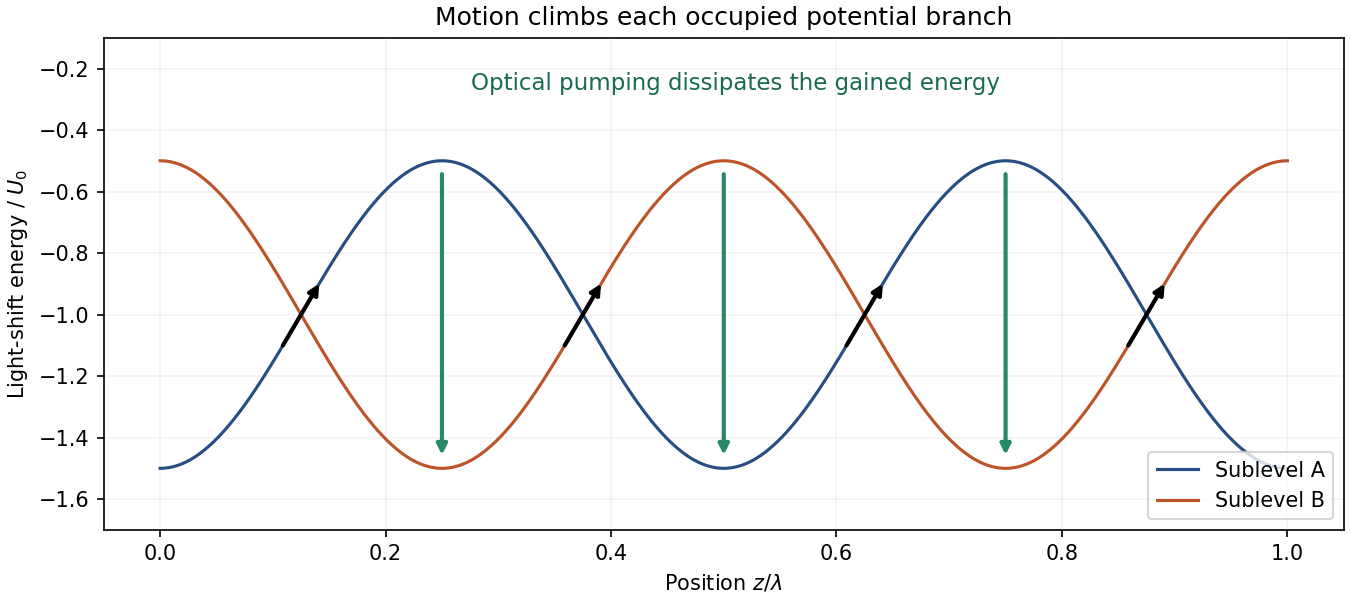

For large detuning compared with the natural linewidth, useful scales areup to angular-coupling and Rabi-frequency convention factors. Here is the optical Rabi angular frequency. The slow-atom capture range is of order . Typical energies in the Sisyphus regime track the light-shift scale rather than only , so reducing intensity can lower temperature below the Doppler limit. Capture becomes narrower, however, and recoil heating, imperfect polarization, magnetic fields and scattered light eventually matter. Define recoil energy ; this is an important scale, not a claim that every sub-Doppler method has the same universal final temperature.[ref]
Manipulating Atoms with Photons by Claude Cohen-Tannoudji. §2, Sub-Doppler cooling; §2.1, Sisyphus effect
The experimental test must establish a narrow velocity distribution independently of fluorescence brightness. William D. Phillips's account describes moving a time-of-flight probe above and below the cloud, deliberately heating the atoms to check a previously absent signal, and release-and-recapture comparisons that included gravity and finite beam geometry. These tests separated very cold atoms from an insensitive detector or a faulty thermometer.[ref]
Nobel Lecture: Laser cooling and trapping of neutral atoms by William D. Phillips. pp. 731–732, Figs. 15–16; pp. 733–734, multilevel interpretation
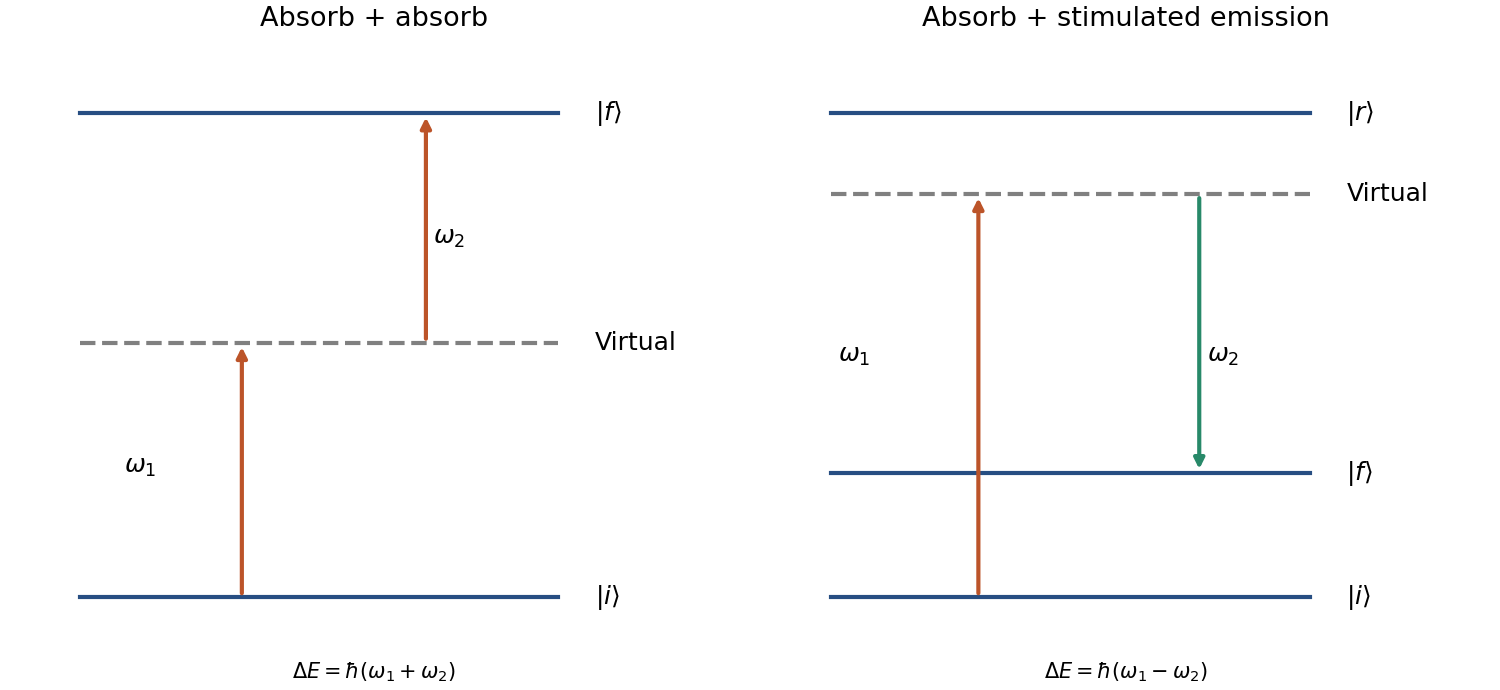
In a modern implementation, field cancellation and polarization checks test the mechanism, while independent expansion thermometry checks the inferred temperature. sub-Doppler cooling exploits internal-state dynamics omitted from the two-level Doppler model; it does not contradict that model within its assumptions.A two-photon transition transfers population through two interactions with the electric-dipole operator. For absorption of two photons,The intermediate atomic states enter a second-order amplitude rather than necessarily being populated. Suppressing field-normalization factors, its structure isBoth time orderings contribute coherently. Close to a real intermediate resonance, linewidths and intermediate-state population must be treated explicitly; an off-resonant virtual-state approximation then ceases to be adequate. Well away from saturation the absorption rate scales as , or as for a single applied frequency.
Each electric-dipole interaction reverses parity, so two such interactions connect states of the same parity. The product operator contains angular tensor ranks , subject to triangle and polarization selection rules. Under the degenerate two-photon selection rule, identical equal-frequency photons have no antisymmetric rank-one contribution cancels; ranks zero and two remain. This permits a transition and excludes in that degenerate E1-E1 case. It does not universally forbid every transition, because a rank-two tensor can also connect some such pairs. For a single orbital electron, the corresponding orbital changes are , with spin unchanged in the nonrelativistic electric-dipole approximation.
In Doppler-free two-photon absorption, counterpropagating equal-frequency photons give first-order Doppler cancellation when one photon is absorbed from each beam:The laser frequency is half the transition frequency. Same-beam two-photon events can still produce a broader Doppler-shifted background; residual beam-angle errors, unequal frequencies, AC Stark shifts and finite transit time limit precision. Thus a narrow two-photon resonance requires control of beam geometry and intensity, not just high laser power.
A stimulated Raman transition is the absorption-emission version: the atom absorbs from one beam and emits into the other, transferring between two long-lived states through an off-resonant upper state. It instead obeysCounterpropagation now enhances momentum transfer rather than cancelling it. With single-photon Hamiltonian matrix elements and a common large angular detuning , eliminating the excited state givesThe two-photon detuning must include differential AC Stark and recoil shifts. Large detuning suppresses spontaneous scattering but also reduces coherent coupling at fixed optical power.

The coherent Raman route is useful for atomic beam splitters and mirrors. Mark Kasevich and Steven Chu demonstrated a laser-cooled sodium matter-wave interferometer using stimulated Raman transitions; its controlled internal-state changes accompanied separated external wave packets.[ref]
Atomic interferometry using stimulated Raman transitions by Mark Kasevich and Steven Chu. Physical Review Letters 67, pp. 181–184 (1991), abstract and interferometer principle
Testing this interpretation requires scanning the two-photon detuning, controlling relative laser phase and checking output populations against pulse timing. A two-photon process is defined by its coherent two-interaction pathway; absorption-absorption and absorption-emission have different resonance and recoil conditions.Write , , and take . The Bogoliubov spectrum is gapless and positive for . Its small- and large-momentum limits areThe low-energy excitations are collective sound modes; high-energy excitations approach particles with a mean-field energy offset. With healing length and ,The crossover occurs at of order one, not at an additional energy gap.
The critical velocity of a homogeneous condensate follows because the Landau criterion compares an excitation energy with the energy that flow can release by transferring its momentum. Creating a mode is energetically possible when . For this isotropic spectrum,The infimum is the long-wavelength speed of sound. This tests energetic stability against the stated excitations; it is not a calculation of a dissipation rate or a universal vortex-nucleation threshold.
For an external potential varying slowly on the healing scale, the Thomas–Fermi approximation for a condensate neglects density-gradient kinetic energy in the stationary Gross–Pitaevskii equation. In occupied regions it givesHere is the appropriate local number density; in the ring it is a linear density and is the one-dimensional coupling. This is the local-density sound speed of a condensate. The formula applies where , not in an empty region where its square root would be imaginary.
Normalize the condensate order parameter to the atom number:up to an arbitrary constant phase. A wavefunction normalized to one instead has amplitude , with then providing density. Acting with gives angular momentum per atom and in total for the uniform ring. The superfluid velocity isThe interaction chemical potential is ; a flowing uniform state also has the constant kinetic contribution to its total chemical potential. Its speed of sound is set by the interaction term. Applying givesFor a uniform ring condensate, this is the continuum phonon criterion used here. Quantization of the available excitation wavelengths in a very small ring can modify a finite-size threshold.
For the nonrotating equilibrium with a raised left half, let and be the bulk linear densities. Within the same Thomas–Fermi approximation for a condensate,When both halves are occupied, normalization fixesand thereforeThese expressions require . Beyond that threshold, extending them would give a negative left density and is unphysical. Instead the left bulk empties, all atoms occupy a segment of length , andAt equality the left bulk just reaches zero density. kinetic energy rounds the interface and produces tails beyond the Thomas–Fermi approximation for a condensate, so an exactly empty half is the idealized bulk result.
A nonconstant breaks rotational symmetry:Consequently angular momentum is no longer a good quantum number, and an eigenfunction need not be times a constant amplitude. Nevertheless, while the order parameter is nonzero around the whole ring, single-valuedness requiresThe integer is a phase winding of a condensate, not an assertion that the inhomogeneous state remains an angular-momentum eigenstate. A superfluid phase slip can change it if the amplitude vanishes locally.
Conservation of particles gives . For steady density the one-dimensional particle current is constant. Since the two halves have equal lengths,The current bottleneck in an inhomogeneous condensate occurs because a lower-density region has faster flow at the same current; it also has a smaller speed of sound. This makes the raised half the limiting region.
For the equilibrium approximation givesThe winding condition and equal lengths requireThus the left-hand sound-speed test isThe right-hand condition is only , so it is less restrictive.
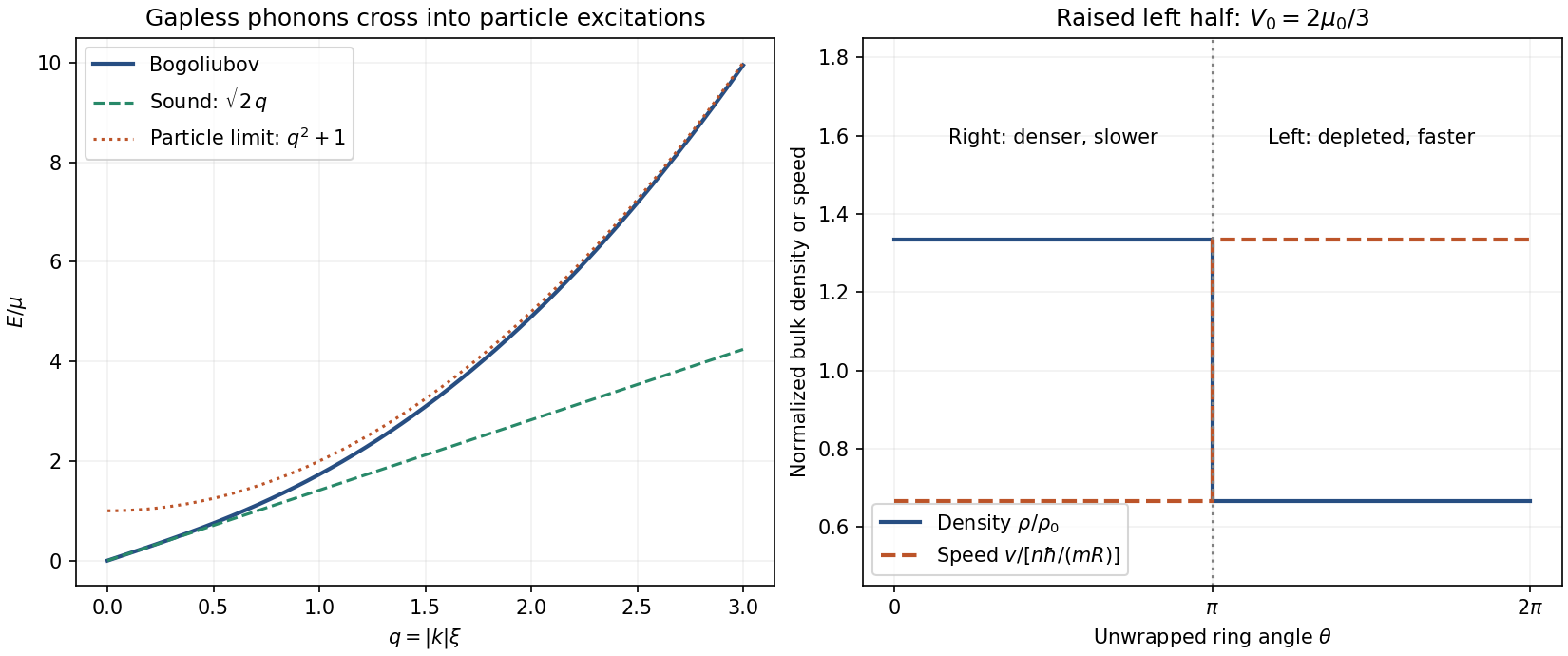

This local sound-speed estimate for ring-flow stability uses the step-potential equilibrium in a ring condensate densities together with the local sound-speed test, as suggested by the preceding approximations. A quantitatively self-consistent finite-current solution also includes and the quantum pressure of a condensate in the stationary Gross–Pitaevskii equation, allowing flow to change the density. Smooth steps suppress reflection but do not alone remove those terms. The result is the stated local-density estimate; it should not be promoted to an exact stability theorem for every finite interacting ring.
Articles by others on the same topic
There are currently no matching articles.