An elastic collision preserves total kinetic energy between the incoming and outgoing states. For isolated colliding bodies, momentum conservation also holds. The kinetic energy condition supplies information beyond momentum conservation alone. [ref]
Consider a stipulated one-dimensional example with rightward positive: , , incoming velocities and . The total momentum is and total kinetic energy is . In SI numerical values, outgoing velocities satisfySubstituting gives . The root , repeats the incoming state; the outgoing separating state is , . Its momenta add to and its kinetic energies add to . The incoming and outgoing relative velocities both have magnitude , consistent with coefficient of restitution .
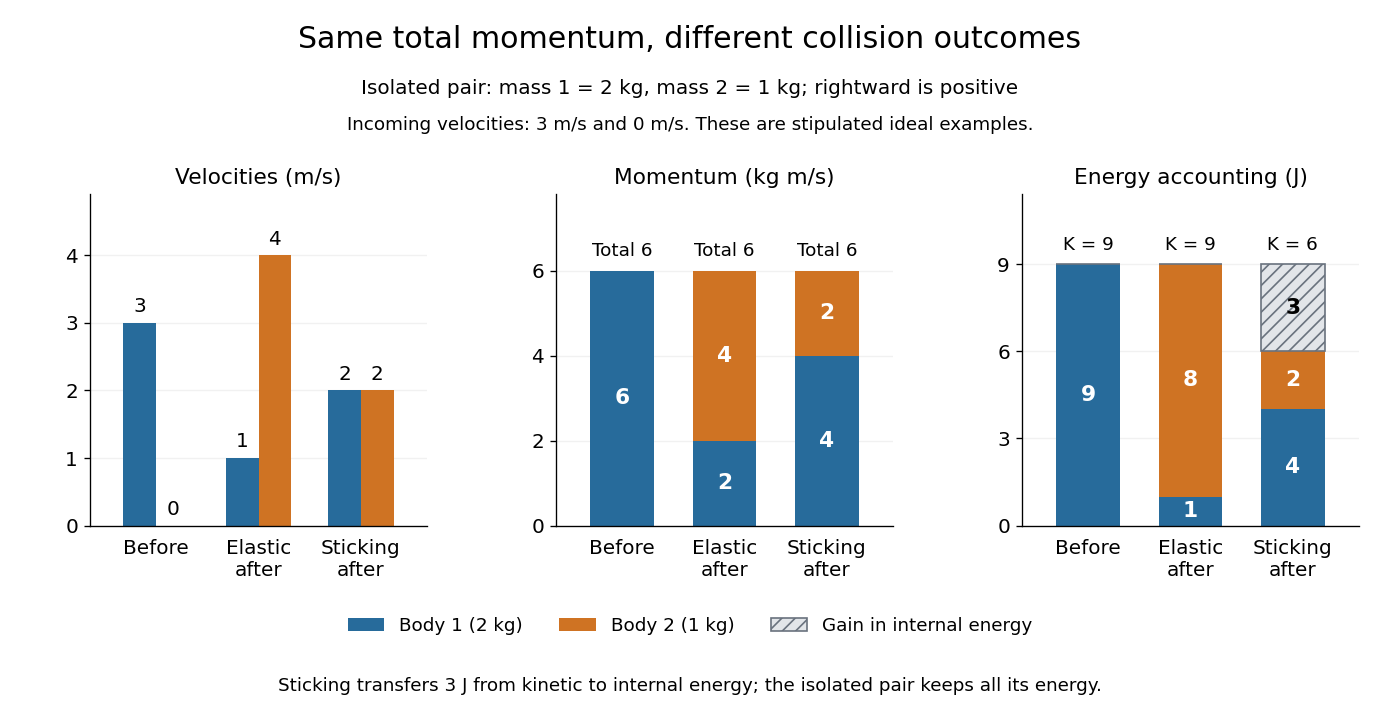
The inelastic collision example below uses exactly these incoming data. Both outcomes preserve total momentum, while only the elastic collision preserves total kinetic energy. These are ideal numerical examples, not experimental measurements.
In units with , a particle of rest mass and total energy strikes a stationary target of rest mass . For the nontrivial one-dimensional elastic collision, reverse the incident momentum in the centre-of-mass frame and transform back to obtain the displayed outgoing projectile energy. The invariant squared total four-momentum is . If and , then . If , retaining arbitrary gives ; only the further fixed-, infinite-target-mass limit gives .
A particle of total incident energy and rest energy strikes an identical stationary particle. If the two outgoing paths make equal and opposite nonzero angles to the incoming direction in the laboratory frame, transverse conservation of momentum makes their outgoing energies equal to . Longitudinal conservation of momentum and the mass shell relation imply . The nonrelativistic limit is ; at large incident energy both paths become forward directed.
In the separated-impact approximation, an upper ball of mass falling at speed meets a lower ball of mass after the latter rebounds elastically from a fixed floor. Their outgoing upward velocities are and . These follow from conservation of momentum and reversal of relative velocity. The upper ball receives a fraction of the initial kinetic energy, where ; subtracting this fraction from unity gives . Hence complete transfer occurs at , whereas a very light upper ball rebounds to nine times the common drop height.
In a nonrelativistic elastic collision of incident mass at speed with initially stationary mass , the centre-of-momentum frame moves at . The projectile's outgoing velocity in that frame has fixed magnitude . Its laboratory velocity tips lie on a circle of radius centred at . For , a tangent from the origin gives the largest laboratory scattering angle, . This geometrical result follows from Galilean velocity addition and conservation of energy.
For fixed particle masses, a Galilean boost by changes total kinetic energy to . An isolated collision conserves total momentum and total nonrelativistic mass , so its final-minus-initial kinetic energy change is independent of the inertial frame. An elastic collision in one such frame is elastic in all of them. Conservation of momentum, rather than invariance of the numerical value of K, is essential to the argument.
Equal laboratory recoil angles constrain outgoing momenta, not equality of masses. In units , take an incoming mass with energy striking a stationary mass . The final momenta and conserve four-momentum and have mass shells and . Both trajectories make angle with the incident axis. This is a concrete counterexample to inferring equal masses from equal outgoing angles alone.
For two identical particles of rest mass , one initially stationary and the other with kinetic energy , symmetric final paths at force equal final energies . The relativistic energy-momentum relation and longitudinal momentum conservation give the title formula. The angle between the paths is , tending to at low kinetic energy and to zero at high kinetic energy.
For a nonrelativistic elastic collision with the target initially at rest, let be the outgoing projectile angle in the centre-of-mass frame. The laboratory target velocity is proportional to . Its unsigned recoil angle is therefore , independent of the mass ratio. At zero deflection the target is stationary and its direction is undefined; the right-angle value is a limit.
A point mass strikes a free rod of equal mass, initially at rest, perpendicularly at distance from its center of mass. Assume a smooth elastic collision and rod moment of inertia about its centre. The final translational speeds are equal precisely when . Indeed, momentum conservation then fixes both final velocities to ; angular impulse gives , and conservation of kinetic energy gives . Eliminating proves the formula. A uniform rod has , hence , which lies within the rod.
Let a nonrotating disc initially move downwards at speed and strike a stationary point support offset from its centre. If the impulse is vertical and the normal coefficient of restitution is one, its upward impulse satisfies . The signed upward centre velocity is therefore the title formula, where is the moment of inertia about the horizontal diameter perpendicular to the impact lever arm. At for a thin circular disc, , so its centre instantaneously stops and all initial kinetic energy becomes rotation. A fixed support can absorb momentum without doing work.
Let one equal-mass disc arrive with velocity while the other is stationary, and let be the unit line of centres at contact. A smooth central elastic impulse exchanges their normal velocity components and leaves tangential components unchanged: and . The final translational velocities are orthogonal when both are nonzero, and no rotation about a disc centre is generated by the normal impulse. This result concerns nonrelativistic smooth discs; roughness introduces tangential contact dynamics.
A massive piston at velocity reverses a particle's normal velocity in its own frame. Transforming back gives , with transverse components unchanged. The particle energy gain is .
A particle of kinetic energy hitting an equal mass at rest, with equal and opposite outgoing angles , obeys . Conservation of total energy gives equal final energies, and longitudinal momentum conservation fixes the angle.
A projectile of mass elastically scattering from a stationary target of mass has the displayed maximum laboratory angle. In units, let its incident energy be and . Boosting the outgoing four-momentum from the center-of-momentum frame gives , with and . The maximum at has . Equality is allowed; a strict upper bound would exclude a realizable outgoing direction. The angular cap is independent of incident energy.


