RNA polymerase first recognizes and binds a gene promoter to form a closed complex with the local DNA duplex still paired. Local strand separation then produces a transcription bubble in an open promoter complex, making the template available for RNA synthesis. Recognition, binding, and opening are distinct events; observing binding alone does not demonstrate strand opening.
In magnetic tweezers, a DNA tether joins a fixed surface to a magnetic bead, with attachments that prevent free swivelling. The magnets pull upward and can impose turns; the bead height reports tether extension. For a torsionally constrained tether, linking number is partitioned into twist and writhe, . If opening the transcription bubble removes helical twist while is fixed, compensating twist or writhe appears elsewhere. In a supercoiled regime, changes in writhe change the extension, making an opening event visible as a bead-height step.
The sign provides an important control. On a positively supercoiled tether, local unwinding requires more positive compensating writhe and generally shortens the tether. On a negatively supercoiled tether, the same unwinding removes some negative writhe and generally lengthens it. A bending or compaction contribution can have the same sign in both cases, whereas the torsional contribution reverses. Comparing signs, together with an extension-versus-turns response measured for the tether, distinguishes local unwinding from mere binding-induced bending. These claims assume the tether remains torsionally constrained and lies in the calibrated supercoiled regime, rather than an arbitrary stretched-DNA regime.
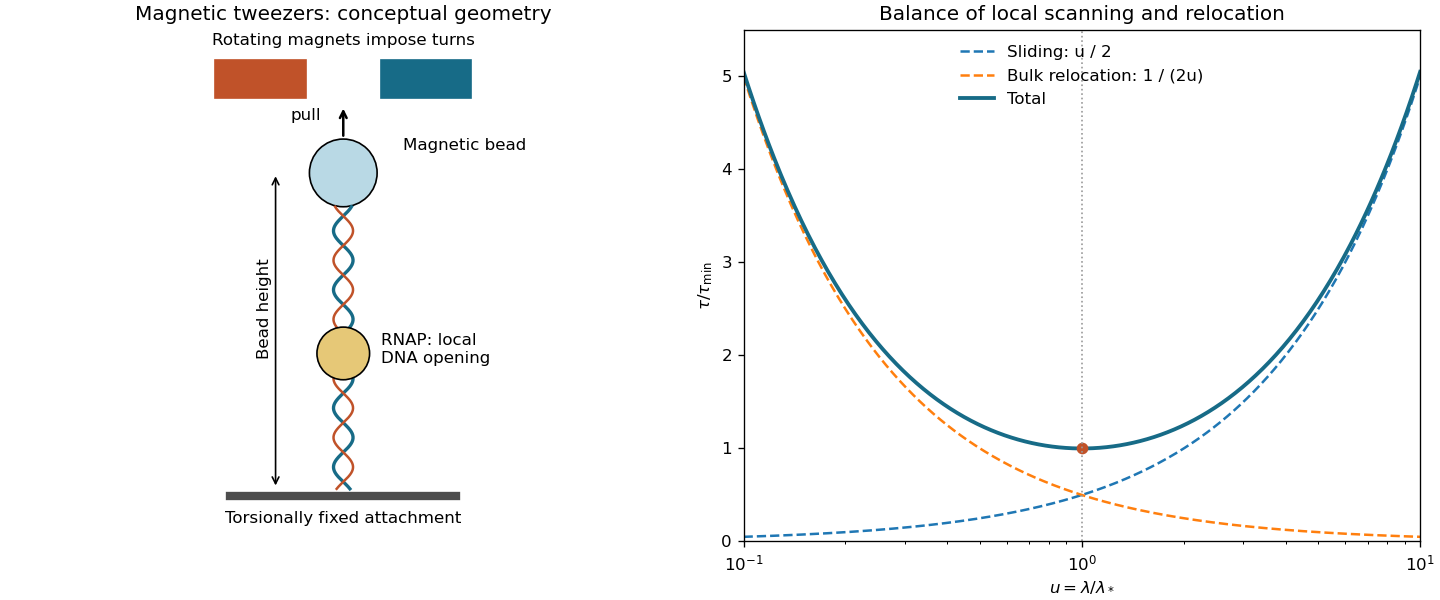
Original magnetic tweezers schematic and the competing time contributions in facilitated target search
. Details. 
For a fixed perfectly absorbing spherical target, steady diffusion outside radius obeys , , and . Spherical symmetry gives , hence . The inward diffusion flux integrated over the target is . Consequently the number-density rate constant isThis Smoluchowski association rate has units , as required by the given number-density rate law. If both partners moved independently, their relative diffusion coefficient would be the sum; the chromosomal target is treated as fixed here.
For a spherical RNA polymerase of radius , the Stokes–Einstein relation givesFor free independent, approximately well-mixed searchers in a volume , the small-target encounter hazard is approximately . ThusThe numerical coefficient explicitly uses a typical illustrative cell volume and an illustrative effective capture radius, not dimensions supplied by the source. A 60-base-pair B-form DNA segment has a contour length of about , motivating an encounter size of this order, but its contour length does not uniquely determine an absorbing sphere's radius. Taking instead doubles the estimate. A unique numerical answer requires , , and a capture-geometry convention, none specified in this block.
The estimate also treats all 6000 molecules as freely available and every encounter as productive. Crowding, nonspecific binding, orientation constraints, imperfect reaction, and finite-domain initial transients can alter it. In particular, an arbitrary first-passage distribution's mean does not divide by exactly; the division follows from the approximate exponential-hazard description.[ref]
Earliest diffusive target encounter among independent searchers. Small-target well-mixed limit and its assumptions
The given facilitated target search time contains a rising term and a falling term . Longer sliding explores more neighbouring DNA without another bulk encounter, reducing the cost of three-dimensional relocation; but it also spends longer revisiting local contour. Roughly local scans, each taking time of order , give the first term. The second represents the bulk encounter cost for an effective capturable contour range of order , with a Smoluchowski association rate scaling as . Numerical geometrical factors are already absorbed in the stipulated scaling formula.
Differentiating at fixed positive givesThe second derivative proves the minimum is unique. The two contributions are equal there. The formal curve diverges at both zero and infinite ; real sliding lengths are bounded, for example by the available contour, so an inaccessible optimum must be replaced by the nearest physical boundary. In dimensionless form, with . The right panel of the original illustration shows its minimum and the two contributing terms. The supplied expression does not include a factor of 6000; it should not silently be identified with the preceding earliest-encounter estimate.
Single-molecule fluorescence microscopy can localize isolated fluorescent proteins and link successive positions into trajectories. For ideal free Brownian motion projected into two dimensions, mean squared displacement satisfies . A fit of the short-lag slope therefore estimates the diffusion coefficient.
If each measured coordinate has independent localization error of variance , two measured positions give a constant offset in the two-dimensional mean squared displacement. Finite exposure averages the motion and biases that relation too. Estimates should therefore account for localization error, motion blur, missed links, and confinement. Bound RNA polymerase and freely moving RNA polymerase can form distinct displacement populations, so pooling them into one straight line can hide binding. Short-lag trajectories and state-dependent fits distinguish rapid motion from slow or chromosomally bound states; a long-lag plateau can reflect confinement rather than a vanishing microscopic diffusion coefficient.
Articles by others on the same topic
There are currently no matching articles.