In spatially gated myosin attachment, for a freshly available head encountering an isolated site, take before the attachment window. Converting time derivatives to position derivatives with gives in the binding window, in the protected bound region, and after detachment becomes allowed. Continuity givesFor , the plateau exceeds and approaches one for much slower motion. For , the binding probability is lower, becoming at very high speed. The spatial detachment tail has length , so faster sliding makes a longer low-probability tail. The following is an original calculation of those profiles; the force panel is derived in c.
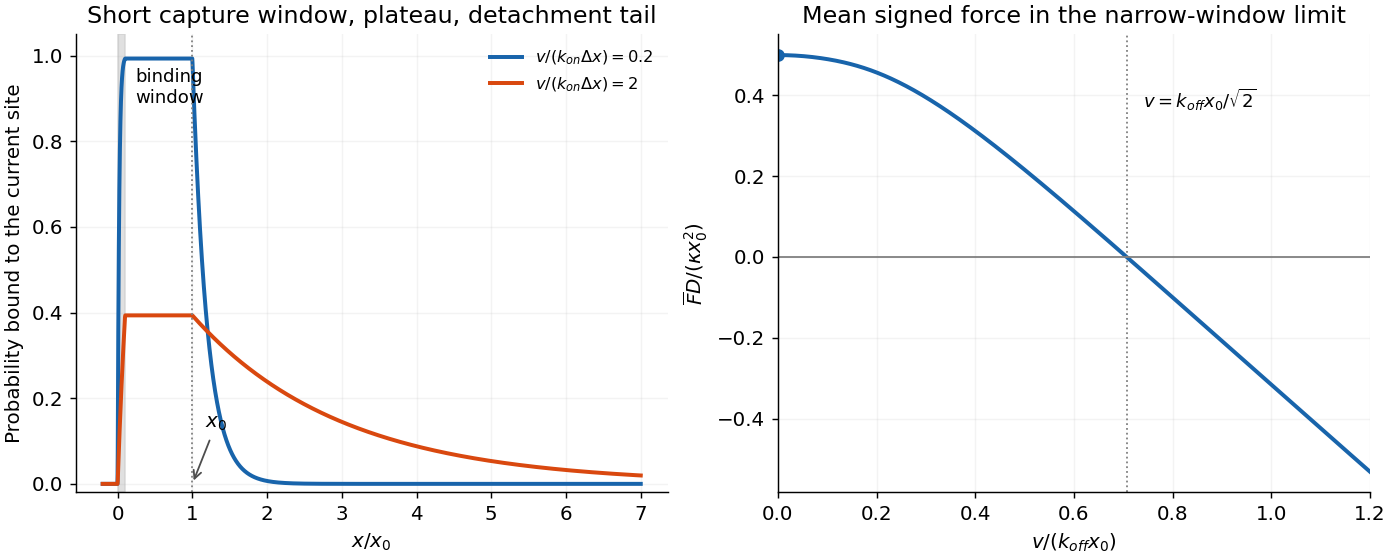

Reset condition. Geometric separation does not alone guarantee detachment before the next site: independently available encounters also need . Without that extra timescale separation the head may still be attached to an earlier site.
For completeness, the periodic steady-state correction can be written explicitly. Put , , andHere is the probability of entering the new window still attached to an earlier site. In the window the new-site probability is ; after it, use its value in the plateau and tail above. For , replace by . This follows from the old-site probability and new attachment rate . The isolated-site result is recovered as .
Articles by others on the same topic
There are currently no matching articles.