A skeletal-muscle fibre contains parallel myofibrils assembled from repeating sarcomeres between Z discs. Thin actin filaments extend from the Z discs; bipolar thick myosin II filaments occupy the central region. Overlap between them allows many myosin heads to interact with actin in parallel.
A rise in cytosolic calcium exposes actin binding sites through the troponin–tropomyosin regulatory system. ATP binding releases a strongly attached myosin head; hydrolysis primes its lever arm, attachment and product release permit a force-generating stroke, and another ATP allows detachment. The cycle converts chemical free energy into mechanical work rather than consuming actin or shortening the filaments themselves.
Relative filament sliding draws the Z discs together. The I band and H zone shorten as overlap increases, whereas the thick-filament A-band length is approximately unchanged. Calcium removal restores inhibition and permits relaxation. The many-head ensemble sustains force even though individual cross-bridges repeatedly attach and detach. This sliding-filament description concerns myosin II in muscle; the processive two-head walking of Myosin V in a is a related but distinct motor arrangement.
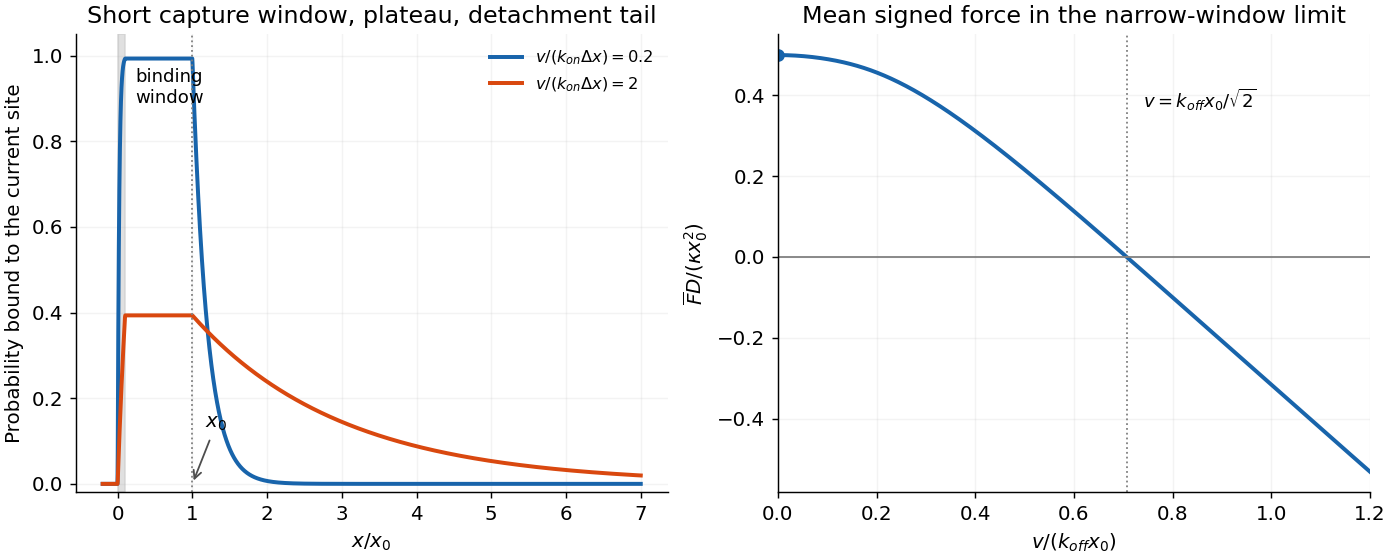
In spatially gated myosin attachment, for a freshly available head encountering an isolated site, take before the attachment window. Converting time derivatives to position derivatives with gives in the binding window, in the protected bound region, and after detachment becomes allowed. Continuity givesFor , the plateau exceeds and approaches one for much slower motion. For , the binding probability is lower, becoming at very high speed. The spatial detachment tail has length , so faster sliding makes a longer low-probability tail. The following is an original calculation of those profiles; the force panel is derived in c.

Reset condition. Geometric separation does not alone guarantee detachment before the next site: independently available encounters also need . Without that extra timescale separation the head may still be attached to an earlier site.
For completeness, the periodic steady-state correction can be written explicitly. Put , , andHere is the probability of entering the new window still attached to an earlier site. In the window the new-site probability is ; after it, use its value in the plateau and tail above. For , replace by . This follows from the old-site probability and new attachment rate . The isolated-site result is recovered as .
For the work of a spatially gated myosin head, the mechanical force exerted by an attached head in the increasing- direction is . It assists motion before and resists it afterwards. For one site encounter the expected work isIn the narrow binding-window limit, retain the capture probability but neglect the attachment displacement compared with . The positive work is . After , use to obtain the negative contribution . HenceAn independent energy calculation gives the same factor: binding near zero loads energy , while an exponentially distributed post-threshold attachment time has , leaving mean elastic energy to be lost upon detachment. The factor of two in that second moment is essential.
One site passes every distance , so average work per distance, or power divided by , givesThe force tends to as and changes sign at in this idealized model. Above that speed forced sliding is resisted on average. The formula uses the reset condition in b, as well as ; if reset fails, replace by the periodic capture probability to leading order in . For arbitrary window width, the isolated-site work is exactly . The loaded spring energy must be supplied by the binding/power-stroke chemistry; this model does not specify an ATP efficiency. Real force-dependent transition rates and energy budgets limit extrapolation of the toy force-velocity law.
Articles by others on the same topic
There are currently no matching articles.