At initiation, RNA polymerase recognizes a promoter and forms a closed bound complex; bacterial promoter recognition involves its specificity factor. Local strand opening exposes the template in an open complex, after which initial RNA synthesis can precede promoter escape into elongation. Binding, opening and productive escape are distinct transitions.
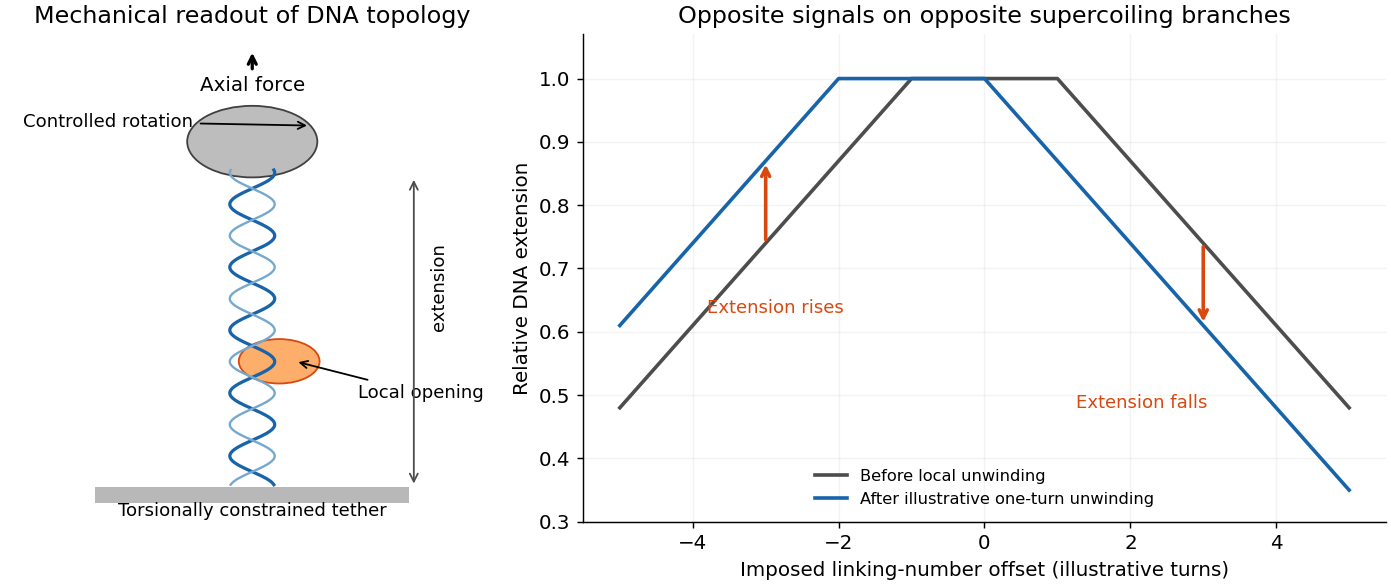
For DNA unwinding measured by magnetic tweezers, magnetic tweezers report the mechanics of a torsionally constrained DNA tether through the position of an attached magnetic bead. Axial magnetic force extends the tether, while imposed rotation controls its linking constraint. Video localization measures extension changes. The important physical relation isOpening a small helical region decreases twist, so the rest of the tether acquires compensating positive writhe. On a negatively supercoiled tether this removes some writhe magnitude and raises its extension; on a positively supercoiled tether it increases writhe magnitude and lowers extension. A change with opposite signs under the two torsional conditions therefore distinguishes unwinding from simple compaction, which would shorten both tethers. Calibrating extension against imposed turns converts a mechanical step into a change in helical winding. This is a conceptual readout of local opening, rather than a direct optical image of separated bases.[ref]
Promoter unwinding and promoter clearance by RNA polymerase: Detection by single-molecule DNA nanomanipulation by Andrey Revyakin and others. 2004 study, linking-number argument and opposite extension responses for positive and negative supercoiling

Articles by others on the same topic
There are currently no matching articles.