Use the source's explicit graded production rules. X is already present at a constant concentration; the input at zero activates it rather than starting accumulation of X. Assume its active level exceeds both relevant X thresholds, put , let , and take . Before the input Z is not produced, so use the initial steady value .
For I1 incoherent feed-forward loop, activation of X starts Y production; for I4 incoherent feed-forward loop it stops Y production. ConsequentlyThe two delays are the times for Y to cross its output-regulation threshold. In I1 incoherent feed-forward loop, initially absent Y permits the high output rate, then accumulated Y represses it. In I4 incoherent feed-forward loop, initially abundant Y activates the high output rate, then Y's decay removes that activation. Thus both have production before their respective delay and afterwards.
With and , their common piecewise response, with or , isThe output is continuous at the production switch. There is an overshoot precisely when ; otherwise it rises monotonically to . For a threshold not extremely close to its limiting values and the supplied , a rapid pulse followed by relaxation to a lower nonzero level is expected. This can provide fast initial response or a transient strong signal, but it is not perfect adaptation to the original zero output.
The original plots below use the illustrative values and . At the two Y curves are complementary and their output delays and Z curves are identical. These threshold values are examples, not extra source data. “AND” here must be read with the stipulated graded rates: replacing them by an ordinary all-or-nothing AND rule would give a different response.
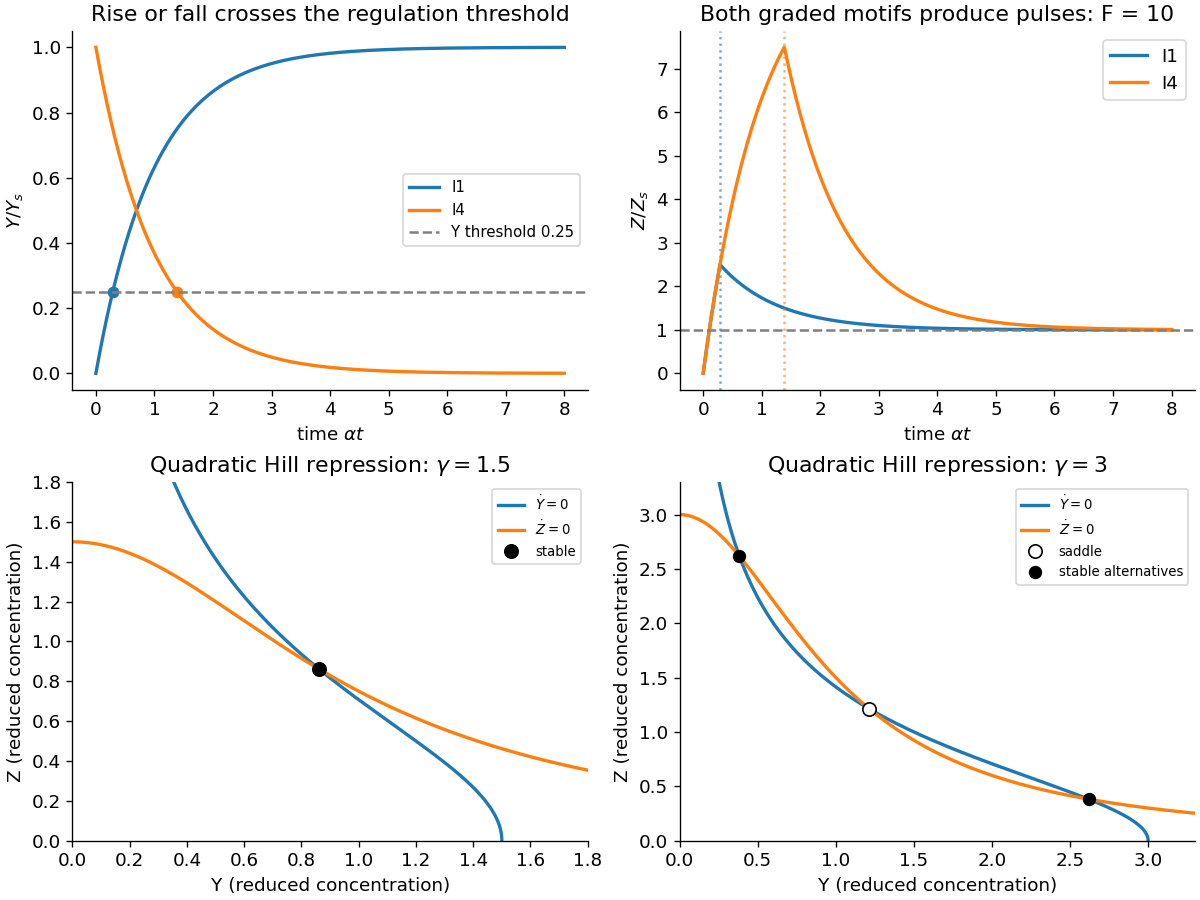
Graded incoherent feed-forward pulses and the change from one to two attracting toggle states
. Original model trajectories and nullclines. Pulse panels use illustrative , and dimensionless time ; switch panels use with the explicitly labelled reduced production strengths. Details.
Articles by others on the same topic
There are currently no matching articles.