The trigonal pyramidal molecular geometry has C3v point group symmetry: identity, two rotations about the threefold axis, and three vertical mirror reflections. Choose along the threefold axis through nitrogen and the center of the hydrogen triangle.
In the C3v point group, the nitrogen valence atomic orbitals transform asThe orbital is invariant under every symmetry operation; is also invariant because each operation preserves the coordinate. The other two components mix as a two-dimensional irreducible representation.
Use the classes of the C3v point group. For the three hydrogen atomic orbitals, the character of a representation counts orbitals fixed by each symmetry operation. Identity fixes three, a nontrivial threefold rotation fixes none, and a vertical mirror fixes one. ThereforeThe character inner product gives multiplicitiesThus , with the contribution accounting for two independent symmetry orbitals.
Neglecting intersite orbital overlap, one normalized real set of symmetry-adapted linear combinations isThe coefficient vectors are orthonormal. The first has equal phase at all three sites; the second opposes site to ; the third has zero amplitude at and opposite phases at . Any orthonormal rotation of the two functions is equally valid. With nonzero intersite orbital overlap, normalization must instead use the overlap matrix.
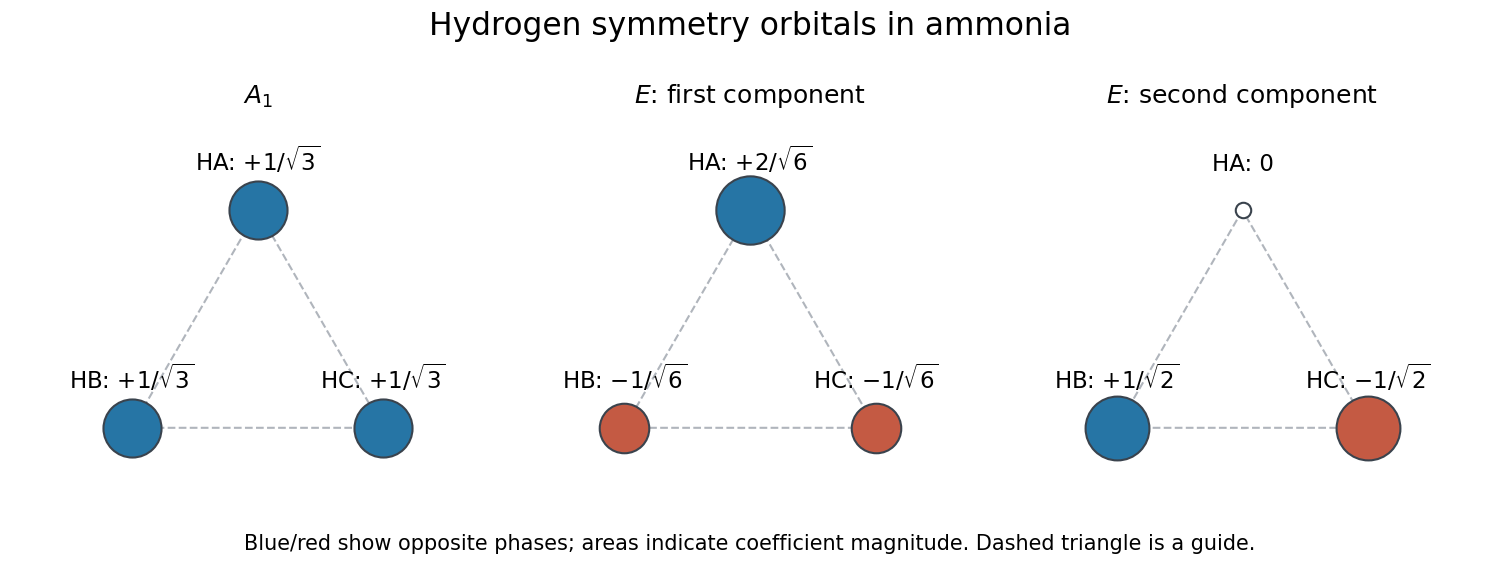

The hydrogen symmetry orbital mixes with both nitrogen and , giving three molecular orbitals. The two hydrogen functions mix with , giving a bonding pair and an antibonding pair. Eight valence electrons fill the lower levels asThis uses conventional numbering that reserves for the omitted nitrogen core orbital. The low and levels provide the principal N–H bonding molecular orbitals; the highest occupied level is the mainly nitrogen lone pair, with some bonding admixture permitted by the pyramidal geometry. Empty and levels are antibonding. Symmetry fixes which orbitals can mix, rather than their quantitative energy separations.
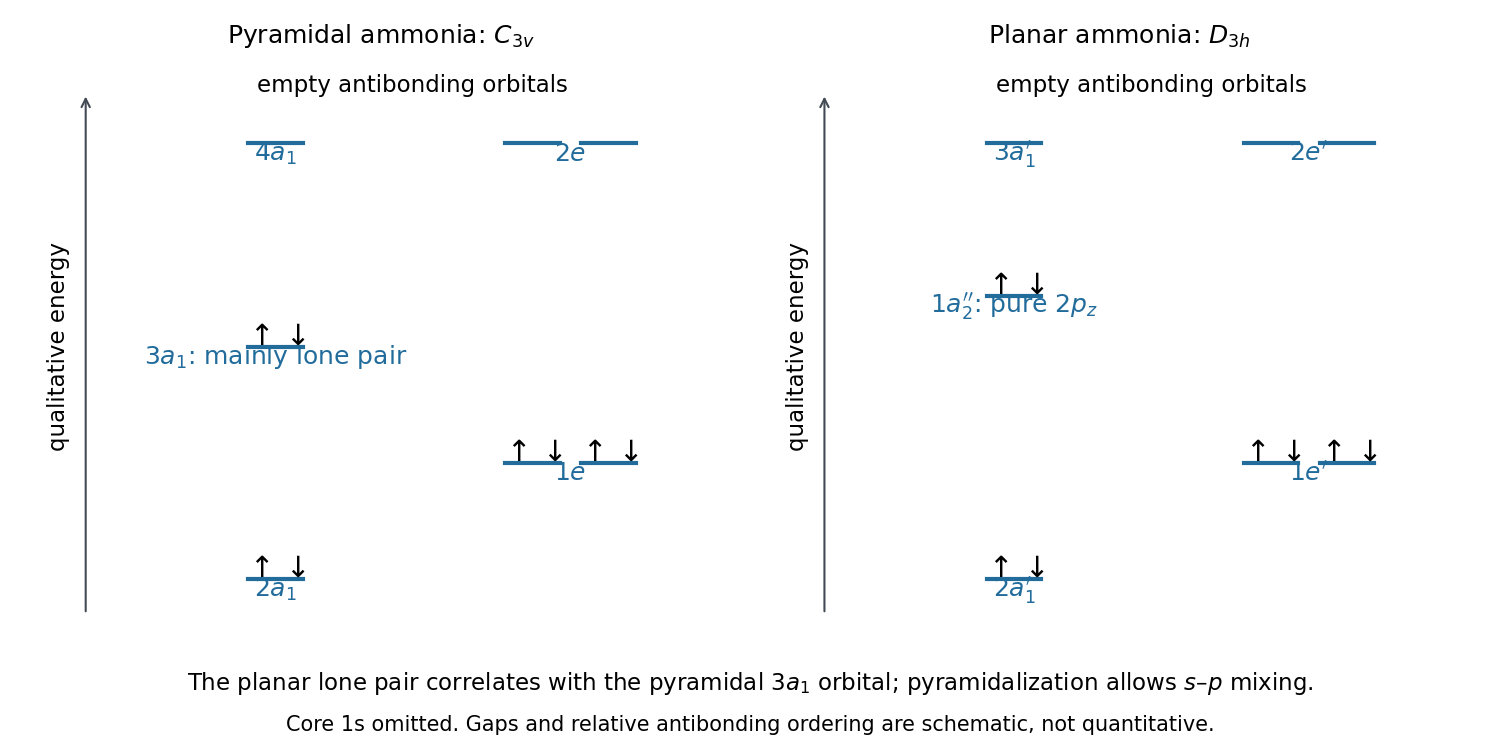
Original qualitative ammonia molecular orbital diagram comparing pyramidal and planar geometries; the core orbital is omitted
. Details. 
The planar equilateral structure has D3h point group symmetry. In addition to the threefold axis, it has a horizontal mirror plane containing all four nuclei and three twofold axes lying in that plane.
For planar ammonia, the nitrogen valence atomic orbitals have symmetries , and . The hydrogen symmetry orbitals span . Consequently the in-plane orbitals form a bonding orbital, a bonding pair and their antibonding partners. The out-of-plane has no matching hydrogen combination and remains a nonbonding orbital. With the core omitted, the conventional valence occupation isThe preceding ammonia molecular orbital diagram shows the correlation. On pyramidalization, and both correlate with of the C3v point group, permitting s–p orbital mixing. The pure planar lone pair can acquire bonding character, lowering its energy and helping stabilize the pyramid. Symmetry alone does not provide a numerical inversion barrier.[ref]
The nitrogen-centered highest occupied molecular orbital of ammonia supplies a lone pair; planar borane has an empty out-of-plane -derived lowest unoccupied molecular orbital. Approach along this acceptor axis gives constructive orbital overlap and donation of the nitrogen pair into the boron-centered acceptor. The resulting N-to-B coordinate covalent bond forms the ammonia borane adduct.
The occupied molecular orbital formed by this interaction is bonding, while the corresponding antibonding combination remains empty. Borane pyramidalizes as coordination increases from three to four. Ammonia can use its existing outward-pointing lone pair; its inversion to the planar transition geometry is not a prerequisite. The Lewis base and Lewis acid descriptions summarize the donor and acceptor roles, while the frontier molecular orbitals explain their directional interaction.
Articles by others on the same topic
There are currently no matching articles.