In atomic units, , and the hydrogen atom hasThe allowed quantum numbers areHere the fixed electron spin quantum number is . The energy eigenvalues are in hartrees; restoring units gives and for the orbital operators and the corresponding factors for spin. The spin-independent hydrogen Hamiltonian does not split the two spin projections.
Keep one normalized spin function fixed and write and , with . Overall constants and the spin factor pass unchanged through the spatial operators.
First, in atomic units, , soFor the squared orbital angular momentum, andTherefore the two terms of the angular operator giveusing . Thus .
Finally, the spatial hydrogen Hamiltonian isFor ,Substitute the already established angular eigenvalue :Hence hartree, consistently with . The angular calculation must precede the radial substitution if one wants to avoid differentiating the entire product repeatedly.
Denote the two complex spatial atomic orbitals by and , retaining the same spin state. With the phases specified by the supplied spherical harmonics, chooseThe two original atomic orbitals are orthonormal, so the squared coefficients add to one and these combinations are normalized and mutually orthogonal. Explicitly,which are real spatial wavefunctions. An overall sign on either orbital has no physical consequence.
These are the familiar and p orbitals. Each has two lobes of opposite wavefunction sign, with an atomic-orbital nodal plane through the atomic nucleus: for and for . The sign is a phase convention, not a positive or negative electric charge; the probability density is nonnegative on both lobes.
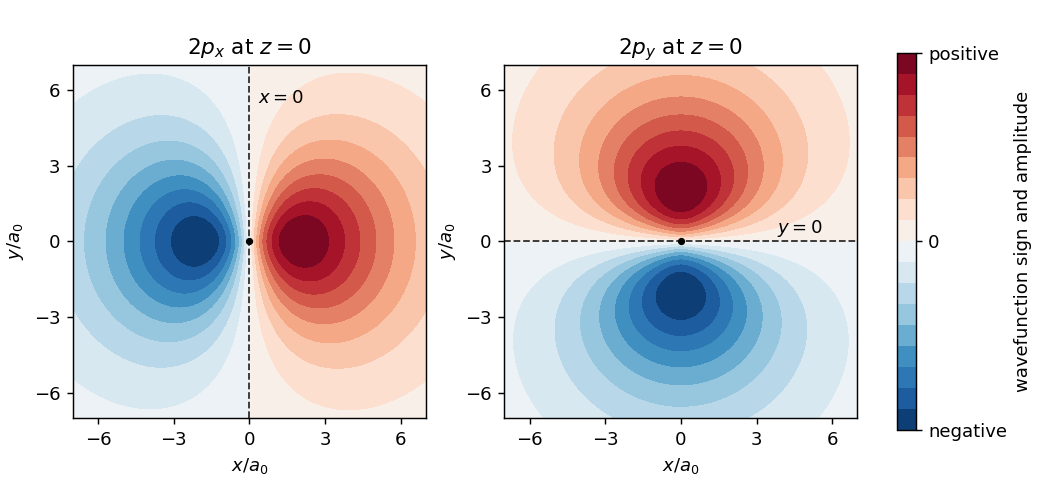
Original sections through the real hydrogen 2p atomic orbitals, showing opposite phases and their nodal planes
. Details. 
Linearity and the shared angular eigenvalue giveUsing the relative phases in part (c),Thus each real orbital remains an energy eigenstate with hartree and has definite orbital angular momentum magnitude , but neither is an eigenfunction of . A measurement of gives or , each with probability . Its mean is zero and its variance is ; a zero mean does not mean that a measurement gives zero.
Articles by others on the same topic
There are currently no matching articles.