A ligand symmetry orbital can mix with a metal combination only if their irreps match. Since the donor levels lie below the metal levels, mixing produces a lower ligand-dominated bonding orbital and a higher metal-dominated antibonding orbital. In a two-level model with ,The requested metal-dominated levels are shown in the right-hand column; the lower ligand-dominated partners are deliberately outside this diagram.
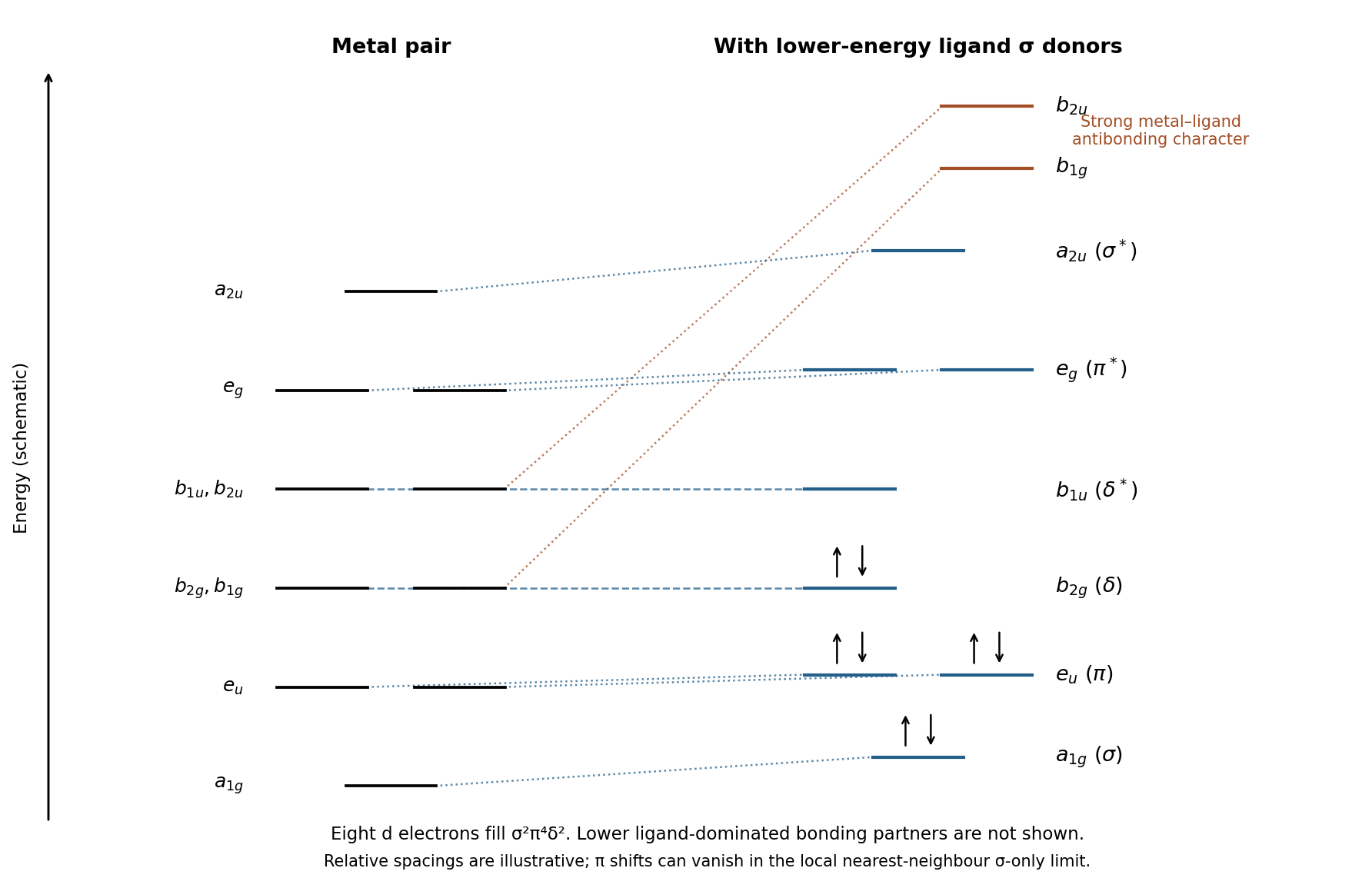

The lobes point directly at the chlorides, so their and combinations are strongly destabilized. The combinations can also interact through their equatorial density. The symmetries have ligand partners, so weaker shifts are symmetry-allowed; their local nearest-neighbour sigma overlap vanishes in the ideal planar geometry, making their shifts much smaller in that approximation. Symmetry allowance alone never sets an overlap integral's size.
There are no ligand sigma combinations of or symmetry, so the -derived delta pair is unaffected by the stipulated sigma-only mixing. In particular the low level survives while the other delta bonding channel becomes strongly metal–ligand antibonding. The plotted spacings and ordering of remote unoccupied levels are schematic; the robust conclusion is the four low Mo–Mo bonding orbitals separated from antibonding or strongly ligand-destabilized orbitals.
Articles by others on the same topic
There are currently no matching articles.