For an elementary bimolecular forward step, . A liquid solution is much less compressible than a gas, so applying pressure changes its volume and reactant concentrations only modestly. With composition and temperature otherwise fixed, the observed substantial acceleration is therefore most naturally assigned to a change in the rate constant.
This is an approximation, not exact incompressibility: for precise pressure kinetics, correct the concentrations for compression and distinguish them from pressure-dependent activities.
At fixed temperature, differentiating the Eyring equation with a pressure-independent prefactor and fixed concentration convention givesSince , the derivative is the difference between the activated complex's partial molar volume and the sum for the reactants:If activation volume is approximately constant over the pressure range, integration givesThus plot against pressure: its slope is . Use pressure in pascals for a volume in . The model neglects pressure dependence of the transmission coefficient, substantial changes in mechanism, and strong curvature from a pressure-dependent activation volume. Fixed concentration-unit conventions and compression corrections matter for non-first-order rates.[ref]
Using the numerical rate constants in , the logarithms areA straight-line least-squares fit isEvery logarithmic residual has magnitude below , so the rates follow the fitted exponential to within ; . Thus a constant activation volume describes these data well.
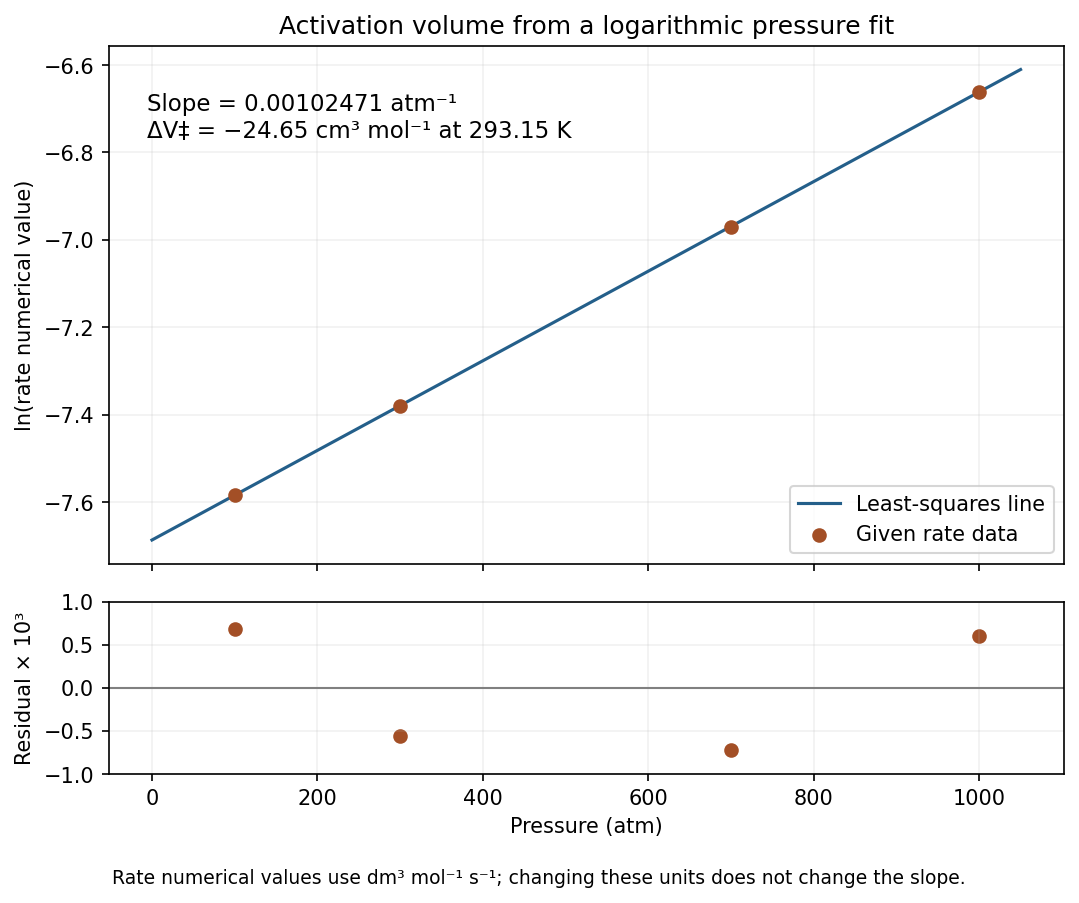

Convert the slope to pascals, using Pa and K:Multiplying all rates by a common unit-conversion factor changes the intercept but leaves this slope and volume unchanged.
The negative activation volume means the transition state occupies less partial molar volume than the two separated reactants. Pressure therefore favours reaching it and increases the forward rate, consistent with a compact associative cycloaddition in which new bonds begin to form.
Articles by others on the same topic
There are currently no matching articles.