In transition state theory, is the dimensionless equilibrium-like constant for forming the activated complex from the reactants under the chosen standard-state convention. It is not the equilibrium constant for forming the stable product.
is the standard activation free energy, the standard activation enthalpy, and the standard activation entropy. Each is the activated-complex quantity minus the corresponding sum for the reactants, with the unstable reaction-coordinate motion treated by the transition-state flux construction.
is the standard concentration, conventionally for the rate units used here. Its inverse converts the attempt frequency into the units of a bimolecular rate constant. The stated Eyring equation assumes unit transmission coefficient.
Resolve the activation free energy into enthalpy and entropy in the Eyring equation:Taking logarithms of numerical values in fixed, consistent units givesThus for slope and intercept ,The logarithms imply reference units, as made explicit in the supplied numerical plot. Approximate linearity requires the activation parameters and transmission coefficient to vary little over the temperature interval; a significant activation heat-capacity difference produces curvature.
The slope is K, so the activation enthalpy isFor , using in gives the numerical prefactor . The intercept therefore yieldsThe large logarithm must be subtracted; identifying with the activation entropy would omit the transition-state attempt-frequency factor. Changing rate units without changing the standard-concentration prefactor consistently would also give a spurious entropy.
The large negative activation entropy is consistent with a strongly organized bimolecular cycloaddition. Two separately translating and rotating molecules must approach with a restricted orientation to form a compact ring-forming transition state. Losing relative positional and orientational freedom lowers entropy.
Internal conformational restrictions and solvent rearrangement can contribute too. In a nonpolar solvent, a simple association picture is more plausible than assigning the whole effect to strong ionic solvation, but the numerical value is not a direct count of molecular orientations alone.
The activation enthalpy is obtained from the slope across the measured interval. The activation entropy comes from the intercept at , far outside that interval, so a small slope uncertainty can produce a much larger uncertainty in the extrapolated intercept. Slope and intercept errors are consequently strongly correlated.
The entropy is also sensitive to the assumed prefactor and standard concentration, whereas a constant multiplicative calibration error shifts the intercept without changing the slope. This explains why its inferred precision is often poorer. Since enthalpy and entropy have different units, a claim about which absolute numerical uncertainty is larger requires a stated comparison convention.
Use the same transition state and consistent standard states in both directions. Subtracting their definitions givessoRing-forming association normally has . Hence the reverse activation entropy should be more positive, or less negative, than the forward value: a single adduct approaches a bond-breaking configuration rather than two molecules losing their relative motion. Its precise value and even whether it crosses zero cannot be deduced without the reaction entropy. The reverse elementary reaction is first order, so its Eyring equation has the corresponding first-order standard-state prefactor.
For an elementary bimolecular forward step, . A liquid solution is much less compressible than a gas, so applying pressure changes its volume and reactant concentrations only modestly. With composition and temperature otherwise fixed, the observed substantial acceleration is therefore most naturally assigned to a change in the rate constant.
This is an approximation, not exact incompressibility: for precise pressure kinetics, correct the concentrations for compression and distinguish them from pressure-dependent activities.
At fixed temperature, differentiating the Eyring equation with a pressure-independent prefactor and fixed concentration convention givesSince , the derivative is the difference between the activated complex's partial molar volume and the sum for the reactants:If activation volume is approximately constant over the pressure range, integration givesThus plot against pressure: its slope is . Use pressure in pascals for a volume in . The model neglects pressure dependence of the transmission coefficient, substantial changes in mechanism, and strong curvature from a pressure-dependent activation volume. Fixed concentration-unit conventions and compression corrections matter for non-first-order rates.[ref]
Using the numerical rate constants in , the logarithms areA straight-line least-squares fit isEvery logarithmic residual has magnitude below , so the rates follow the fitted exponential to within ; . Thus a constant activation volume describes these data well.
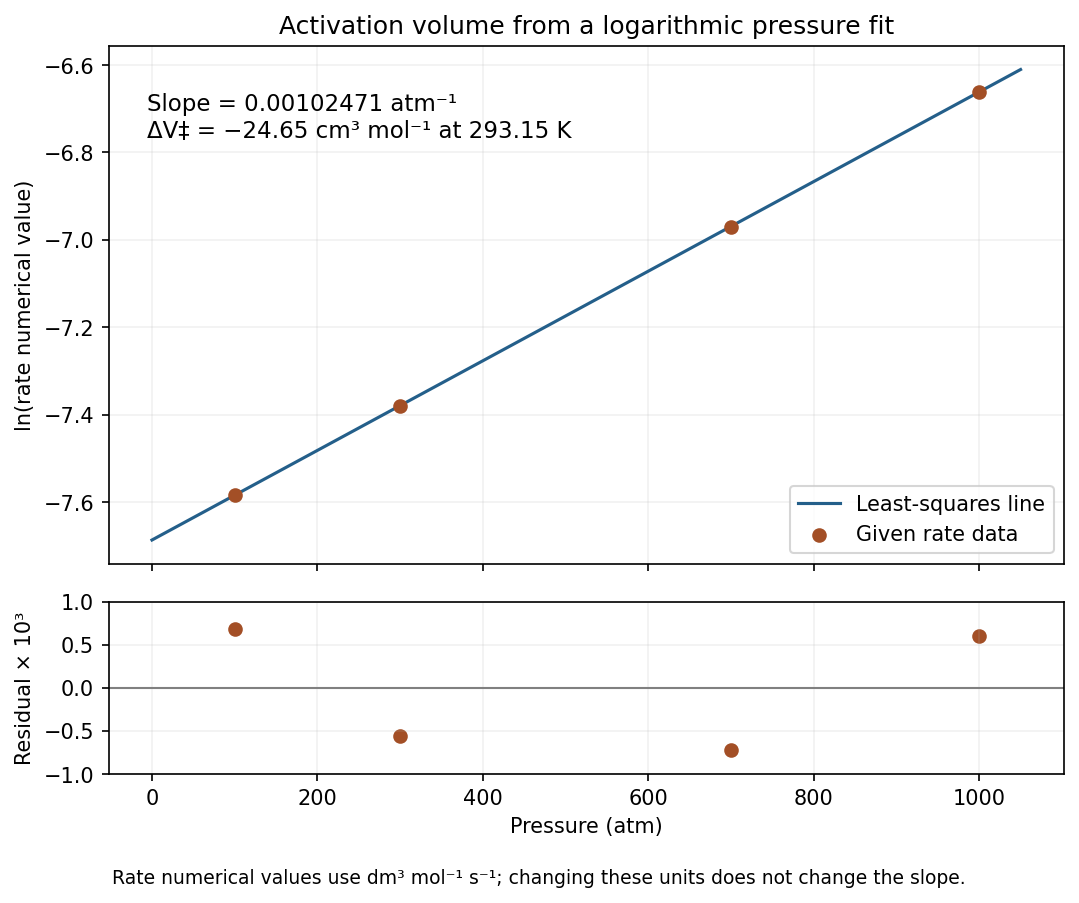

Convert the slope to pascals, using Pa and K:Multiplying all rates by a common unit-conversion factor changes the intercept but leaves this slope and volume unchanged.
The negative activation volume means the transition state occupies less partial molar volume than the two separated reactants. Pressure therefore favours reaching it and increases the forward rate, consistent with a compact associative cycloaddition in which new bonds begin to form.
Articles by others on the same topic
There are currently no matching articles.