The planar para-quinone framework has three mutually perpendicular twofold axes, inversion through its centre, and the associated mirror planes. With horizontal, along the two C=O bonds and perpendicular to the molecule, it belongs to the D2h point group, .
Write for the orthonormal atomic orbital on numbered site , with every positive lobe pointing along . A normalized set of symmetry-adapted linear combinations isEach has unit squared coefficient sum, and every distinct pair has zero inner product. The orbital representation therefore reduces to . For example, the fully symmetric site sum still has orbital symmetry because a orbital itself changes sign under operations that reverse . Ignoring that sign would assign the wrong representations.
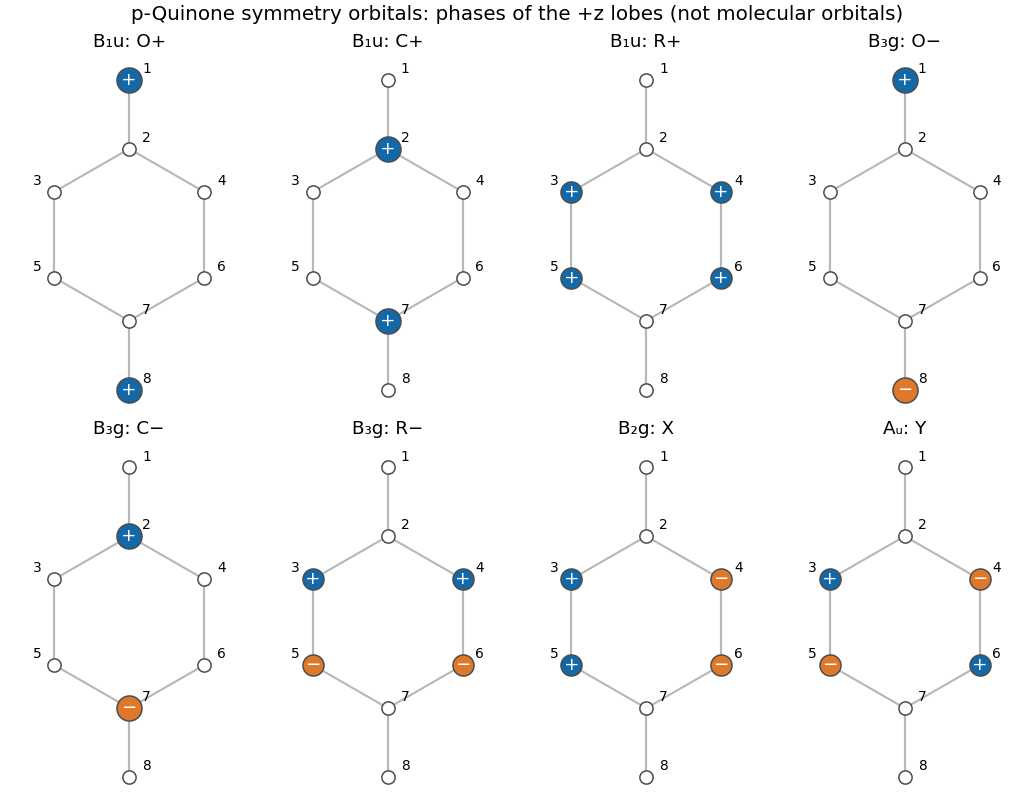

Set , with the usual bonding convention . In the Hückel method, the dimensionless matrix has diagonal entries one on oxygen sites 1 and 8, zero on carbon, and unit entries between bonded neighbours. In the bases and above, its blocks areThe one-dimensional and blocks have and , respectively. The characteristic polynomial of the block factors asso its three molecular orbital energies areFor the block the matrix trace is zero. Thus its three values sum to zero, and the pair supplied in the paper gives the remaining one as . Directly, its secular equation is , whose roots are approximately , and . The supplied pair is approximate, so from its trace and from the exact block should not be mistaken for an additional physical splitting.
All eight energies, ordered from low to high for , areThe eight electrons fill the four lowest molecular orbitals. The equality at is an accidental degeneracy of this parameterized model, not a multidimensional representation of .
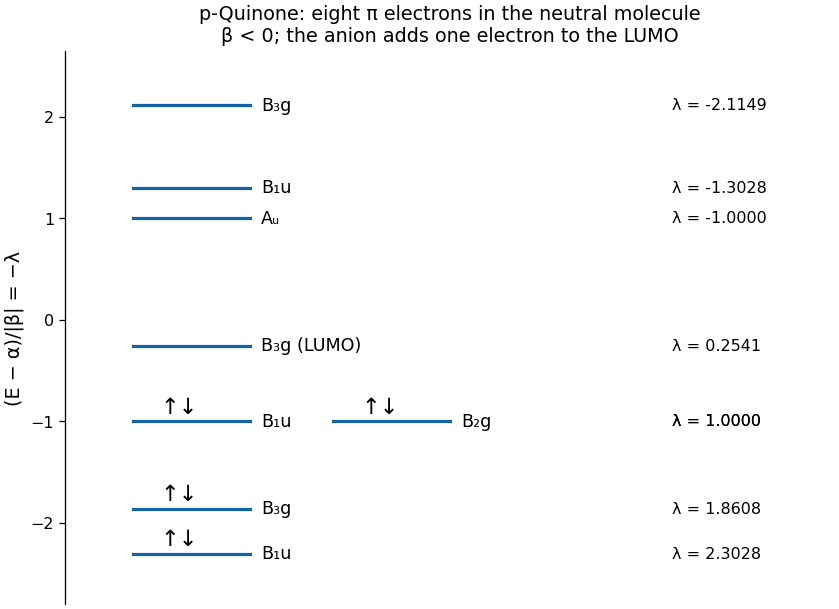
Original Hückel method energy-level diagram for neutral para-quinone, with eight electrons and its unoccupied level
. Details. 
The extra electron occupies the lowest unoccupied molecular orbital of the neutral molecule, the orbital at the middle root of . WriteThe first and third rows of the block giveChoosing the overall phase so that site 1 is positive gives . In the original site order,The squared coefficients sum to one. Within this fixed-orbital Hückel orbital charge density approximation, the added electron contributes site populationsThus the oxygen sites receive the largest added negative charge, each receiving an increment of approximately . Including the four doubly occupied neutral orbitals gives an anion population of about on each oxygen, on sites 2 and 7, and on each remaining carbon. Thus oxygen also has the largest total population in this model. A coefficient's sign is an orbital phase, not the sign of its electric charge. Predicting an actual charge density would additionally require orbital relaxation and a population-analysis convention; the stated result is the requested orbital model.
Articles by others on the same topic
There are currently no matching articles.