The product is 1,4-dimethoxy-2,5-bis(2-methylbutan-2-yl)benzene. Each new substituent is , a tert-amyl group, rather than the unrearranged secondary alkyl group of the alcohol. The two substituents are related by the symmetry of the ring.
The proton assignments are:
| chemical shift / ppm | Assignment | Reason |
|---|---|---|
| Two aromatic H, at positions 3 and 6 | symmetry makes them equivalent; neither has an adjacent aromatic H to give a resolved ordinary ortho splitting. | |
| Two methoxy groups, six H | Equivalent groups give a NMR singlet. | |
| Two ethyl groups, four H | Each couples to a terminal three-proton methyl group, giving a NMR quartet. | |
| Four methyl groups attached to the two quaternary benzylic carbons, twelve H | These methyl groups have no neighboring methine group proton and give a NMR singlet. | |
| Two terminal ethyl methyl groups, six H | Each couples to two methylene group protons, giving a NMR triplet with the same coupling constant as the NMR quartet. |
The integrals add to 30 H. The unusually shielded terminal ethyl methyl signal is compatible with an aryl-containing environment; its NMR quartet–NMR triplet partner and integral are the decisive assignment evidence. The molecular formula and degree of unsaturation, , fit a benzene ring with saturated side chains.
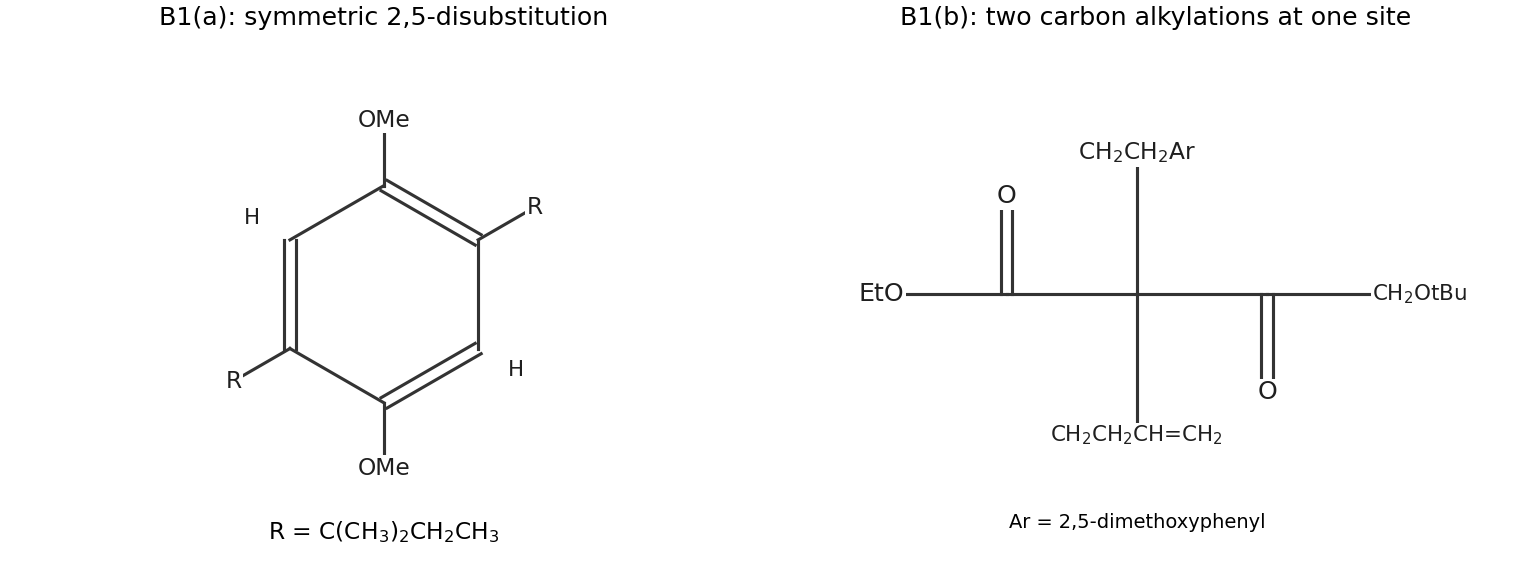
Original structures of the rearranged aromatic alkylation product and dialkylated beta-ketoester
. Details. 
Articles by others on the same topic
There are currently no matching articles.