The product is 1,4-dimethoxy-2,5-bis(2-methylbutan-2-yl)benzene. Each new substituent is , a tert-amyl group, rather than the unrearranged secondary alkyl group of the alcohol. The two substituents are related by the symmetry of the ring.
The proton assignments are:
| chemical shift / ppm | Assignment | Reason |
|---|---|---|
| Two aromatic H, at positions 3 and 6 | symmetry makes them equivalent; neither has an adjacent aromatic H to give a resolved ordinary ortho splitting. | |
| Two methoxy groups, six H | Equivalent groups give a NMR singlet. | |
| Two ethyl groups, four H | Each couples to a terminal three-proton methyl group, giving a NMR quartet. | |
| Four methyl groups attached to the two quaternary benzylic carbons, twelve H | These methyl groups have no neighboring methine group proton and give a NMR singlet. | |
| Two terminal ethyl methyl groups, six H | Each couples to two methylene group protons, giving a NMR triplet with the same coupling constant as the NMR quartet. |
The integrals add to 30 H. The unusually shielded terminal ethyl methyl signal is compatible with an aryl-containing environment; its NMR quartet–NMR triplet partner and integral are the decisive assignment evidence. The molecular formula and degree of unsaturation, , fit a benzene ring with saturated side chains.
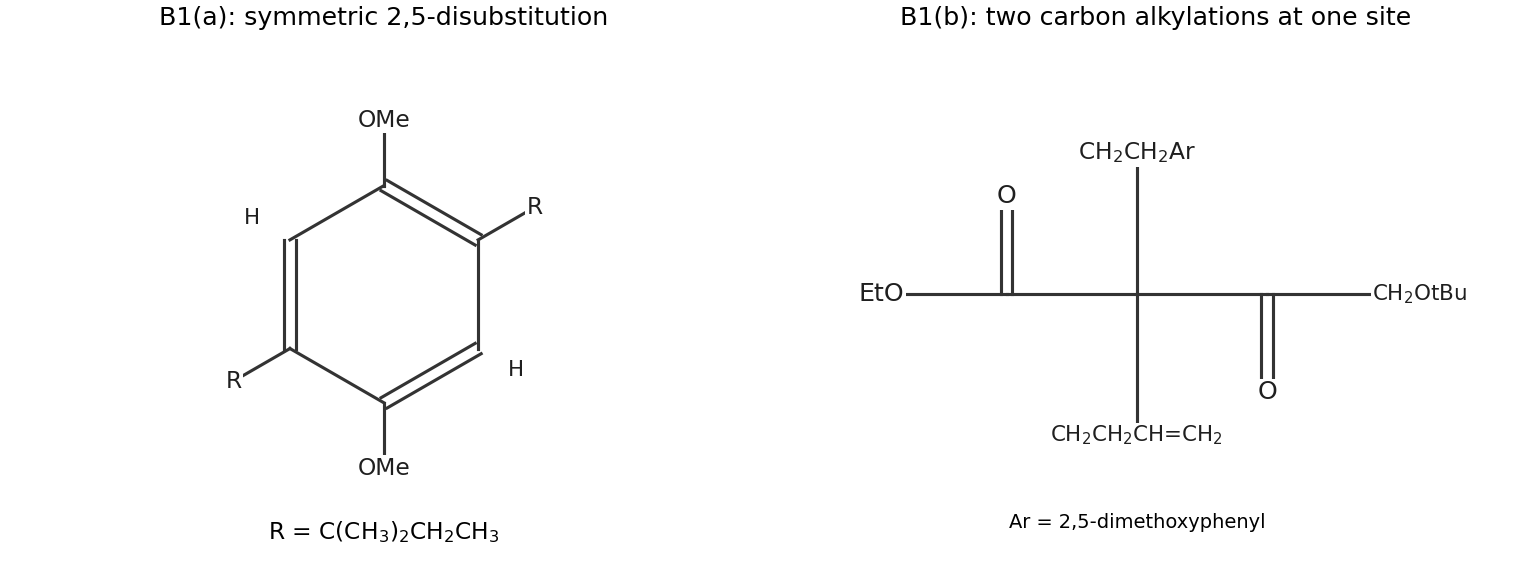
Original structures of the rearranged aromatic alkylation product and dialkylated beta-ketoester
. Details. 
protonation of the alcohol converts its OH group into a water leaving group. Departure of water initially gives the secondary carbocation . A 1,2-hydride shift from the neighboring methine group transfers its C–H bonding pair to the electron-deficient carbon:The resulting tertiary carbocation is the tert-amyl electrophile. An aromatic bond of the dimethoxybenzene attacks that carbon, producing a Wheland intermediate. Removal of the proton from the attacked ring carbon restores aromaticity and regenerates acid. Repeating this Friedel-Crafts alkylation at the symmetry-related second site gives the disubstituted product.
The hydride migration explains the new ethyl group and the absence of a benzylic methine group proton. Simply attaching the original alcohol skeleton at its OH-bearing carbon would not explain the twelve-proton NMR singlet.
The methoxy groups activate the aromatic ring by electron donation through chemical resonance and direct electrophilic substitution ortho and para. Their para positions are already occupied by one another, so the first alkylation occurs at an available ortho position; the four initially vacant positions are equivalent by symmetry.
After placing the first tert-amyl group at position 2, position 5 is favored for the second substitution. It is para to that bulky group and ortho to the other methoxy group. Position 3 is crowded between methoxy and tert-amyl substituents, while position 6 is near the first tert-amyl group across the intervening methoxy-bearing carbon. The 2,5 arrangement distributes the bulky groups on opposite parts of the ring and preserves the equivalence seen in the spectrum.
Alkyl groups do not electronically deactivate the ring, so the stopping point needs a steric explanation. After two such substitutions the remaining positions are much more congested, each adjacent to a bulky tert-amyl group and a methoxy group. Two large substituents are accommodated much more readily than a third, despite excess alcohol. The formula and NMR identify this sterically favored disubstitution; they do not imply that a Friedel-Crafts reaction always stops after two alkylations.
Let denote the 2,5-dimethoxyphenyl group. A is the doubly C-alkylated beta-ketoesterThe central carbon has no hydrogen after the second step. The alkene, ester and tert-butyl ether remain intact.
carbonate reversibly removes a proton from the methylene group between the two carbonyl groups. The resulting resonance-stabilized enolate attacks the primary iodoethyl carbon of the aryl-containing reagent by an displacement, releasing iodide. The monoalkylated intermediate still has one proton at the same activated carbon. A second deprotonation followed by attack on the primary bromide introduces the but-3-en-1-yl group.
The beta-dicarbonyl position is much more acidic than the methylene group next to the ketone and ether at the other end, explaining the alkylation site. Counting the retained carbon skeleton gives , including the two carbonyl groups and one terminal alkene. The second panel of the original product drawing specifies this connectivity.
The new ring is formed by intramolecular Friedel-Crafts addition to the ketone. titanium tetrachloride coordinates the ketone oxygen of the cyclic beta-ketoester, increasing electrophilicity at that carbonyl carbon. The nearby electron-rich aryl ring attacks this activated ketone at the available position ortho to its ethyl tether.
The electron-flow sequence is: an aromatic bond forms the new aryl–carbonyl-carbon bond, the ketone bond moves onto oxygen, and loss of the aromatic proton restores aromaticity. The two-carbon tether and the shared quaternary carbon make the newly closed carbocycle six-membered. Hydrolytic work-up converts the titanium-bound alkoxide into the tertiary alcohol.
The lactone carbonyl survives. This is an addition to the ketone with retention of its oxygen as OH, rather than an acyl substitution that removes that oxygen. The pendant terminal alkene is not involved. These bond changes account for the fused aromatic ring system and the alcohol in C without needing to assign the new stereochemistry.
Articles by others on the same topic
There are currently no matching articles.