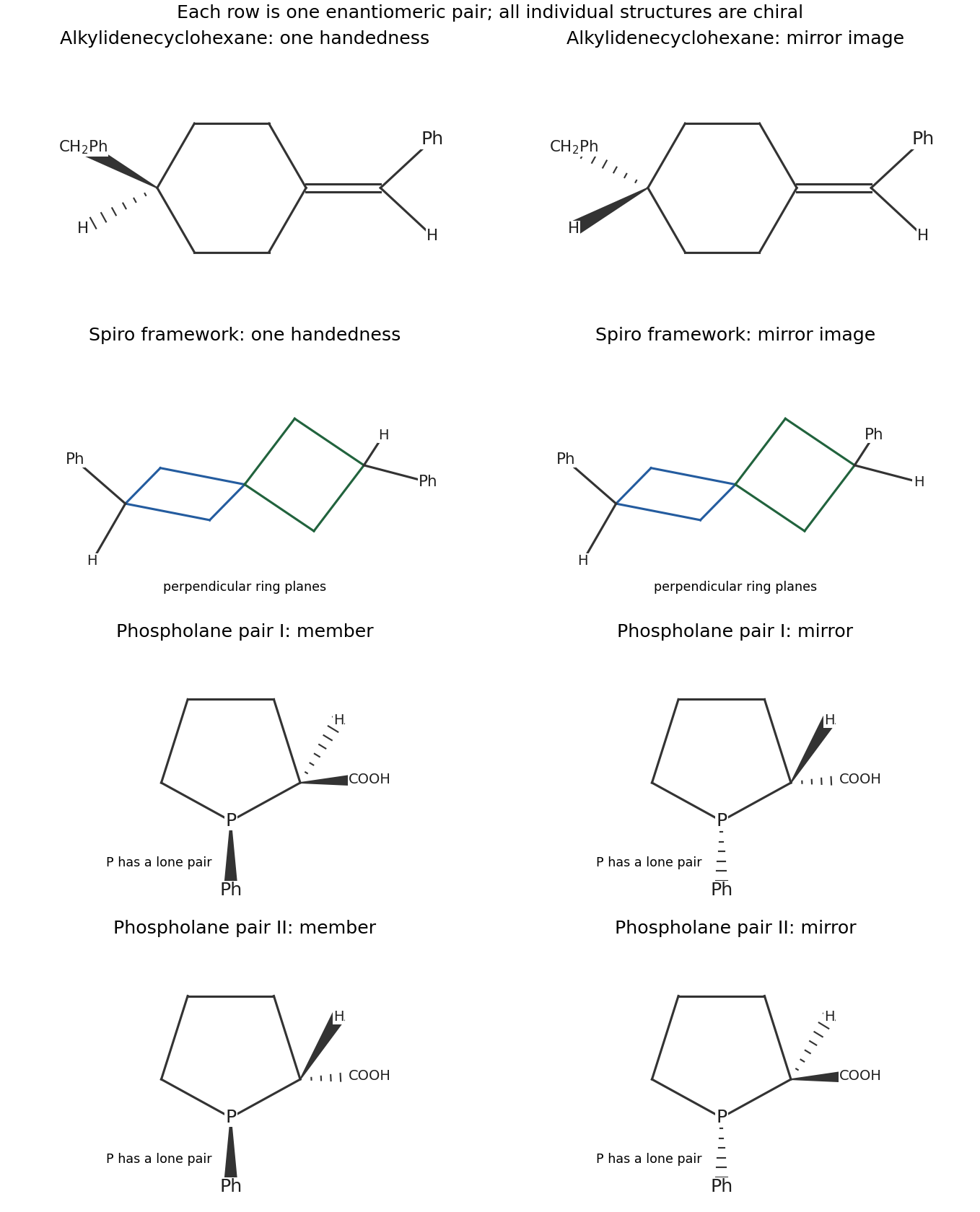
There are two, two and four stereoisomers, respectively; all eight individual stereoisomers are chiral. The drawings below give the mirror pairs. Solid and hashed wedges distinguish opposite faces; ordinary changes between conformers are not counted again.
- The benzyl-substituted alkylidenecyclohexane has an axial stereogenic element. At one end the exocyclic alkene presents Ph and H; at the other end the substituted ring carbon presents benzyl and H. The ring constrains the intervening paths, so exchanging one end pair gives the nonsuperposable mirror image. There is one enantiomeric pair, rather than an independent ordinary pair multiplied by a carbon-center count.
- The diphenylspiro compound also has one axial chirality. The two four-membered rings occupy different, approximately perpendicular planes. Their remote Ph/H substitutions distinguish the two handed arrangements. It gives one enantiomeric pair and no meso form. axial chirality of this spiro framework is experimentally established, for example by resolution of its 2,6-dicarboxylic-acid derivatives.[ref]Enantiopure spiro[3.3]heptane-2,6-dicarboxylic acid by Hong-Zhi Tang and others. Abstract, isolation of enantiopure spiro derivatives
- The phospholane has a stereogenic carbon at the COOH-bearing position and a pyramidal phosphorus stereocenter. The phosphorus has three different carbon ligands and a lone pair: its two ring paths differ because only one encounters the substituted carbon immediately. The four configurations are , , and . The first and last form a mirror pair, as do the middle two. carbon and phosphorus cannot be interchanged by a symmetry operation, so there is no meso reduction in the count.
Unlike the usual rapidly inverting trialkylamine, a pyramidal phosphine can retain a phosphorus configuration on an ordinary observational timescale; its two phosphorus configurations must therefore be included.
Both reactions are E2 eliminations requiring an axial chloride and an axial beta hydrogen in an antiperiplanar conformation relative to the C–Cl bond. The reacting C–H bond supplies the alkene bond as the C–Cl bond breaks; hydroxide accepts the proton.
For the trans-1,2 substrate, the low-energy chair has methyl and chlorine both equatorial. ring inversion is needed to place chlorine axial, but this also places methyl axial. The population of the reactive chair is consequently small, explaining the slow reaction. At the methyl-bearing neighboring carbon the axial position is occupied by methyl, not hydrogen. Only the other beta carbon has the needed anti axial H, so elimination gives 3-methylcyclohexene rather than the more substituted alkene.
For the cis substrate, a favorable chair has methyl equatorial and chlorine axial. It can react without paying the axial-methyl penalty, explaining the faster rate. Both adjacent carbons now supply an anti axial hydrogen. Removing the H on the methyl-bearing carbon gives 1-methylcyclohexene, the major product; removing the other gives 3-methylcyclohexene, the minor product. The former has the more substituted double bond.
Thus alkene stability selects between accessible pathways in the cis case, but it cannot create the missing antiperiplanar conformation H in the trans case.
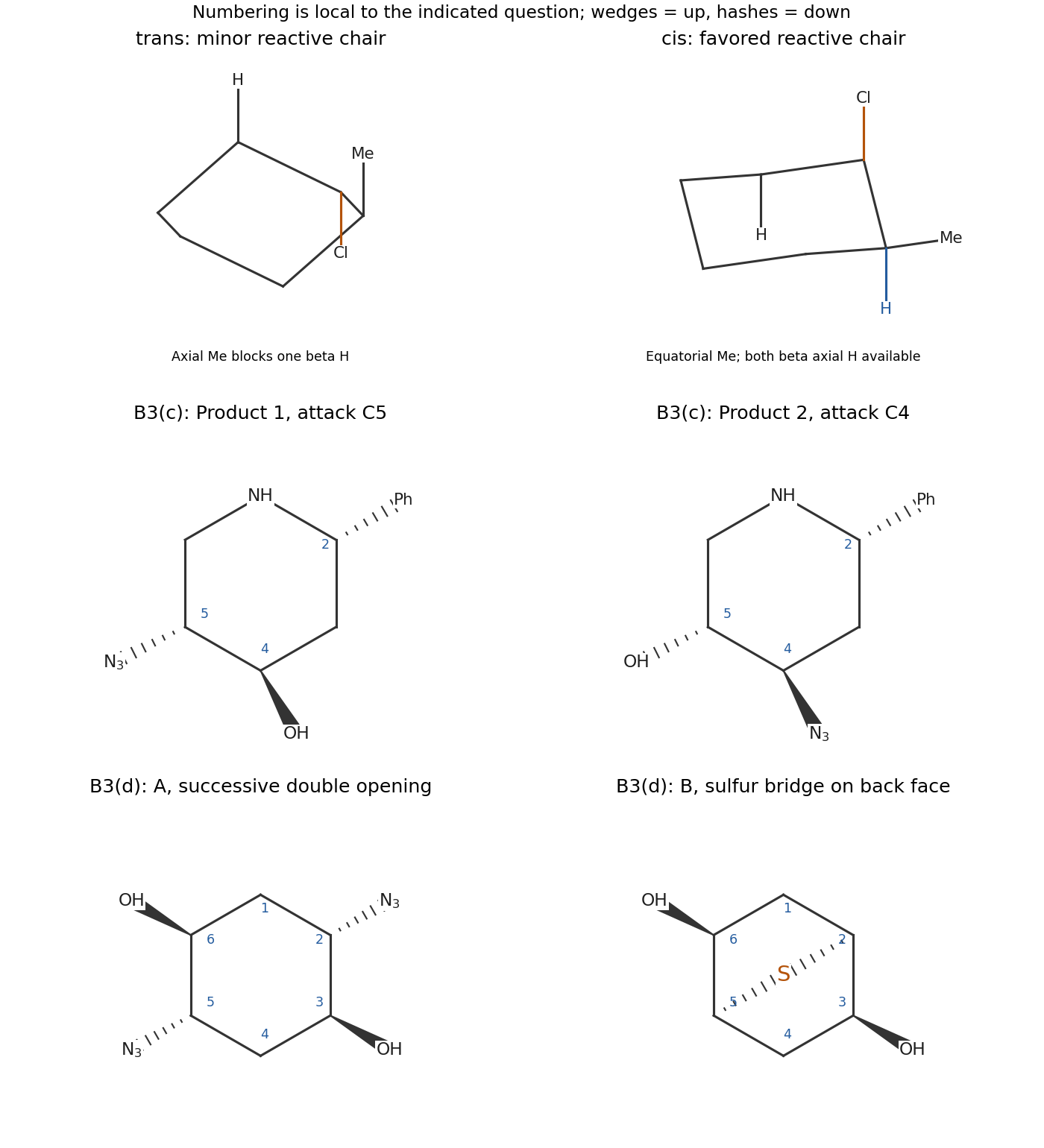


Number the nitrogen N1, the phenyl-bearing carbon C2, and then continue through C3–C6 around the piperidine. Call the solid-wedge epoxide face up; the phenyl group is down in both starting structures. The bulky phenyl group favors a pseudoequatorial orientation.
epoxide opening follows the Fürst-Plattner preference for a chair-like, trans-diaxial opening trajectory. Attack at the two epoxide carbons is not equivalent: the favored route evolves toward an ordinary chair, whereas the alternative demands a less favorable twist/boat-like distortion. Such conformational control of epoxy-2-arylpiperidine opening is supported by synthetic studies.[ref]
1,3-Allylic Strain as a Strategic Diversification Element for Constructing Libraries of Substituted 2-Arylpiperidines by Thomas C. Coombs and others. Scheme 1, chair-like trans-diaxial epoxide opening; applied here with the free-NH conformer
For the first epoxide, azide attacks C5 from down, breaking the C5–O bond. The residual C4–O bond is retained, so work-up gives C5–N3 down and C4–OH up, with the original C2–Ph down. For the second, down-face epoxide, azide attacks C4 from up, leaving C4–N3 up and C5–OH down. These assignments are shown in the middle row of the original stereochemical map.
In each mechanism an azide terminal nitrogen attacks the epoxide carbon, the C–O bonding pair goes to oxygen, and protonation gives the alcohol. Each attacked center inverts, and the azide and OH are trans. The phenyl-bearing center is unchanged. Reversing the epoxide face changes which carbon has the favored axial attack trajectory; a steric rule based only on distance from phenyl misses that conformational effect.
Number the cyclohexane consecutively, putting the top methylene group at C1 and the two original epoxides at C2/C3 and C5/C6. Both epoxide oxygens are up.
A is a diazidocyclohexanediol, with each epoxide replaced by one azide and one alcohol. A standard successive chair-favored opening gives N3 down at C2 and C5, OH up at C3 and C6. This is the 1,4-diazido/1,4-diol connectivity drawn in the bottom row of the original map.
For each opening, azide attacks from the face opposite oxygen, breaking one C–O bond with inversion at the attacked carbon. protonation of the two resulting alkoxides gives the two OH groups. After the first opening, the preferred conformation of the opened portion must be used for the second trans-diaxial opening; simply imposing one unchanged chair on both steps can select the wrong regioisomer.
The elemental change is addition of two groups and two work-up protons to , giving . The formula alone would not distinguish alternative positional isomers; the depicted assignment uses the ordinary successive-opening conformational model.
sulfide first opens one epoxide by backside attack, giving a carbon-bound thiolate and an alkoxide. Using the same numbering, take this first attack at C2: the C2–S bond is down and C3–O remains up.
The attached sulfur still bears a nucleophilic lone pair and negative charge. It attacks C5 of the second epoxide intramolecularly, breaking C5–O and closing a bridge between C2 and C5. Work-up protonates the oxygen anions at C3 and C6. Thus B is 7-thiabicycloheptane-2,5-diol, with both OH groups on the face opposite the sulfur bridge.
Both C–S bonds are formed by inversion at their attacked epoxide carbons. Because the original epoxides are cis, both new C–S bonds point to the same opposite face and one sulfur chemical atom can connect them. The 1,4 bridge gives two five-membered sulfur-containing circuits, unlike the more strained closure between nearby 1,3 positions.
The sulfur therefore replaces two separate external nucleophiles: two epoxides are opened but only one sulfur chemical atom is incorporated. Adding that sulfur and two work-up protons gives , consistent with B.
Articles by others on the same topic
There are currently no matching articles.