A is the predicted major diastereomer. At the carbon adjacent to the ketone, take phenyl as the large group, vinyl as medium, and hydrogen as small. There is no adjacent heteroatom donor that would force a five-membered chelate. The appropriate first model is therefore the non-chelating Felkin-Anh model.
View along the carbonyl-carbon–stereocentre bond. Rotate to place the large alpha phenyl group approximately perpendicular to the carbonyl plane. Of the two resulting approaches opposite that large group, the favourable Bürgi-Dunitz trajectory passes nearer hydrogen rather than vinyl. Propyl transfer to the carbonyl and protonation of its oxygen give the configuration labelled A: in the printed projection the new OH projects forward and the propyl bond backward, while the original vinyl bond remains backward. Rotation used to construct a Newman projection must not be mistaken for inversion of the original stereocentre.
This is a relative-selectivity prediction, not a numerical product ratio. Simple attack on the face that happens to look less crowded in the initial flat drawing is unreliable because the relevant C–C single bond can rotate. B is the competing product from the less favourable approach beside vinyl. The model and its preference for the trajectory beside the small group are described in the institutional treatment.[ref]
Felkin-Anh and Cram Chelate by University of Windsor. pp. 1–2, section 1, nonpolar alpha substituents and the small-group trajectory
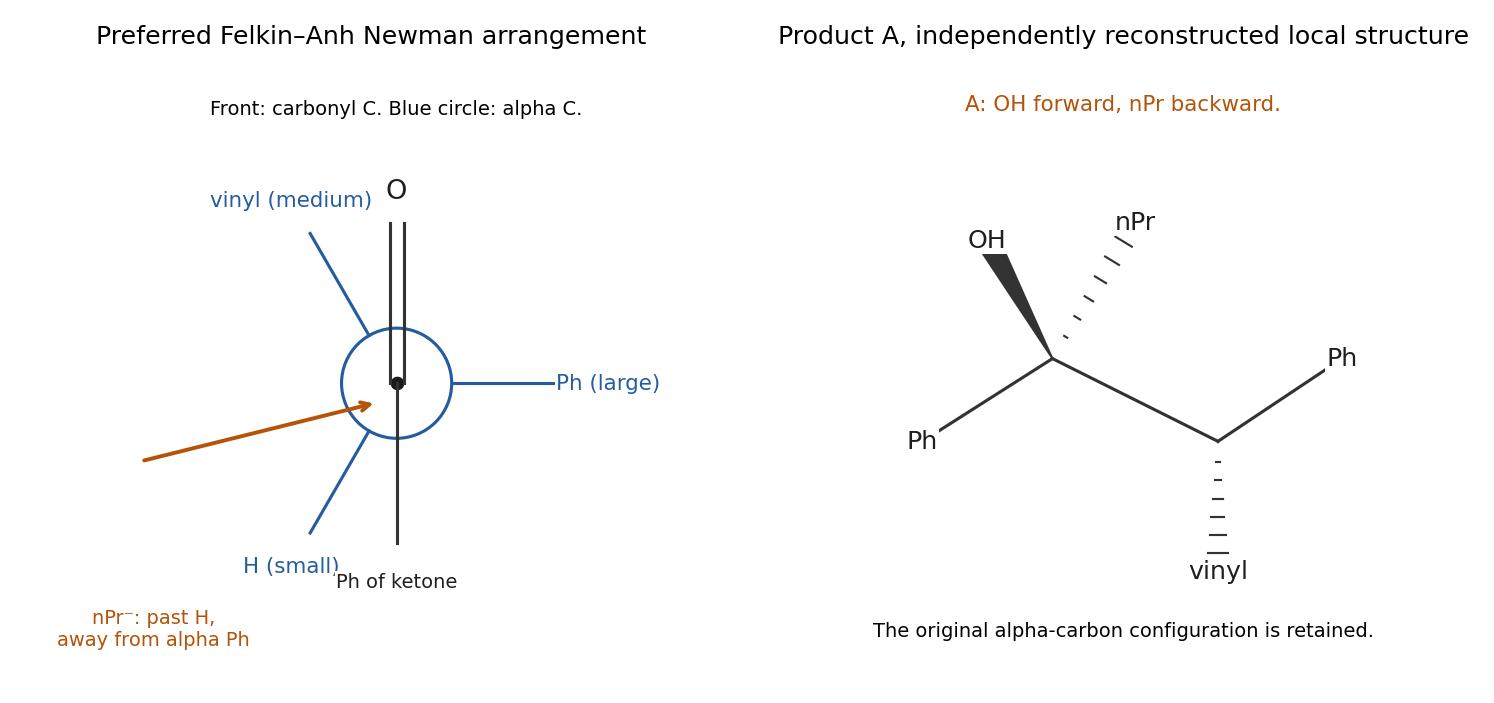
Original Newman construction of the preferred Felkin–Anh approach and the local stereochemistry corresponding to product A
. Details. 
Articles by others on the same topic
There are currently no matching articles.