A is the predicted major diastereomer. At the carbon adjacent to the ketone, take phenyl as the large group, vinyl as medium, and hydrogen as small. There is no adjacent heteroatom donor that would force a five-membered chelate. The appropriate first model is therefore the non-chelating Felkin-Anh model.
View along the carbonyl-carbon–stereocentre bond. Rotate to place the large alpha phenyl group approximately perpendicular to the carbonyl plane. Of the two resulting approaches opposite that large group, the favourable Bürgi-Dunitz trajectory passes nearer hydrogen rather than vinyl. Propyl transfer to the carbonyl and protonation of its oxygen give the configuration labelled A: in the printed projection the new OH projects forward and the propyl bond backward, while the original vinyl bond remains backward. Rotation used to construct a Newman projection must not be mistaken for inversion of the original stereocentre.
This is a relative-selectivity prediction, not a numerical product ratio. Simple attack on the face that happens to look less crowded in the initial flat drawing is unreliable because the relevant C–C single bond can rotate. B is the competing product from the less favourable approach beside vinyl. The model and its preference for the trajectory beside the small group are described in the institutional treatment.[ref]
Felkin-Anh and Cram Chelate by University of Windsor. pp. 1–2, section 1, nonpolar alpha substituents and the small-group trajectory
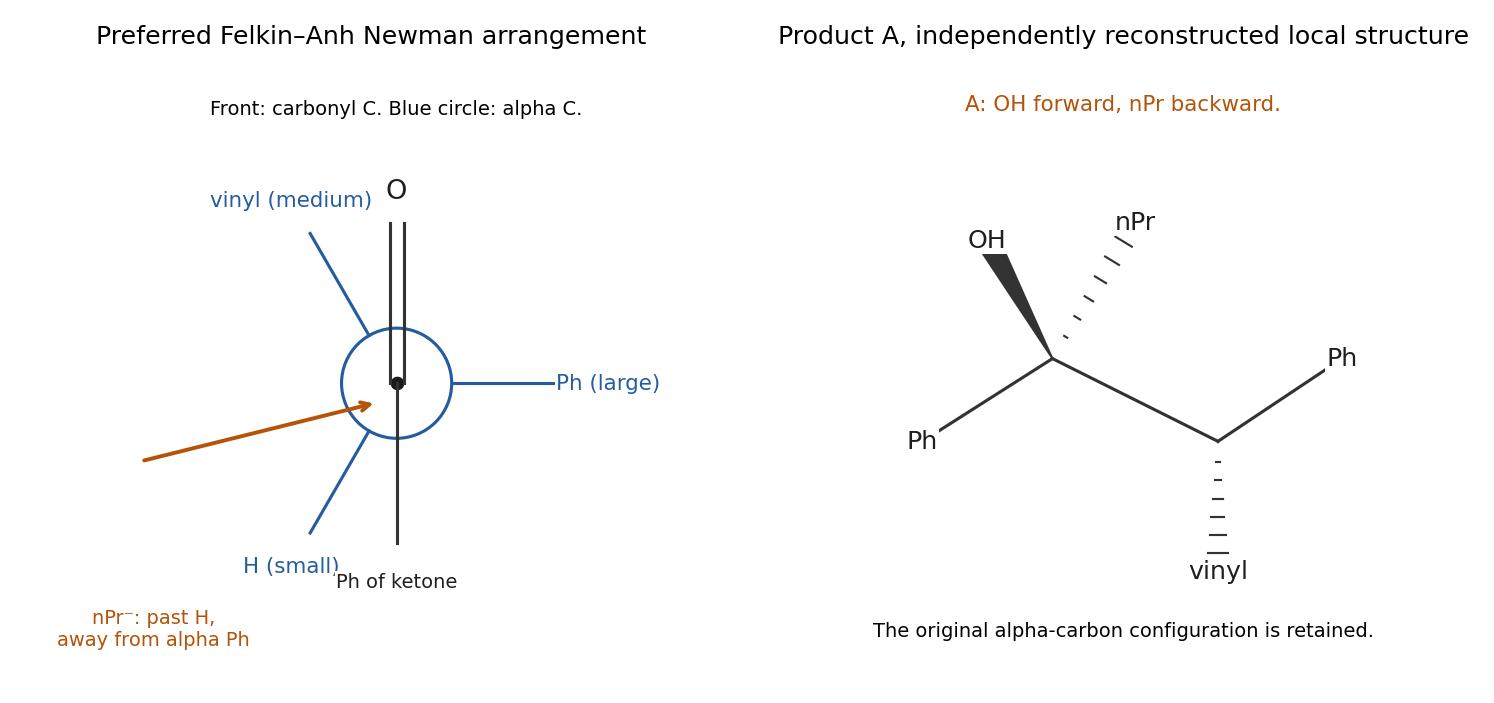
Original Newman construction of the preferred Felkin–Anh approach and the local stereochemistry corresponding to product A
. Details. 
The alkene attacks electrophilic mercury(II), with acetate departure as appropriate, to give a bridged mercurinium ion between the ring carbon and the exocyclic methylene. That bridge is polarized: the more substituted ring carbon can better stabilize developing positive charge than the terminal CH2 carbon. water attacks the ring carbon, opening the mercury bridge there, and deprotonation gives the tertiary alcohol with an exocyclic CH2–HgOAc substituent.
Subsequent sodium-borohydride demercuration replaces the terminal C–Hg bond by C–H. Thus the original exocyclic CH2 becomes Me, and the new OH remains on the substituted ring carbon. The result is Markovnikov hydration of the exocyclic alkene. There is no need for a freely equilibrating tertiary carbocation, and no rearrangement of the carbohydrate carbon skeleton or cleavage of the methyl acetal is required. The question does not require the mercury-stage facial selection or a detailed demercuration mechanism.
protonation activates the oxygen of the anomeric acetal bridge. Cleavage of its bond to the anomeric carbon releases that tether oxygen as the terminal primary alcohol, while the other ring oxygen stabilizes the developing anomeric electrophile by lone pair donation. The resulting oxocarbenium description has a nearly planar reactive anomeric centre; it need not be drawn as a long-lived free carbocation.
methanol attacks that centre, giving a protonated methyl acetal, and deprotonation regenerates acid. The former bridge becomes CH2OH; the anomeric substituent becomes OMe. The other C–O bonds and existing carbon configurations are retained. The ring can adopt a different chair once the bridge constraint is removed, so an apparent movement of substituents in the projection does not imply inversion at all the other carbons.
The depicted anomeric OMe is axial in the product chair. This geometry allows an endocyclic oxygen lone pair to align antiperiplanar to the exocyclic C–OMe bond, providing stabilization associated with the anomeric effect. Acidic conditions also permit cleavage and recapture at the anomeric centre, so selection is not simply backside displacement at an unchanged tetrahedral starting carbon. The anomeric effect rationalizes the specified axial product; the scheme alone gives neither its numerical equilibrium population nor evidence that every other anomer is absent.
triethylamine removes an alpha proton from nitromethane to generate a nitronate population. Its carbon attacks the cyclic ketone carbonyl of E, forming a new C–CH2NO2 bond while the C=O pi pair moves onto oxygen. protonation by triethylammonium or another proton donor gives the tertiary alcohol F and regenerates base. This is a Henry reaction, also called a nitroaldol reaction: the former ketone carbon now bears both OH and CH2NO2.
The nitro group remains attached to its original nitromethane carbon; attack through oxygen would give a different connectivity. The methyl acetal and the original alcohol substituents need not be cleaved or displaced. This addition produces the isolated connectivity without requiring dehydration to a nitroalkene. The stated complex mixture is compatible with competing additions or stereoisomers, but the scheme supplies no basis for claiming F is the unique or kinetically dominant product. Only its formation is being explained.
Articles by others on the same topic
There are currently no matching articles.