B and C are the two geometrical ketoxime isomers, formed by replacing the reactive ring C=O with C=N–OH. The separate spiroacetal remains intact. Define as the original ketone carbon, as the adjacent ring path towards the aromatic ring, and as the adjacent path towards the spiroacetal-bearing junction. These are the two carbon substituents directly bonded to , not detachable independent fragments.
In B, N–OH is anti to the bond across C=N; in C, N–OH is anti to . Those geometries predict exactly the respective nitrogen insertions in D and E. Both products have formula : condensation adds NH2OH to and removes H2O. An alternative ring regioisomer or reaction at the protected ketone would not represent the pair of oxime geometrical isomers.
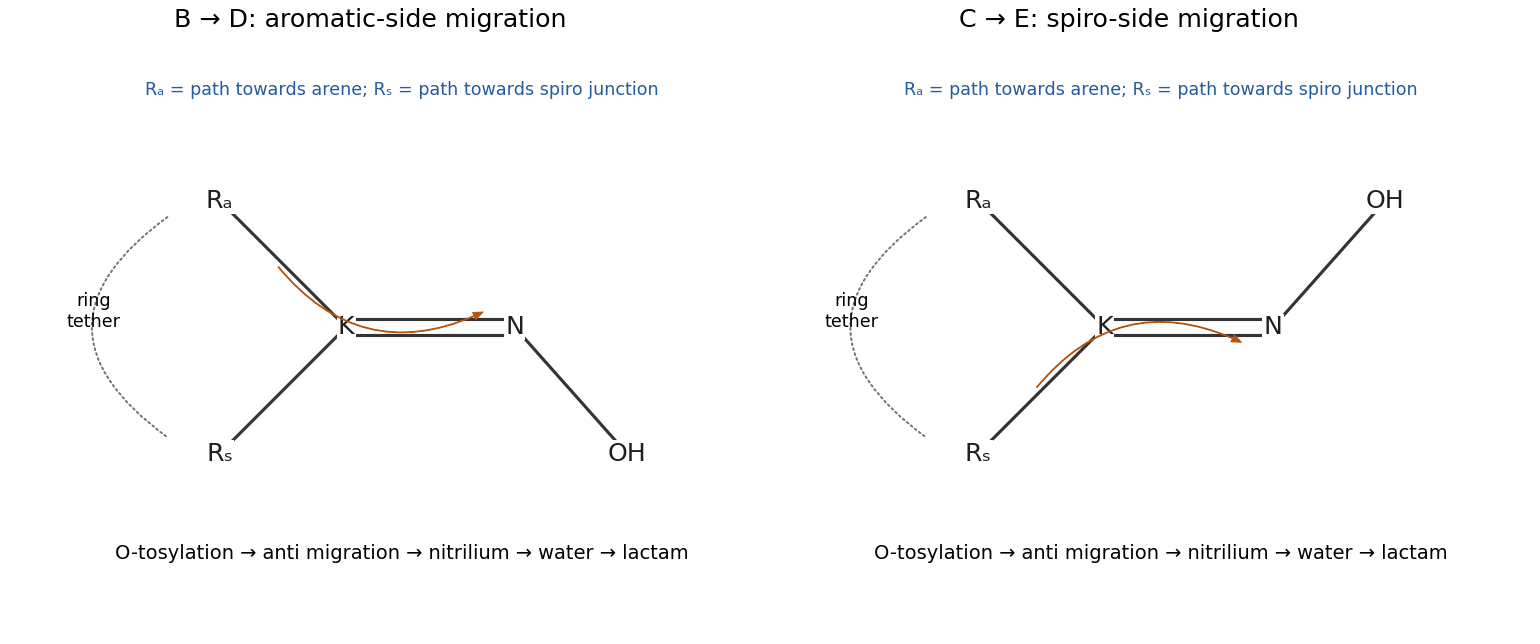
Original local structures of the two ketoximes and their anti-migrating ring bonds; the remaining scaffold joins the two labelled ring paths
. Details. 
Both permitted alternatives follow the same condensation–activation–migration sequence. sodium acetate liberates a useful concentration of hydroxylamine from its hydrochloride while providing a buffered medium. nitrogen of NH2OH attacks the ketone carbonyl; proton transfer gives a carbinolamine. protonation of its carbon-derived OH and loss of water, with nitrogen lone-pair donation, then gives the oxime after deprotonation. The two C=N geometries can be separated.
For the B-to-D route, oxime O-tosylation begins when oxime oxygen attacks sulfur of tosyl chloride and chloride leaves; triethylamine accepts the released proton. The resulting O-tosyl oxime has an excellent leaving group. The bond, anti to N–OTs, migrates to nitrogen while N–O cleaves, giving a ring-expanded nitrilium ion. Its local connectivity is , with the existing scaffold still joining the two paths. water attacks the nitrilium carbon . proton transfers and imidic-acid/amide tautomerization produce D, with nitrogen inserted on the aromatic side of the old carbonyl.
For the C-to-E route, the same O-tosylation activates the other oxime geometry. Now the anti bond is ; its migration gives , and aqueous trapping produces E, with nitrogen inserted on the spiro-junction side. Each Beckmann rearrangement expands the ketone's six-membered ring to a seven-membered lactam. The original carbonyl carbon remains the amide carbonyl carbon; nitrogen is the inserted atom. In this mechanism the ketone oxygen is lost during oxime condensation, the oxime oxygen leaves with the sulfonate group, and water supplies the new amide oxygen.
The C–C bond anti to the activated N–O bond migrates. This is antiperiplanar migration in the Beckmann rearrangement. Donation from that sigma bond into the developing electron deficiency at nitrogen requires the appropriate antiperiplanar geometry. Migration and leaving-group departure are coupled, giving a nitrilium ion rather than an equilibrating free carbon carbocation. B places the aromatic-side bond in the migrating orientation and therefore gives D; C places the spiro-side bond in that orientation and gives E. The two products consequently record the oxime geometries. A rule based only on which group seems intrinsically more electron rich would miss this geometric constraint; retention of configuration in a migrating group is also consistent with concerted bond migration.
Articles by others on the same topic
There are currently no matching articles.