B and C are the two geometrical ketoxime isomers, formed by replacing the reactive ring C=O with C=N–OH. The separate spiroacetal remains intact. Define as the original ketone carbon, as the adjacent ring path towards the aromatic ring, and as the adjacent path towards the spiroacetal-bearing junction. These are the two carbon substituents directly bonded to , not detachable independent fragments.
In B, N–OH is anti to the bond across C=N; in C, N–OH is anti to . Those geometries predict exactly the respective nitrogen insertions in D and E. Both products have formula : condensation adds NH2OH to and removes H2O. An alternative ring regioisomer or reaction at the protected ketone would not represent the pair of oxime geometrical isomers.
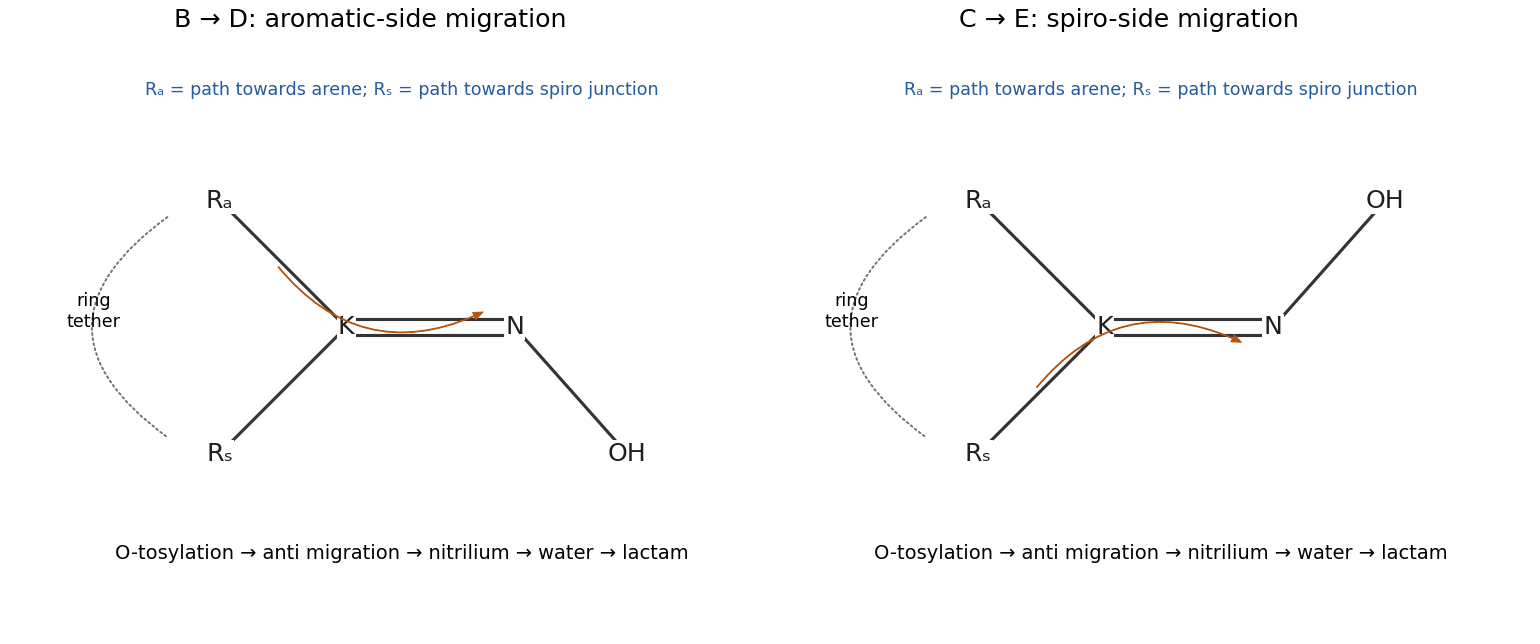
Original local structures of the two ketoximes and their anti-migrating ring bonds; the remaining scaffold joins the two labelled ring paths
. Details. 
Both permitted alternatives follow the same condensation–activation–migration sequence. sodium acetate liberates a useful concentration of hydroxylamine from its hydrochloride while providing a buffered medium. nitrogen of NH2OH attacks the ketone carbonyl; proton transfer gives a carbinolamine. protonation of its carbon-derived OH and loss of water, with nitrogen lone-pair donation, then gives the oxime after deprotonation. The two C=N geometries can be separated.
For the B-to-D route, oxime O-tosylation begins when oxime oxygen attacks sulfur of tosyl chloride and chloride leaves; triethylamine accepts the released proton. The resulting O-tosyl oxime has an excellent leaving group. The bond, anti to N–OTs, migrates to nitrogen while N–O cleaves, giving a ring-expanded nitrilium ion. Its local connectivity is , with the existing scaffold still joining the two paths. water attacks the nitrilium carbon . proton transfers and imidic-acid/amide tautomerization produce D, with nitrogen inserted on the aromatic side of the old carbonyl.
For the C-to-E route, the same O-tosylation activates the other oxime geometry. Now the anti bond is ; its migration gives , and aqueous trapping produces E, with nitrogen inserted on the spiro-junction side. Each Beckmann rearrangement expands the ketone's six-membered ring to a seven-membered lactam. The original carbonyl carbon remains the amide carbonyl carbon; nitrogen is the inserted atom. In this mechanism the ketone oxygen is lost during oxime condensation, the oxime oxygen leaves with the sulfonate group, and water supplies the new amide oxygen.
The C–C bond anti to the activated N–O bond migrates. This is antiperiplanar migration in the Beckmann rearrangement. Donation from that sigma bond into the developing electron deficiency at nitrogen requires the appropriate antiperiplanar geometry. Migration and leaving-group departure are coupled, giving a nitrilium ion rather than an equilibrating free carbon carbocation. B places the aromatic-side bond in the migrating orientation and therefore gives D; C places the spiro-side bond in that orientation and gives E. The two products consequently record the oxime geometries. A rule based only on which group seems intrinsically more electron rich would miss this geometric constraint; retention of configuration in a migrating group is also consistent with concerted bond migration.
The lactol is a cyclic hemiacetal and can open to , retaining its pre-existing alkoxy-bearing stereocentre. Its two anomers lose their anomeric configuration on opening to the planar aldehyde, so both can feed the same addition pathway. A first equivalent of decylmagnesium bromide can be consumed by the free OH, producing decane and a magnesium alkoxide; the excess reagent supplies the carbon nucleophile for addition.
magnesium can coordinate both the aldehyde oxygen and the adjacent benzyloxy oxygen. This produces a five-membered chelate, with ring sequence Mg–O(carbonyl)–C(aldehyde)–C(alpha)–O(benzyloxy), that restricts rotation about the aldehyde–alpha-carbon bond. Decyl attack on the less crowded face, away from the alpha-carbon's hydroxyethyl chain in the chelated arrangement, forms the new C–C bond and a magnesium alkoxide at the former aldehyde carbon. Acidic workup protonates both alkoxides to give G. The OBn bond is retained; it is not displaced by the Grignard reagent.
The product configuration is the one with OBn and the newly formed OH both projecting forward in the specified zigzag chain, while the opposite configuration at the new alcohol carbon is disfavoured. This is the Cram chelation model for an alpha-alkoxy aldehyde, rather than stereochemical memory of the starting lactol OH. Coordination is a mechanistic explanation consistent with MgBr2 and the product; the scheme does not quantify individual organomagnesium aggregates.[ref]
Felkin-Anh and Cram Chelate by University of Windsor. p. 3, section 2, Chelation and Addition–Cram Chelate Rule
The relevant primary synthetic sequence is documented independently.[ref]Highly Stereoselective Asymmetric Total Synthesis of (−)-Jimenezin via Sequential Intramolecular Amide Enolate Alkylation by Thien Nhan Lu and others. 2022, synthetic sequence leading through the protected oxygen heterocycle
Write the reacting terminus as , where includes the pre-existing stereocentres and the intact substituent. ozone undergoes 1,3-dipolar cycloaddition across the terminal alkene to give a molozonide. In a resonance description of ozone as , the alkene pi pair bonds to one terminal oxygen while the other terminal oxygen forms the second C–O bond and the ozone pi bond shifts onto its central oxygen. Cleavage of this unstable primary ozonide produces a carbonyl compound and a carbonyl oxide, which recombine to form the secondary ozonide. Reductive workup breaks the peroxide bonds and gives the carbonyl fragments and formaldehyde.
Excess sodium borohydride also reduces the newly formed aldehyde: hydride attacks its carbonyl carbon, shifting the pi electrons onto oxygen, and the final acidic workup protonates the alkoxide. Thus the retained chain becomes . The terminal alkene carbon becomes formaldehyde and can be reduced to methanol; it is no longer part of the main product. This accounts for the one-carbon shortening of the retained skeleton.
The original amide carbonyl is present in both H and I and is not reduced under the ordinary borohydride workup. The existing stereocenters and benzyl ether are retained. Stopping the mechanism at an aldehyde, or deleting the amide C=O when reading the smaller printed scheme, would give the wrong product. The new terminal alcohol carbon is CH2 and therefore adds no stereocenter.
Articles by others on the same topic
There are currently no matching articles.