The carbon end of a carbonyl ligand has a filled molecular orbital with an outward-facing lobe. Its overlap with a vacant metal orbital of the same axial symmetry gives CO-to-metal sigma donation. Occupied metal orbitals can simultaneously overlap with the empty CO antibonding molecular orbitals, giving metal-to-CO pi backbonding. Two perpendicular pi channels are possible; the schematic represents one. Orbital signs indicate phase, not electric charge.
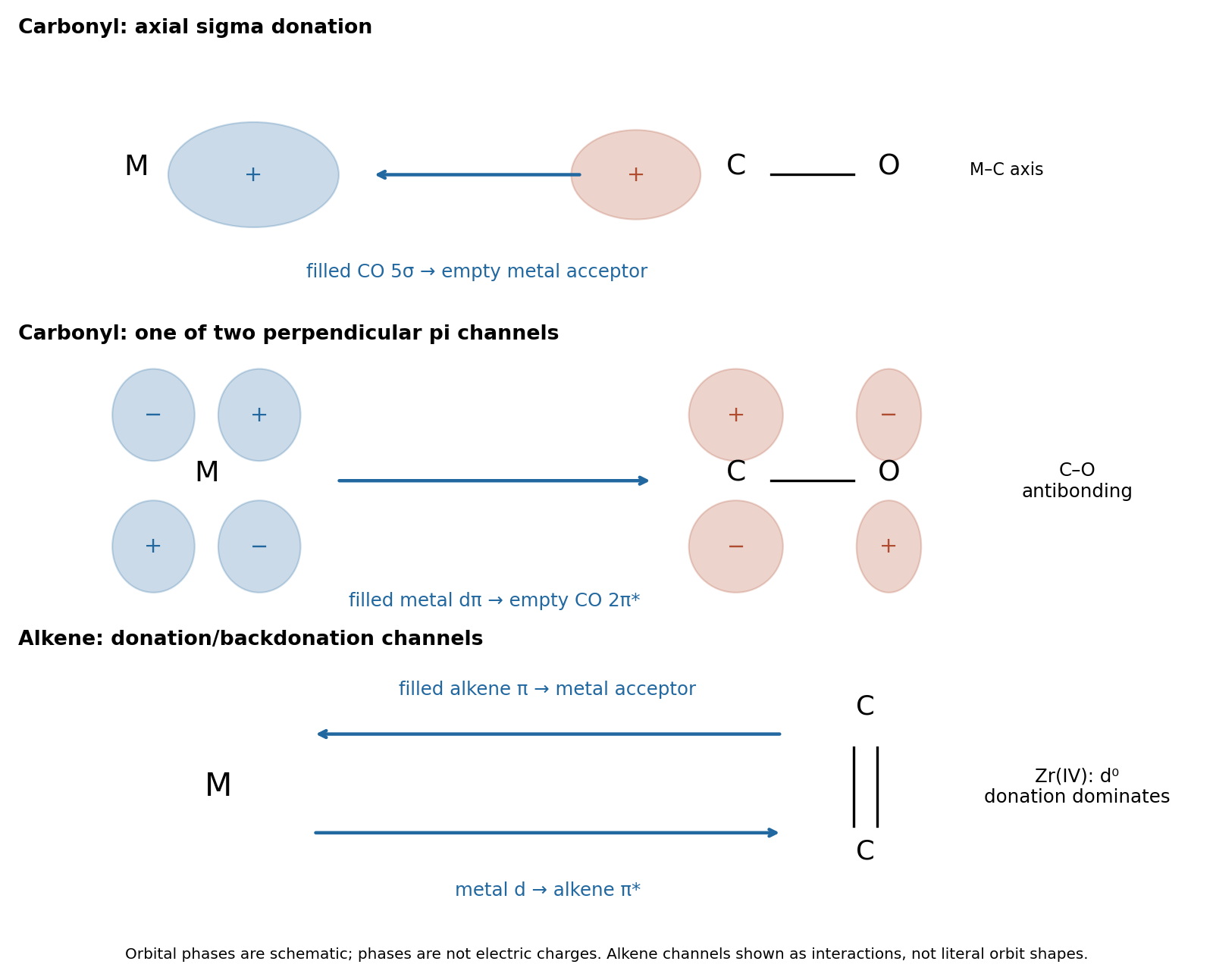

The two interactions reinforce one another: sigma donation transfers density toward the metal, and pi backbonding distributes it into the ligand acceptor orbitals. Both strengthen M–C attachment, while backbonding weakens C–O. Occupation of CO decreases the internal C–O bond order, generally increasing its bond length and lowering its stretching spectroscopic wavenumber. This is why a strongly backbonded carbonyl ligand can have a strong metal–carbon bond and a weakened internal carbon–oxygen bond at the same time.
Articles by others on the same topic
There are currently no matching articles.