The carbon end of a carbonyl ligand has a filled molecular orbital with an outward-facing lobe. Its overlap with a vacant metal orbital of the same axial symmetry gives CO-to-metal sigma donation. Occupied metal orbitals can simultaneously overlap with the empty CO antibonding molecular orbitals, giving metal-to-CO pi backbonding. Two perpendicular pi channels are possible; the schematic represents one. Orbital signs indicate phase, not electric charge.
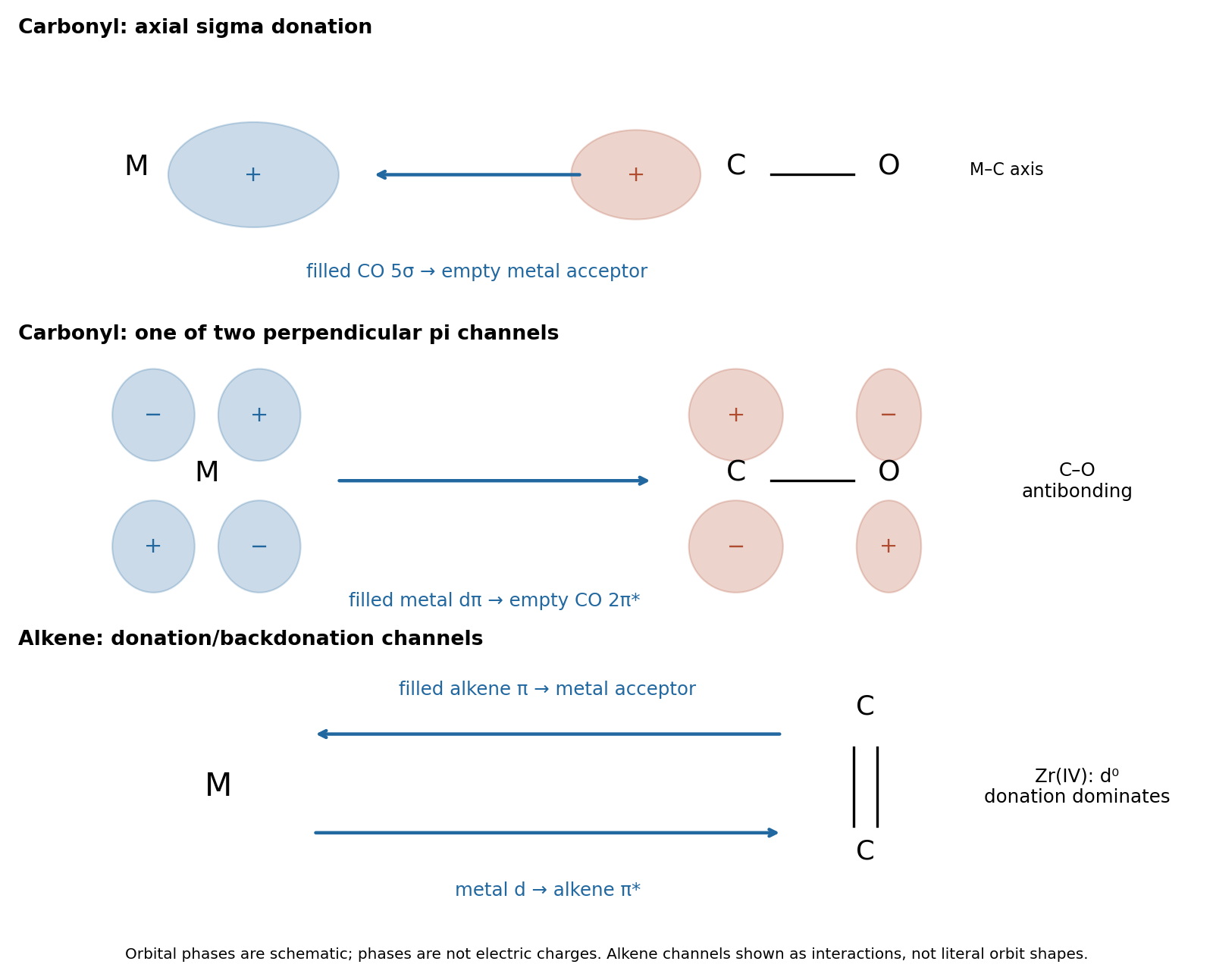
The two interactions reinforce one another: sigma donation transfers density toward the metal, and pi backbonding distributes it into the ligand acceptor orbitals. Both strengthen M–C attachment, while backbonding weakens C–O. Occupation of CO decreases the internal C–O bond order, generally increasing its bond length and lowering its stretching spectroscopic wavenumber. This is why a strongly backbonded carbonyl ligand can have a strong metal–carbon bond and a weakened internal carbon–oxygen bond at the same time.
Place four terminal trifluorophosphine donors on each cobalt and join the cobalt centers by a single metal-metal bond, as in the first panel. The P atoms bind to cobalt; the fluorines remain attached to phosphorus. Each neutral donor supplies two electrons. Neutral electron counting givesThe ionic description is Co(0), , with eight electrons from the four donors and one from the Co–Co bond. A Co–Co single bond supplies the missing electron at each center. No bridging PF is required by this count.
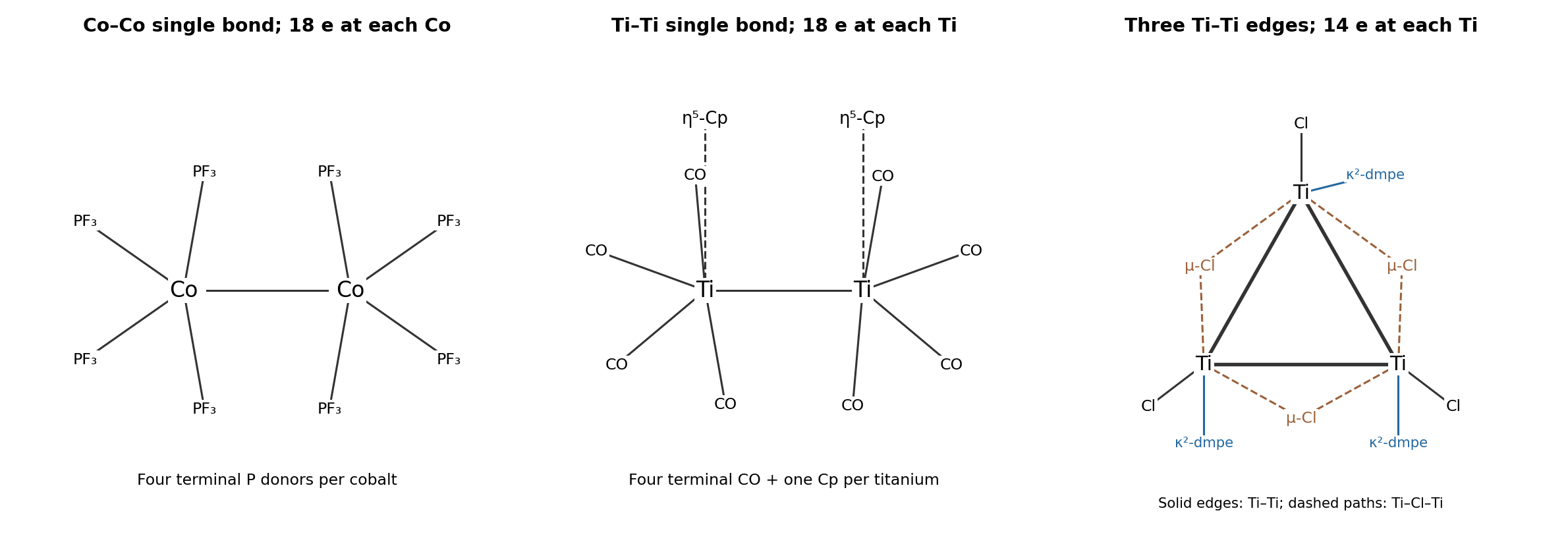
Use an cyclopentadienyl ligand and four terminal carbonyl ligands at each titanium, with a Ti–Ti single metal-metal bond. The middle panel shows this connectivity. Neutral electron counting assigns five electrons to each Cp and givesEquivalently, the two Cp anions require an average oxidation state Ti(I), hence ; ionic counting gives . The formal Ti–Ti bond order is one. The large coordination envelope can make this bond weak and long; reaching 18 electrons is bookkeeping, rather than proof of a short, strong bond. There is no need to invent extra CO bridges or a higher Ti–Ti bond order.
A suitable structure is a triangular Ti metal cluster with one 1,2-Bis(dimethylphosphino)ethane chelate and one terminal chloride at each titanium, and one bridging ligand -Cl spanning each edge. Include a direct Ti–Ti single metal-metal bond along each edge. The last panel distinguishes these direct bonds from the chloride bridges.
The six chlorides have total formal charge , so equivalent centers are Ti(II), . At each titanium the two phosphorus donors supply four electrons, the terminal chloride supplies two, and the two incident chloride bridges each donate a pair in ionic electron counting. Two incident Ti–Ti single bonds supply another two electrons:Each center can contribute one electron to each of its two edge bonds, making three bonds from six metal electrons overall. This is a 14-electron early-metal cluster, not an 18-electron complex. Forcing the 18-electron rule here would invent excessive bond orders. chloride bridges donate to more than one center, so summing local counts is not the same as counting distinct electrons of the whole cluster.
The principal electronic variable is the net population of metal–metal bonding molecular orbitals relative to antibonding molecular orbitals. For otherwise comparable complexes, a larger bond order generally gives a shorter metal-metal bond; removing an antibonding electron can shorten a bond even though the total electron count falls. Different orbital symmetries also matter: sigma, pi and delta overlaps respond differently to distance and rotation of the metal fragments.
metal size, oxidation state and radial orbital extent set the underlying distance scale. Comparing a first-row metal with a larger heavier congener does not isolate bond order. Increasing positive charge often contracts the metal orbitals, but can also change electron occupancy, ligand binding and electrostatic interactions. The ligand field and donor/acceptor properties of the surrounding ligands in coordination chemistry determine which metal orbitals remain available for direct bonding and how much density instead participates in pi backbonding.
Finally, the geometry can enforce or oppose the preferred separation. Bridging ligands impose bond-angle and bond-length constraints; bulky substituents produce steric hindrance; crystal packing can perturb the observed distance. A bond length is evidence for bonding only in its electronic and structural context. In particular, two bridges can hold metals close without proving a high direct bond order, while a sterically congested formal single bond can be unusually long.
For the doubly bridged tetracarbonyl, each iron has one terminal carbonyl ligand, two bridging carbonyl ligands and one cyclopentadienyl ligand. Neutral electron counting gives before direct bonding, so a single Fe–Fe bond gives 18 at each iron. For the triply bridged tricarbonyl, each iron instead has before direct bonding; formal completion to 18 requires a double Fe–Fe bond. Equivalently, the total fragment counts before metal–metal bonding are 34 and 32 respectively.The increased direct bond order explains the substantial contraction. The pentamethylcyclopentadienyl ligands also alter steric and electronic effects, and bridge geometry changes, so this is not a controlled measurement of bond order alone. Nevertheless, the markedly shorter distance in the less carbonyl-saturated dimer is consistent with stronger direct Fe–Fe bonding. The isolated triply bridged compound was characterized structurally and magnetically in the primary work.[ref]
Dinuclear, 18-electron species having a triplet ground state: isolation, characterization, and crystal structure of photogenerated (η5-C5Me5)2Fe2(μ-CO)3 by Josephine Paw Blaha and others. 1985, pp. 4561–4562, isolation, crystal structure and triplet assignment
The dimer has two unpaired electrons and a triplet ground state, . Its approximately threefold-symmetric Fe(CO) core supplies a pair of degenerate frontier molecular orbitals. The last two electrons occupy separate members with parallel spins, favored by exchange, rather than pairing in one. A useful qualitative picture is a sigma bond plus two perpendicular, singly occupied pi half-bonds: together these support a formal Fe–Fe double bond while retaining paramagnetism. The spin-only magnetic moment for is ; real moments can include orbital and spin–orbit effects.
The formal 18-electron count does not require every molecular orbital to be doubly occupied. It is therefore compatible with an open-shell dimer. The primary structural/magnetic study establishes this unusual triplet state; an isolated-atom high-spin diagram would not describe the coupled metal–ligand system.[ref]
In the ionic assignment, both tetrahedral anions would require Mn(VII), . Such a high oxidation state is strongly oxidizing and is best supported by strong bonding to oxygen. Short Mn–O bonds combine good orbital overlap with oxygen's resistance to further oxidation. This stabilizes permanganate relative to a hypothetical all-sulfide analogue.
sulfide is larger, more polarizable and much easier to oxidize than oxide. An attempted Mn(VII) sulfide would therefore combine an exceptionally oxidizing metal center with reducing ligands: internal redox can reduce manganese while oxidizing sulfur, for example toward S–S-bonded or elemental sulfur products. The larger sulfur donors also provide less favorable short multiple bonding to the small, highly charged manganese center. The oxygen compound supports Mn(VII); the sulfide combination is redox-incompatible. This predicts instability without requiring a specific unprovided decomposition product.
For an octahedral complex, strong axial sigma donation raises the metal–ligand antibonding -derived orbitals. A hydride is a very strong sigma donor: its occupied orbital overlaps effectively along a metal–ligand axis and has no filled perpendicular p orbitals to act as a conventional pi donor. It can therefore produce a large octahedral splitting by raising relative to .
Triphenylphosphine also gives sigma donation, but its useful acceptor orbitals additionally receive metal pi backbonding. This lowers the metal -derived levels and enlarges their separation from . The acceptors have substantial P–C antibonding character; invoking a dominant phosphorus acceptor is unnecessary. Thus hydride is strong-field principally through sigma bonding, while PPh combines sigma donation with pi acceptance. The spectrochemical series describes the resulting splitting, not just a ranking of ligand basicity.
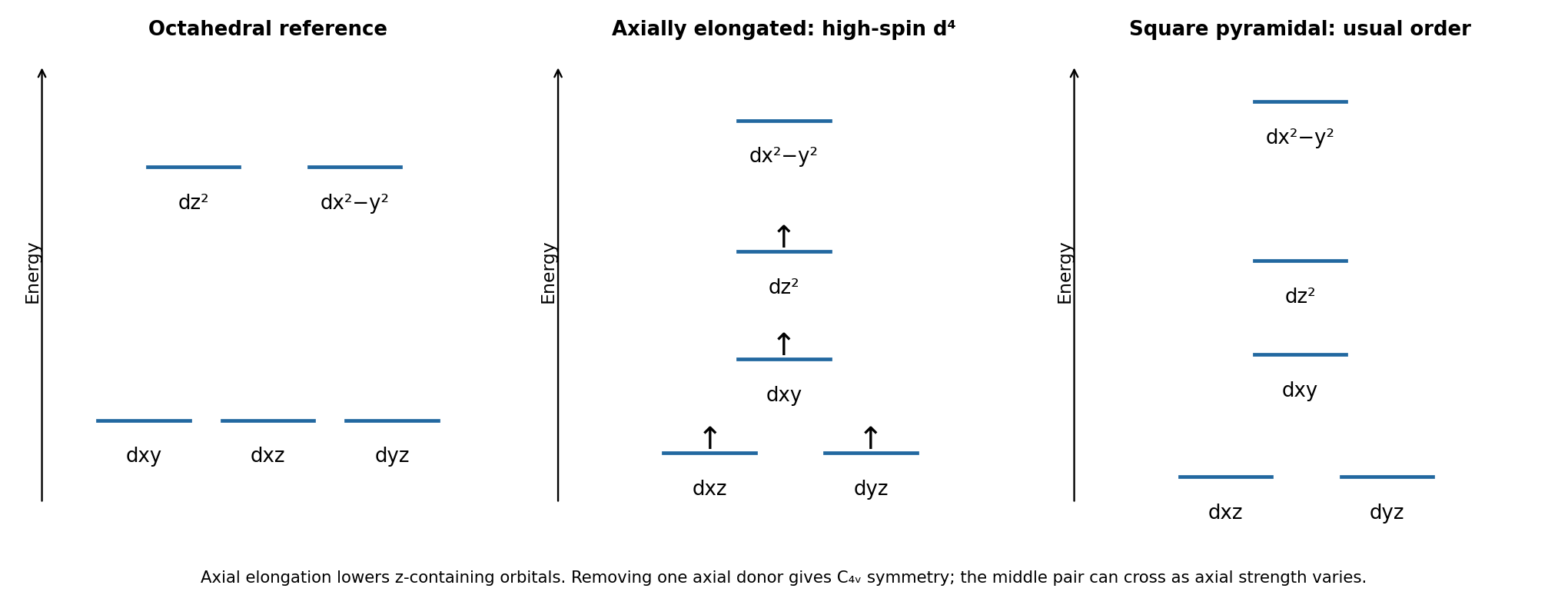
The metal is Cr(II), . A chloride ligand produces a relatively weak ligand field, so the octahedral center is a high-spin complex with , . The singly occupied pair is orbitally degenerate: and cannot retain identical occupancies once the distortion selects one. This is a strong setting for the Jahn-Teller effect.
On tetragonal elongation, the two axial Cr–Cl distances increase. Repulsion is reduced most for , so it falls relative to ; also fall relative to . The single electron occupies the lower -derived level. The electronic stabilization offsets an elastic cost until a distorted equilibrium geometry is reached. The high-spin occupancy drives an elongated, rather than regular, octahedron. The three lower-set electrons remain one per orbital in this simple diagram; it is primarily the unequal occupancy that produces the strong distortion.
The all-carbonyl hydride, HCo(CO), is more acidic. Loss of gives , whose negative charge is stabilized by pi backbonding into four carbonyl ligands. Replacing one CO by triphenyl phosphite reduces the net electron-withdrawing character of the ligand set relative to four carbonyls. The substituted hydride is more electron rich and its conjugate-base anion is less stabilized against protonation.Both conjugate bases have a conventional 18-electron count, so the difference is not a missing-electron argument. It is the relative stabilization of acid and base by the ligands in coordination chemistry. This concerns heterolytic deprotonation, not the homolytic Co–H bond-dissociation energy.
For comparable octahedral environments with the same donor set, the expected qualitative order isAcross comparable first-row ions, the increasing effective attraction and changing metal–ligand distances tend to increase octahedral splitting, giving Mn(II) below Fe(II). Raising the charge on the same metal gives Fe(III) above Fe(II), because the ligand interaction generally strengthens and metal–ligand distances contract. Moving from to more radially extended orbitals gives larger metal–ligand overlap, placing Mo(III) above Fe(III); Rh(III) lies further along the same series and typically gives the larger splitting. The ion Pt(IV) combines the heavier row with high charge and gives the largest splitting here.
This is a matched-environment trend, not an intrinsic list of constants for bare ions. Actual also depends strongly on donor identity, geometry and distance. It would be meaningless to compare an unspecified weak-field tetrahedral compound with a strong-field octahedral compound solely through this ordering.
Start from an octahedral molecular geometry with ligands on , with above . Remove the donor while keeping the other five positions. Loss of axial repulsion lowers substantially; still points directly at four basal donors and remains highest. Loss of an axial donor also lowers the orbitals with dependence relative to . The remaining fourfold axis keeps and degenerate.
The usual qualitative square-pyramidal molecular geometry diagram, shown in the last panel above, is thereforeThe corresponding labels are . Energies can be re-zeroed to the new orbital barycenter after ligand removal. Symmetry fixes the degeneracy and labels, but does not universally fix the separation of and : a weak or distant axial donor can reverse this middle pair on approach to the square-planar limit. The displayed ordering assumes an appreciable fifth axial interaction.
Treat the two donors of 2-Picolylamine as distinct: denotes pyridyl N and denotes amino N. Each ligand must join two adjacent octahedral positions because its five-membered chelate ring cannot span a trans pair. The three sites can either occupy a triangular face, giving a facial isomer, or a meridian containing a trans pair, giving a meridional isomer. Each geometry has a pair of nonsuperposable mirror images. Therefore there are four configurational stereoisomers: fac-, fac-, mer- and mer-. Rapid ring puckering or amine inversion does not introduce additional persistent configurations in this count.
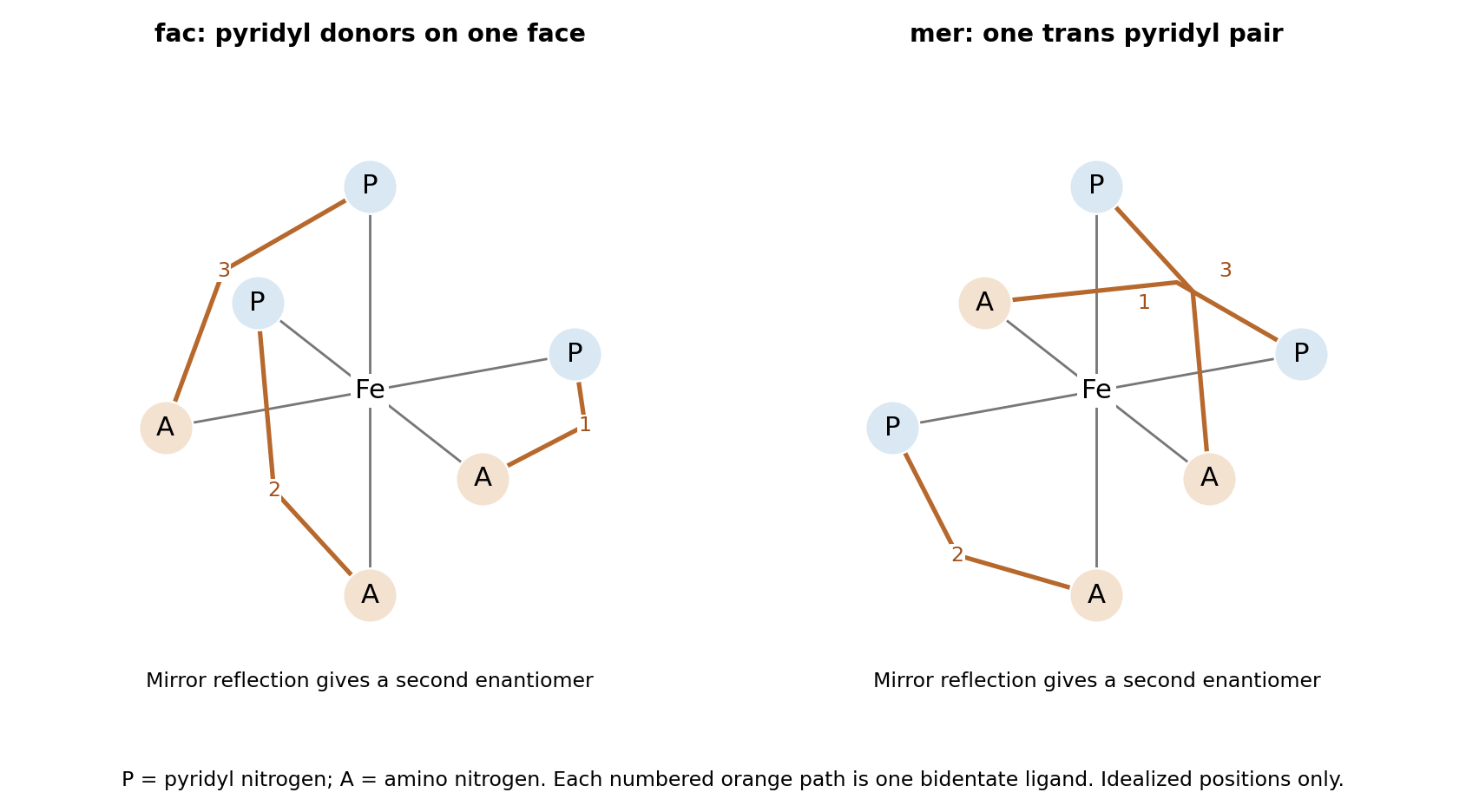
The mer geometry is the reasonable steric prediction for the more stable form. It spreads the bulky pyridyl rings farther apart, allowing one pyridyl–pyridyl trans relationship, whereas the fac geometry groups all three pyridyl donors on one face. This is a qualitative preference, not a proof independent of counterions and solvent: hydrogen bonding and packing can favor the alternative. Primary structures of different salts contain both geometries, so neither should be claimed impossible.[ref]
Spin Crossover in [Fe(2-Picolylamine)3]2+ Adjusted by Organosulfonate Anions by Xin-Hua Zhao and others. 2015, pp. 7857–7867, mer structures in compounds 1 and 2 and fac structure in compound 3
iron remains Fe(II), , in both states; the change is a spin crossover, rather than a change in oxidation state. At the higher temperature the high-spin complex has : four unpaired electrons, , andThis matches the observed moment. At low temperature a low-spin complex with has and shows diamagnetism. Cooling switches high-spin to low-spin . Emptying the metal–ligand antibonding orbitals strengthens and shortens the Fe–N bonds, accounting for the contraction by roughly .
The octahedral splitting and electron pairing energy must be sufficiently close for both states to be accessible. The low-spin state gains electronic energy, while the high-spin state has greater spin degeneracy and usually greater vibrational entropy because of its softer bonds. The resulting Gibbs free energy balance favors high spin at higher temperature. The two endpoint observations do not by themselves specify hysteresis or transition cooperativity; those require a temperature series. Coupled structural and magnetic measurements distinguish this explanation from a mere bond-length anomaly.
The filled alkene molecular orbital donates into a vacant metal acceptor orbital directed toward the center of the C=C bond. In the reverse direction, a filled metal orbital can overlap with the alkene antibonding molecular orbital. These are the donation and pi backbonding components of the Dewar-Chatt-Duncanson model, illustrated in the lower part of the bonding schematic. The alkene is an alkene ligand, attached through both carbons. Increasing backbonding weakens and lengthens C=C and can push the bonding toward a metallacyclopropane description.
Zr(IV) is , so alkene-to-metal donation predominates. It has suitable empty orbitals but no occupied metal set to provide substantial conventional backbonding. An electron-deficient cationic zirconocene can consequently bind and activate an alkene largely through its Lewis acidity; it should not be drawn as a strongly backbonded late-metal alkene merely because its formal coordination mode is .
The trityl cation acts as an electrophile and removes one metal-bound methyl by methyl abstraction. The balanced conversion isThus and , 1,1,1-triphenylethane. Transfer is formally of to carbon, not transfer of a hydride or a methyl radical. zirconium remains Zr(IV), . Ionic electron counting changes from in the dimethyl to at the cation, creating an accessible coordination site. The borate is a weakly coordinating anion, although ion pairing can still occur in solution.
Write for the current growing chain. Propene first binds at the available site of , giving a coordinated alkene adjacent to the metal-bound chain. In the Cossee-Arlman mechanism, the chain migrates to the substituted alkene carbon while the terminal carbon forms the new Zr–C bond:The electron-pair arrows for insertion take the old Zr–R bond toward the substituted alkene carbon and the alkene pi bond toward the new Zr–terminal-carbon bond. A four-center arrangement permits both bonds to change in one migratory insertion; Zr remains Zr(IV). The product again has an accessible site, so coordination and insertion can repeat.
Predominant 1,2 insertion leaves a primary Zr–CH chain end and generates head-to-tail polypropylene. It avoids the more crowded alternative secondary Zr–CH(Me) end and unfavorable methyl contacts with the cyclopentadienyl ligands in the insertion geometry. This explains regioselectivity. An unbridged, unsubstituted zirconocene does not by itself establish a fixed tacticity; the schematic alignment of methyl groups in a polymer drawing is not evidence for an isotactic product.
A plausible explanation is a stronger, less labile Hf–C interaction, reflecting the different bonding of the heavier metal. Breaking and reorganizing that interaction in migratory insertion can raise the propagation barrier and reduce the insertion rate. At the same time, stronger retention of the metal-bound alkyl can suppress beta-hydride elimination or other chain transfer in chain polymerization processes even more strongly.
The chain length depends on competing rates, not on propagation speed alone. In a simple stationary competition,where the denominator includes the operative chain-transfer or chain-stopping rates per active chain. The Hf catalyst can propagate more slowly yet make longer chains if transfer is suppressed by a still larger factor. Slower insertion alone would not explain longer polymers. Distinguishing particular transfer pathways would require polymer end-group analysis and the concentration dependence of molecular mass and polymerization rate.
In borazine, each B and N is approximately trigonal planar. The alternating ring contains a sigma framework with perpendicular p orbitals; the nitrogen lone pairs can donate into the boron acceptor orbitals. Six pi electrons can therefore be distributed around the ring, giving partial B–N multiple-bond character rather than six ordinary isolated single bonds. Equal ring distances are compatible with this symmetric delocalization.
The electronegativity difference makes each B–N bond strongly polar, . The occupied pi orbitals are weighted toward N, and the empty acceptors toward B. In benzene, equivalent carbon centers give much more even pi distribution and strong resistance to addition that destroys the aromatic system. borazine resembles benzene geometrically but has substantially more polarized, more reactive bonding. It presents electrophilic boron sites to nucleophiles and nitrogen donors to Lewis acids. Polar reagents can add across B–N, and water can cleave the ring; benzene ordinarily favors substitution under suitable conditions rather than facile polar addition or hydrolysis. The label “inorganic benzene” should therefore not be interpreted as identical aromatic stabilization or reactivity. nitrogen-bound Lewis-acid adducts and hydrogen-halide additions demonstrate this contrast experimentally.[ref]
The methyl nucleophile attacks an electrophilic ring boron. That boron becomes tetrahedral, bearing its original methyl, the incoming methyl, and its two ring nitrogen neighbors. This interrupts its p-orbital participation, so the metal attaches to the remaining five-atom conjugated segment. is the anionic heptamethylated-ring Cr(CO) complex, paired formally with ; solvent ligation and ion pairing at magnesium are not specified by the spectrum. The original connectivity, with the attacked boron labeled , is shown in the first panel below.
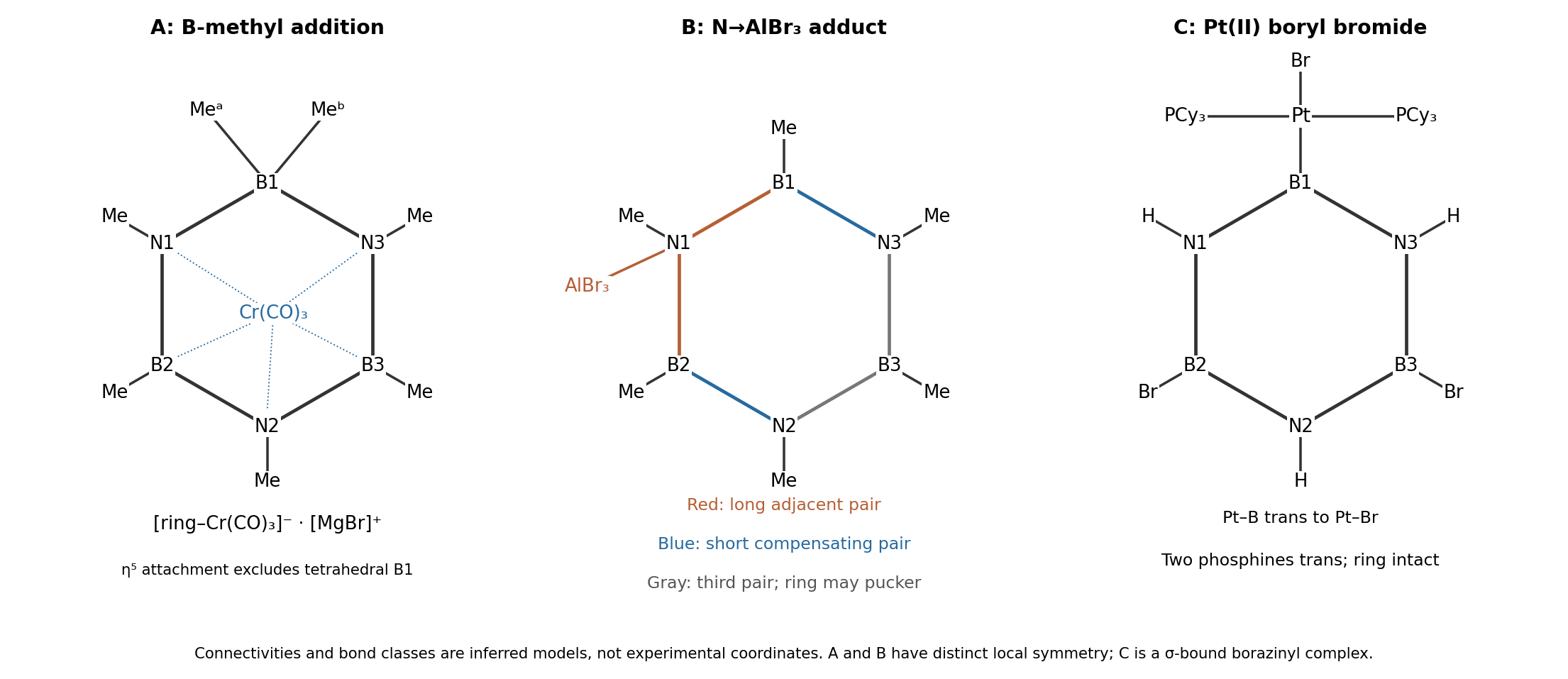
There are seven methyl groups. The two attached to tetrahedral are inequivalent because the chromium-bound face distinguishes their environments: one signal of relative integral one for each. The other two B–Me groups are equivalent to one another, giving a signal of integral two. The two N–Me groups adjacent to form another equivalent pair, while the N–Me opposite is unique. The predicted methyl-group multiplicities are therefore , the same unordered set as the observed ratio. Multiplying by three gives proton integrals totaling 21. This assignment assumes no fast process interchanging the two methyl environments.
The six-electron neutral ring donor has become an anionic six-electron donor, so Cr(0) retains an 18-electron count: . This borazine dearomatization explains both the changed hapticity and the extra methyl without requiring attack at chromium or loss of a carbonyl.
is a 1:1 nitrogen-bound adduct, with at one ring nitrogen. Its lone pair is diverted from N-to-B pi donation into the new coordinate bond. That nitrogen becomes approximately tetrahedral and the ring can pucker. The two B–N bonds adjacent to it lose pi character and lengthen; the neighboring unbound nitrogen atoms can donate more strongly into those borons, shortening the next pair of B–N bonds. The remaining pair forms a third class. The second structural panel marks these three two-bond sets; it represents connectivity and bond classes, not a measured geometry.
In the slow-exchange structure, two boron atoms flank the bound nitrogen and are equivalent to one another, while the third boron is unique. This gives two B environments in a ratio. At room temperature, rapid exchange of the Lewis acid among the three equivalent nitrogen sites averages every boron over the same environments, giving one boron-11 nuclear magnetic resonance signal. Cooling slows exchange relative to the resonance-frequency difference and resolves the two environments.
This is Chemical exchange in NMR, not restoration of equal instantaneous B–N bonds. A spectrum alone cannot distinguish intramolecular migration from reversible dissociation and reassociation; concentration dependence and crossover experiments would test that distinction. Related N-bound borazine adducts have been characterized by diffraction and variable-temperature NMR, supporting the structural logic while not supplying the exact temperature dependence of this particular hexamethyl compound.[ref]
Aluminium and gallium trihalide adducts of 2,4,6-triorganylborazines and the synthesis of triorganylborazinium tetrabromoaluminates by B. Gemünd and others. 2008, pp. 137–142, N-bound adduct structures and variable-temperature NMR
A ring-retaining bromination replaces the three hydridic B–H positions while preserving N–H. Its net stoichiometry isUse controlled bromination and conditions allowing elimination of hydrogen bromide from addition intermediates, rather than identifying the first bromine adduct as the final ring product. Boron-bound hydrogen has hydride-like character because boron is less electronegative than hydrogen; its replacement is consistent with electrophilic attack by bromine. The primary preparative work reports B-tribromoborazines obtained by bromination of borazine and its N-methyl analogue.[ref]
B-Tribromoborazines from the Bromination of Borazine and N-Trimethylborazine by Reed F. Riley and Carl J. Schack. 1964, pp. 1651–1653, bromination and formation of B-tribromoborazines
The product must retain the unsaturated BN ring. Merely adding three HBr molecules to borazine initially gives a saturated hydrogen-halide addition product, not the required formula. Addition followed by suitable elimination is distinct from simply asserting direct B–H protonolysis by HBr.
oxidative addition inserts Pt into one B–Br bond. All three B–Br positions of the starting ring are equivalent, so there is no distinct choice among them before the first substitution. The product is the square-planar Pt(II) boryl bromide , with the two phosphines trans, the Pt–B bond trans to Pt–Br, and the six-membered ring intact. The third panel shows this connectivity. This is a metal–boron sigma bond, not attachment of the whole ring as an pi ligand. Formal electron counting gives Pt(II), , with electrons, appropriate for square-planar coordination. The primary synthesis establishes this trans-bromo(borazinyl) structure.[ref]
Synthesis of η1-borazine complexes of palladium and platinum by Holger Braunschweig and others. 2008, pp. 3531–3534, oxidative addition products and their structural characterization
The electron-rich Pt(0) reacts at the polarized B–Br bond, whose electrophilic boron and departing bromide provide a favorable bond-activation pathway. This accounts for B functionalization without needing cleavage of a ring B–N bond or selection of a nitrogen-bound product. It does not imply that arbitrary N–H activation is impossible under every condition.
Replacing an electronegative bromine substituent by a metal fragment changes the boron's electron demand. Relative to the B–Br sites, the metal-bound boron is less effective at accepting N-to-B pi donation, so its adjacent B–N bonds are expected to have less multiple-bond character and be longer; donation toward the remaining B–Br sites produces compensating unequal ring bonds. The original threefold equivalence is lost. The detailed lengths depend on the full electronic structure; a localized drawing with three rigid alternating double bonds would conceal the redistribution that the unequal lengths reveal.
In the chromium complex, Cr(0) is and receives substantial donation from four carbonyl ligands. Its occupied orbitals can give pi backbonding into the boron-rich acceptor orbitals of the BN ring, while the nitrogen-rich occupied ring orbitals donate to the metal. This favors binding across the ring face, approximately , with all four ring atoms participating. A nearly planar ring maintains the p-orbital alignment needed for that interaction and accounts for comparable Cr–B and Cr–N distances. A four-electron ring donor also gives the useful count .
Ti(IV) in TiCl is and strongly electron deficient. It is a good acceptor for the two nitrogen lone pairs, but has no filled set for comparable backbonding into the boron acceptors. chromium therefore favors a face-bound pi complex, while titanium favors N,N sigma coordination. Donation makes the nitrogen environments more nearly tetrahedral and permits the 2,4-Diazadiboretidine ring to pucker. The borons are not directly bound in the same way, explaining . The distinction follows from electron availability, rather than simply calling every short metal–ring contact a separate ordinary sigma bond.
The reactive fragment is the C6 amidine-like portion of the purine ring; the N9–ribose attachment is retained. Write it locally as , with the rest of the fused ring understood. One productive acid catalysis route protonates N1, making C6 more electrophilic. water then adds at C6 while the C6=N1 pi electrons move onto N1. Subsequent proton transfers generate a carbinolamine and then a protonated amino leaving group:These are local bonding fragments: C6 retains its bond to the adjoining ring carbon at every step. In the addition step, an oxygen lone pair forms C6–O and the C6=N1 pi bond opens. During collapse, an oxygen lone pair reforms C6=O and the C6–N6 bond breaks toward the departing nitrogen. Solvent mediates each proton transfer; no direct unsupported transfer across a long distance is required.
water supplies the new C6 oxygen, and ammonia is expelled after protonation of the leaving group. Final deprotonation gives the lactam form of inosine. In acidic bulk solution the released ammonia is largely trapped as ammonium. The catalytic proton transfers regenerate acid around the substitution cycle; ammonium trapping separately affects the net proton balance. This is hydrolytic deamination, not cleavage of the glycosidic bond.
A glutamic acid residue supplies a carboxyl group whose protonation state can change with the active site environment. The following five schematic contributions are possible in a hypothetical enzyme; they are alternatives and overlapping physical effects, rather than five independently established reactions of this enzyme. In the diagrams is the protein tether, and is the reacting purine carbon.
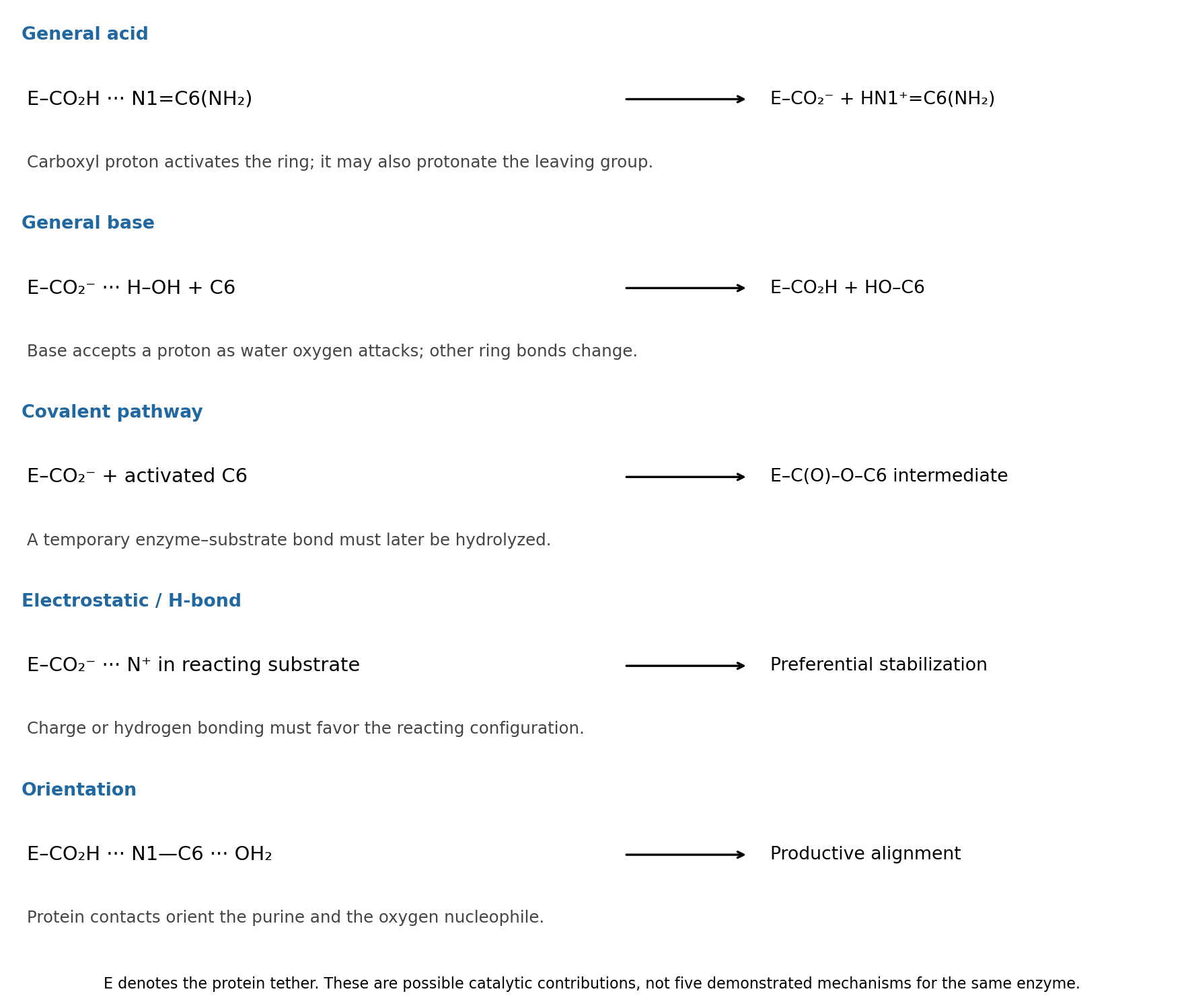
general acid catalysis: . Donation of the carboxyl proton activates the amidine-like C6 center for water attack. The same acid could instead assist the amino leaving group: . These are two locations for general acid catalysis, rather than two different categories.
general base catalysis: , coupled to oxygen attack on C6. Accepting a proton makes water a more effective nucleophile. This does not require an appreciable pool of free hydroxide in bulk solution.
covalent catalysis: a glutamate oxygen can in principle attack activated C6 to form . After addition/elimination replaces the amino group, water must hydrolyze that transient enzyme–substrate bond to release product and regenerate . Such a pathway is a chemically distinct possibility, not established by the given structure.
electrostatic catalysis: the carboxylate can stabilize a developing positive charge, for example in a protonated purine or amino leaving group; a protonated carboxyl can also donate a hydrogen bond to an oxygen developing negative charge. This contributes only if the reacting configuration is stabilized relative to the bound starting state. A carboxylate placed next to an oxyanion without compensating geometry would instead be unfavorable.
proximity and orientation catalysis: donor and acceptor hydrogen bonds can hold the purine and attacking water in a productive arrangement, schematically . Binding reduces unproductive orientations and can distort the substrate toward a reactive geometry. This last contribution is sometimes described through substrate binding or strain; a binding interaction is not automatically catalytic unless it improves access to the transition state.
The zinc ion is coordinated by protein donors and a water oxygen placed near the reacting C6 center. Zinc acts as a Lewis acid that activates and positions water. Its positive charge withdraws electron density from oxygen, lowers the effective p of coordinated water and facilitates formation of the attacking hydroxide, potentially with assistance from a nearby base. The same metal–oxygen interaction can stabilize developing negative charge as the addition intermediate forms. Zinc stays Zn(II); this is metal ion catalysis, not a zinc redox cycle.
The structure identifies a plausible reaction geometry, but a static X-ray model does not by itself establish the water's protonation state, proton-transfer order or the rate-limiting step. Structural work with bound transition-state analogues independently supports a zinc-containing catalytic center.[ref]
Atomic structure of adenosine deaminase complexed with a transition-state analog: understanding catalysis and immunodeficiency mutations by David K. Wilson and others. 1991, pp. 1278–1284, catalytic zinc and the bound transition-state analogue
An appropriate experimental test would compare native enzyme, a metal-depleted preparation and stoichiometrically zinc-reconstituted enzyme, checking retained fold and active enzyme concentration. Loss and recovery of activity with those controls distinguishes a catalytic metal requirement from nonspecific denaturation.His238 contributes strongly to turnover, with a plausible acid/base or electrostatic role near the attacking water. Replacing its imidazole by the methyl side chain of alanine removes both proton-transfer capacity and a positioned polar group, so the large fall in turnover number fits impaired chemical catalysis. A candidate role is acceptance of a proton from zinc-bound water, or stabilization and subsequent proton shuttling around the attacking oxygen.
Little change in the Michaelis constant suggests that the major kinetic defect is not a gross loss of substrate recognition, but is not generally a binding dissociation constant: for the elementary scheme. Nor does reduced uniquely prove that His238 is the initial general base. Purified-protein controls should check fold, zinc occupancy and active concentration. Importantly, primary mouse-enzyme experiments found that His238 mutants could still hydrate a substrate analogue, directly illustrating this mechanistic limitation.[ref]
Site-directed mutagenesis of histidine 238 in mouse adenosine deaminase: substitution of histidine 238 does not impede hydroxylate formation by V. Sideraki and others. 1996, abstract and pp. 15019–15028, purine-riboside hydration by mutant enzyme
An ionizable Asp296 carboxyl group is not essential to the measured catalytic pathway at pH 7. Asparagine retains a similar side-chain size and an amide donor/acceptor pair, while losing the carboxyl group's ordinary acid/base chemistry and negative charge. Preserved kinetics are therefore consistent with a binding or positioning hydrogen bond that survives the conservative substitution, or with a dispensable/redundant contact.
This does not prove that Asp296 makes no interaction in the native enzyme, nor that every substitution at that position would be harmless. The displayed Asp296 contact is also distinct from Asp295, which coordinates zinc; their neighboring residue numbers must not be conflated. Other pH values could expose a contribution hidden by the assay condition.
Glu217 is important for catalysis, most naturally through proton transfer at the purine ring. Changing a glutamic acid residue to glutamine preserves much of the side-chain size and hydrogen-bonding geometry, while removing an ordinary carboxylic acid/base pair. Its placement near N1 makes acid donation there a plausible way to activate C6 for water addition and stabilize the resulting nonaromatic intermediate. The large turnover defect with little change in the Michaelis constant supports that catalytic interpretation, subject to the same and protein-integrity qualifications as above.
The protonated carboxyl drawn at pH 7 need not behave like free glutamate in water: local electrostatics and burial can shift its p, and protonation may change during the cycle. The mutation alone cannot choose between an initially protonated Glu217 acid and a Glu217 residue that first accepts and then relays a proton. Primary mutational work supports catalytic roles for active-site histidine and glutamate groups while explicitly comparing purified enzymes and zinc content.[ref]
Mutational analysis of active site residues of human adenosine deaminase by D. Bhaumik and others. 1993, pp. 5464–5470, kinetic and zinc-content comparisons
The oxygen installed at C6 is derived from solvent water. An attacking zinc-bound water or hydroxide therefore provides the straightforward explanation of the oxygen-18 label. The result supports hydrolytic addition rather than direct oxygen transfer from a pre-existing protein carboxyl group as the sole oxygen source.
It does not by itself establish the identity of the base, the timing of proton transfers, or exclusion of a transient covalent enzyme intermediate: water could introduce the labeled oxygen during breakdown of such an intermediate. Product oxygen exchange must also be excluded. Incubate preformed unlabeled inosine in labeled water with and without enzyme, and use early-time quenched reactions to compare incorporation with product formation. These controls test whether labeling reports the formation step rather than later exchange.
A chemically coherent mechanism combines zinc-activated water addition with a proton relay involving His238 and Glu217. In a simple route consistent with the displayed contacts, neutral His238 accepts a proton from zinc-bound water while protonated Glu217 donates to substrate N1. These transfers can be coupled to the bond-forming event rather than requiring accumulation of a free, doubly activated substrate. Zinc-bound hydroxide attacks C6; the C6=N1 pi electrons move onto N1, yielding the tetrahedral C6 intermediate bearing OH and NH while N1 bears H.
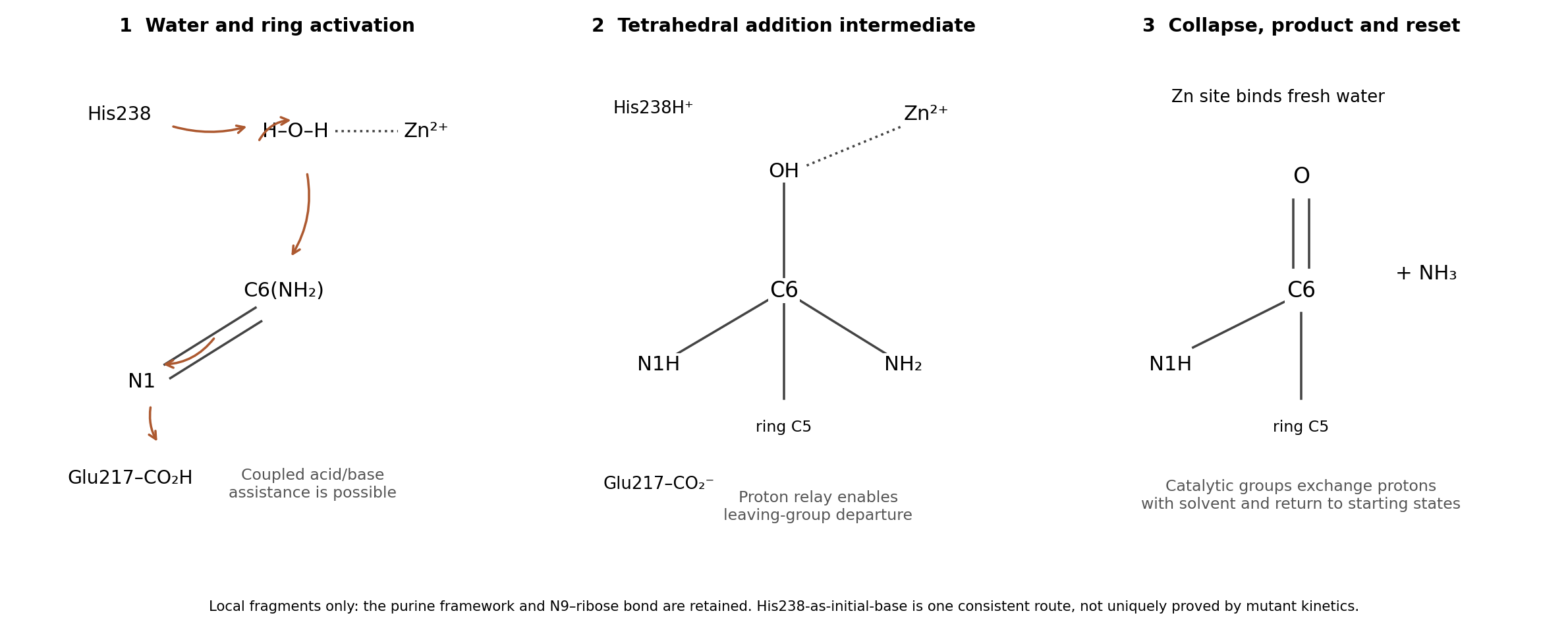


Next, the exocyclic amino group receives a proton, through His238, Glu217 and/or intervening water as permitted by the changing geometry. The oxygen is deprotonated as it forms the C6 carbonyl, and the C6–N6 bond cleaves to release ammonia. These transfers can be coupled in the collapse step, avoiding expulsion of . Zinc stabilizes the reacting oxygen and the organized intermediate; the ring regains conjugation in the inosine product. Product dissociation, fresh water binding and proton exchange with solvent reset the catalytic groups.
The core result is zinc-assisted addition–elimination, with acid/base proton transfers and water supplying C6 oxygen. The contributions are metal ion catalysis, general base catalysis, general acid catalysis, electrostatic catalysis and proximity and orientation catalysis. The proposed route does not require covalent catalysis by a protein side chain: a substrate–water C–O bond is not an enzyme–substrate covalent linkage. Asp296 can retain a structural hydrogen-bonding role without acting as an indispensable acid/base.
The data establish the importance of His238 and Glu217 but do not uniquely assign the entire proton relay. In particular, an alternative has Glu217 first deprotonate water and then deliver that proton to N1, with His238 assisting hydroxide stabilization and later amino-group protonation. The primary observation that His238 substitution need not abolish analogue hydration cautions against calling its initial-base role proven.[ref]
Site-directed mutagenesis of histidine 238 in mouse adenosine deaminase: substitution of histidine 238 does not impede hydroxylate formation by V. Sideraki and others. 1996, pp. 15019–15028, retained hydroxylate formation and proposed electrostatic contribution
pH-rate profiles, solvent isotope effects and time-resolved intermediate experiments would discriminate these refinements. The diagram is a proposed catalytic route, not a structure directly observed by the crystal experiment. Articles by others on the same topic
There are currently no matching articles.