The carbon end of a carbonyl ligand has a filled molecular orbital with an outward-facing lobe. Its overlap with a vacant metal orbital of the same axial symmetry gives CO-to-metal sigma donation. Occupied metal orbitals can simultaneously overlap with the empty CO antibonding molecular orbitals, giving metal-to-CO pi backbonding. Two perpendicular pi channels are possible; the schematic represents one. Orbital signs indicate phase, not electric charge.
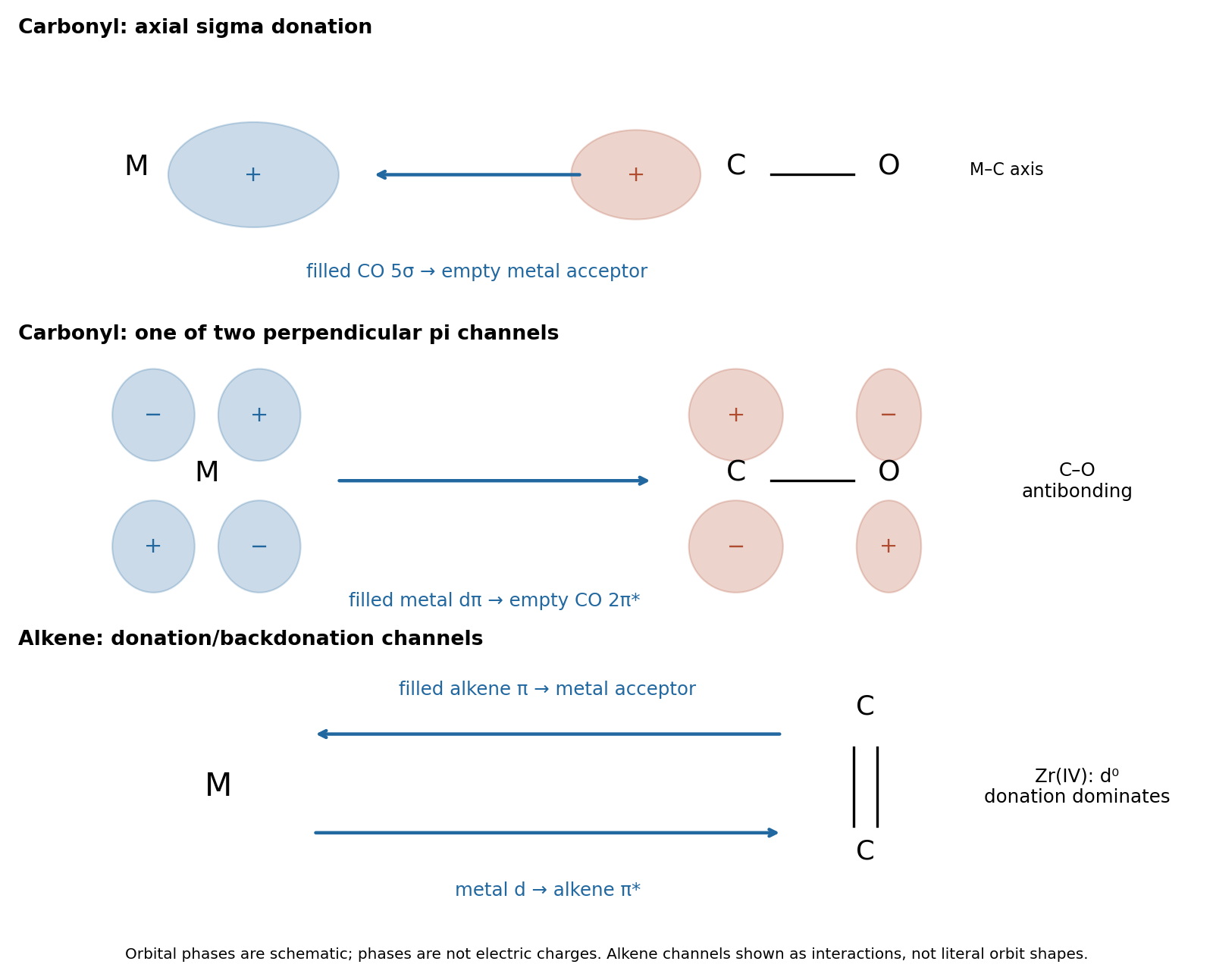
The two interactions reinforce one another: sigma donation transfers density toward the metal, and pi backbonding distributes it into the ligand acceptor orbitals. Both strengthen M–C attachment, while backbonding weakens C–O. Occupation of CO decreases the internal C–O bond order, generally increasing its bond length and lowering its stretching spectroscopic wavenumber. This is why a strongly backbonded carbonyl ligand can have a strong metal–carbon bond and a weakened internal carbon–oxygen bond at the same time.
Place four terminal trifluorophosphine donors on each cobalt and join the cobalt centers by a single metal-metal bond, as in the first panel. The P atoms bind to cobalt; the fluorines remain attached to phosphorus. Each neutral donor supplies two electrons. Neutral electron counting givesThe ionic description is Co(0), , with eight electrons from the four donors and one from the Co–Co bond. A Co–Co single bond supplies the missing electron at each center. No bridging PF is required by this count.
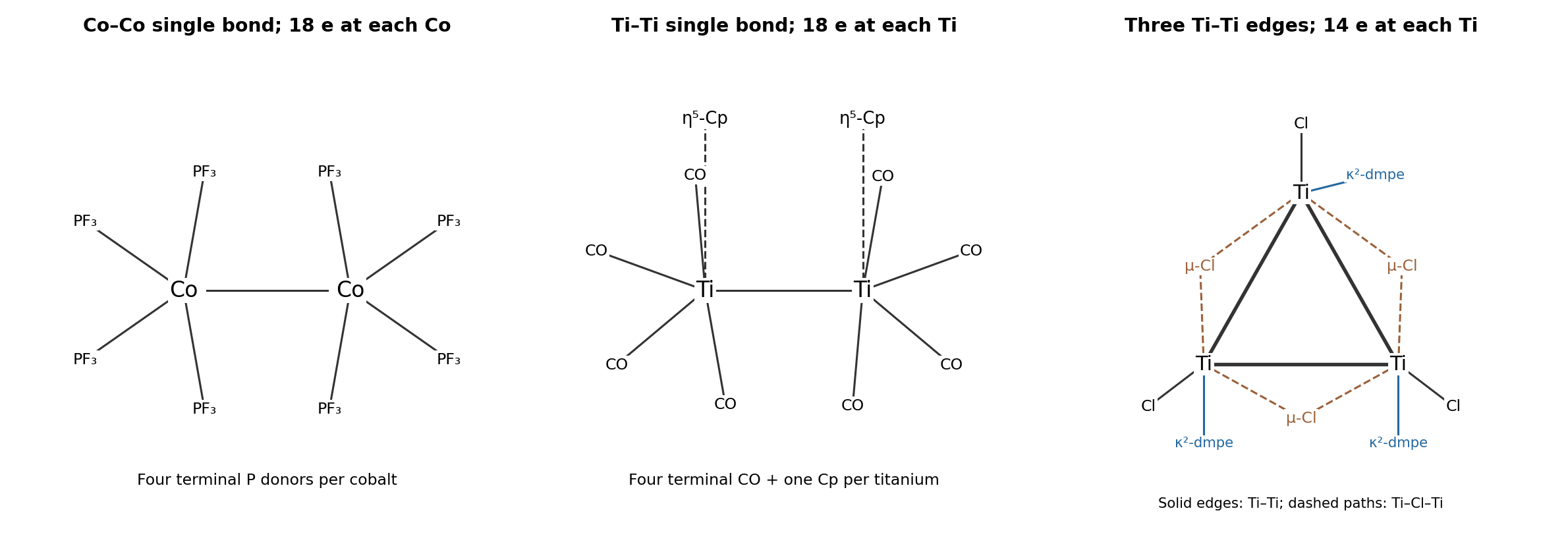


Use an cyclopentadienyl ligand and four terminal carbonyl ligands at each titanium, with a Ti–Ti single metal-metal bond. The middle panel shows this connectivity. Neutral electron counting assigns five electrons to each Cp and givesEquivalently, the two Cp anions require an average oxidation state Ti(I), hence ; ionic counting gives . The formal Ti–Ti bond order is one. The large coordination envelope can make this bond weak and long; reaching 18 electrons is bookkeeping, rather than proof of a short, strong bond. There is no need to invent extra CO bridges or a higher Ti–Ti bond order.
A suitable structure is a triangular Ti metal cluster with one 1,2-Bis(dimethylphosphino)ethane chelate and one terminal chloride at each titanium, and one bridging ligand -Cl spanning each edge. Include a direct Ti–Ti single metal-metal bond along each edge. The last panel distinguishes these direct bonds from the chloride bridges.
The six chlorides have total formal charge , so equivalent centers are Ti(II), . At each titanium the two phosphorus donors supply four electrons, the terminal chloride supplies two, and the two incident chloride bridges each donate a pair in ionic electron counting. Two incident Ti–Ti single bonds supply another two electrons:Each center can contribute one electron to each of its two edge bonds, making three bonds from six metal electrons overall. This is a 14-electron early-metal cluster, not an 18-electron complex. Forcing the 18-electron rule here would invent excessive bond orders. chloride bridges donate to more than one center, so summing local counts is not the same as counting distinct electrons of the whole cluster.
The principal electronic variable is the net population of metal–metal bonding molecular orbitals relative to antibonding molecular orbitals. For otherwise comparable complexes, a larger bond order generally gives a shorter metal-metal bond; removing an antibonding electron can shorten a bond even though the total electron count falls. Different orbital symmetries also matter: sigma, pi and delta overlaps respond differently to distance and rotation of the metal fragments.
metal size, oxidation state and radial orbital extent set the underlying distance scale. Comparing a first-row metal with a larger heavier congener does not isolate bond order. Increasing positive charge often contracts the metal orbitals, but can also change electron occupancy, ligand binding and electrostatic interactions. The ligand field and donor/acceptor properties of the surrounding ligands in coordination chemistry determine which metal orbitals remain available for direct bonding and how much density instead participates in pi backbonding.
Finally, the geometry can enforce or oppose the preferred separation. Bridging ligands impose bond-angle and bond-length constraints; bulky substituents produce steric hindrance; crystal packing can perturb the observed distance. A bond length is evidence for bonding only in its electronic and structural context. In particular, two bridges can hold metals close without proving a high direct bond order, while a sterically congested formal single bond can be unusually long.
For the doubly bridged tetracarbonyl, each iron has one terminal carbonyl ligand, two bridging carbonyl ligands and one cyclopentadienyl ligand. Neutral electron counting gives before direct bonding, so a single Fe–Fe bond gives 18 at each iron. For the triply bridged tricarbonyl, each iron instead has before direct bonding; formal completion to 18 requires a double Fe–Fe bond. Equivalently, the total fragment counts before metal–metal bonding are 34 and 32 respectively.The increased direct bond order explains the substantial contraction. The pentamethylcyclopentadienyl ligands also alter steric and electronic effects, and bridge geometry changes, so this is not a controlled measurement of bond order alone. Nevertheless, the markedly shorter distance in the less carbonyl-saturated dimer is consistent with stronger direct Fe–Fe bonding. The isolated triply bridged compound was characterized structurally and magnetically in the primary work.[ref]
Dinuclear, 18-electron species having a triplet ground state: isolation, characterization, and crystal structure of photogenerated (η5-C5Me5)2Fe2(μ-CO)3 by Josephine Paw Blaha and others. 1985, pp. 4561–4562, isolation, crystal structure and triplet assignment
The dimer has two unpaired electrons and a triplet ground state, . Its approximately threefold-symmetric Fe(CO) core supplies a pair of degenerate frontier molecular orbitals. The last two electrons occupy separate members with parallel spins, favored by exchange, rather than pairing in one. A useful qualitative picture is a sigma bond plus two perpendicular, singly occupied pi half-bonds: together these support a formal Fe–Fe double bond while retaining paramagnetism. The spin-only magnetic moment for is ; real moments can include orbital and spin–orbit effects.
The formal 18-electron count does not require every molecular orbital to be doubly occupied. It is therefore compatible with an open-shell dimer. The primary structural/magnetic study establishes this unusual triplet state; an isolated-atom high-spin diagram would not describe the coupled metal–ligand system.[ref]
Articles by others on the same topic
There are currently no matching articles.