In the ionic assignment, both tetrahedral anions would require Mn(VII), . Such a high oxidation state is strongly oxidizing and is best supported by strong bonding to oxygen. Short Mn–O bonds combine good orbital overlap with oxygen's resistance to further oxidation. This stabilizes permanganate relative to a hypothetical all-sulfide analogue.
sulfide is larger, more polarizable and much easier to oxidize than oxide. An attempted Mn(VII) sulfide would therefore combine an exceptionally oxidizing metal center with reducing ligands: internal redox can reduce manganese while oxidizing sulfur, for example toward S–S-bonded or elemental sulfur products. The larger sulfur donors also provide less favorable short multiple bonding to the small, highly charged manganese center. The oxygen compound supports Mn(VII); the sulfide combination is redox-incompatible. This predicts instability without requiring a specific unprovided decomposition product.
For an octahedral complex, strong axial sigma donation raises the metal–ligand antibonding -derived orbitals. A hydride is a very strong sigma donor: its occupied orbital overlaps effectively along a metal–ligand axis and has no filled perpendicular p orbitals to act as a conventional pi donor. It can therefore produce a large octahedral splitting by raising relative to .
Triphenylphosphine also gives sigma donation, but its useful acceptor orbitals additionally receive metal pi backbonding. This lowers the metal -derived levels and enlarges their separation from . The acceptors have substantial P–C antibonding character; invoking a dominant phosphorus acceptor is unnecessary. Thus hydride is strong-field principally through sigma bonding, while PPh combines sigma donation with pi acceptance. The spectrochemical series describes the resulting splitting, not just a ranking of ligand basicity.
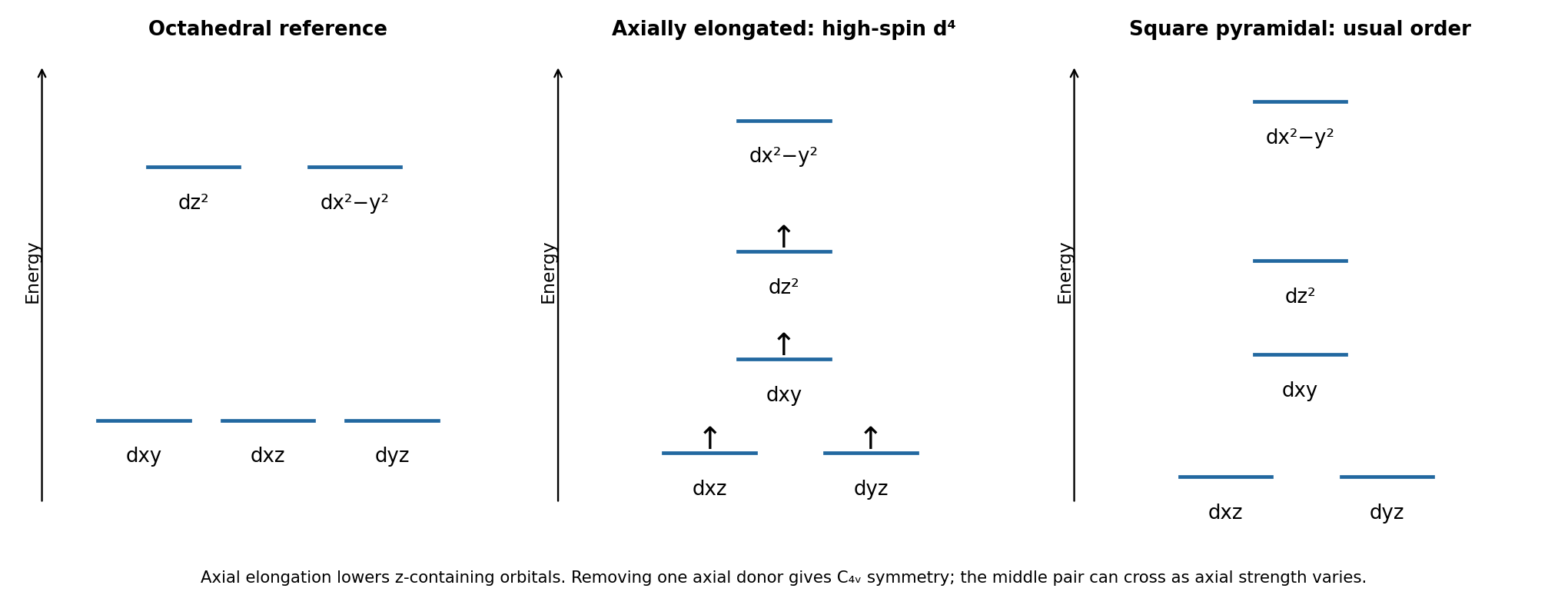
The metal is Cr(II), . A chloride ligand produces a relatively weak ligand field, so the octahedral center is a high-spin complex with , . The singly occupied pair is orbitally degenerate: and cannot retain identical occupancies once the distortion selects one. This is a strong setting for the Jahn-Teller effect.
On tetragonal elongation, the two axial Cr–Cl distances increase. Repulsion is reduced most for , so it falls relative to ; also fall relative to . The single electron occupies the lower -derived level. The electronic stabilization offsets an elastic cost until a distorted equilibrium geometry is reached. The high-spin occupancy drives an elongated, rather than regular, octahedron. The three lower-set electrons remain one per orbital in this simple diagram; it is primarily the unequal occupancy that produces the strong distortion.

The all-carbonyl hydride, HCo(CO), is more acidic. Loss of gives , whose negative charge is stabilized by pi backbonding into four carbonyl ligands. Replacing one CO by triphenyl phosphite reduces the net electron-withdrawing character of the ligand set relative to four carbonyls. The substituted hydride is more electron rich and its conjugate-base anion is less stabilized against protonation.Both conjugate bases have a conventional 18-electron count, so the difference is not a missing-electron argument. It is the relative stabilization of acid and base by the ligands in coordination chemistry. This concerns heterolytic deprotonation, not the homolytic Co–H bond-dissociation energy.
For comparable octahedral environments with the same donor set, the expected qualitative order isAcross comparable first-row ions, the increasing effective attraction and changing metal–ligand distances tend to increase octahedral splitting, giving Mn(II) below Fe(II). Raising the charge on the same metal gives Fe(III) above Fe(II), because the ligand interaction generally strengthens and metal–ligand distances contract. Moving from to more radially extended orbitals gives larger metal–ligand overlap, placing Mo(III) above Fe(III); Rh(III) lies further along the same series and typically gives the larger splitting. The ion Pt(IV) combines the heavier row with high charge and gives the largest splitting here.
This is a matched-environment trend, not an intrinsic list of constants for bare ions. Actual also depends strongly on donor identity, geometry and distance. It would be meaningless to compare an unspecified weak-field tetrahedral compound with a strong-field octahedral compound solely through this ordering.
Start from an octahedral molecular geometry with ligands on , with above . Remove the donor while keeping the other five positions. Loss of axial repulsion lowers substantially; still points directly at four basal donors and remains highest. Loss of an axial donor also lowers the orbitals with dependence relative to . The remaining fourfold axis keeps and degenerate.
The usual qualitative square-pyramidal molecular geometry diagram, shown in the last panel above, is thereforeThe corresponding labels are . Energies can be re-zeroed to the new orbital barycenter after ligand removal. Symmetry fixes the degeneracy and labels, but does not universally fix the separation of and : a weak or distant axial donor can reverse this middle pair on approach to the square-planar limit. The displayed ordering assumes an appreciable fifth axial interaction.
Articles by others on the same topic
There are currently no matching articles.