A bond-dissociation energy specifies the energy needed for a stated dissociation into separated fragments. An energy from the lowest vibrational state, an energy from the bottom of a potential energy well, and a finite-temperature molar dissociation enthalpy require different conventions; do not silently mix them in an electronegativity formula.
Which fragments, in which quantum states, and at which temperature? For a neutral gaseous molecule with a specified two-electron covalent bond, the usual thermochemical convention is homolysis,Each fragment receives one of the two bonding electrons; the dots denote unpaired electrons. The final fragments are isolated from each other, with their own relaxed molecular geometry and specified electronic quantum states. The energy cost includes this relaxation, rather than merely stretching the initial chemical bond while freezing everything else. For a neutral parent, heterolysis instead produces , or the opposite assignment of electric charges; those are different final states and different energies. A value for gaseous neutral fragments cannot be transferred to ions, a chemical solution, or a solid without accounting for those changed conditions.[ref]
bond-dissociation energy. definition of bond-dissociation energy: molar enthalpy for homolysis of a specified molecular entity
The distinction is useful beyond terminology. Pauling electronegativity compares consistently defined bond-dissociation energies; photodissociation can reveal a specified ground-state threshold; a thermal chemical reaction balance requires compatible enthalpies. A threshold is also different from an activation energy: it compares initial and final quantum states, whereas a barrier can obstruct the path between them.
For a diatomic molecule, let be the electronic potential energy at bond length , with the atomic nuclei treated as fixed while finding the electronic energy. Choose zero at infinitely separated chemical atoms in the specified electronic quantum states. If the minimum occurs at , the bond potential-well depth isThe bottom of this curve describes an equilibrium bond length, not an attainable motionless vibrational quantum state. Changing the zero of potential energy shifts both endpoints equally and leaves unchanged. A quantum harmonic oscillator approximates the curve near its minimum but rises without limit, so that local approximation alone cannot supply a dissociation asymptote. A Morse potential supplies both a minimum and a finite separated-fragment limit.[ref]
dissociation energy. definition: subscripts e and 0 distinguish the potential-energy minimum and ground state
The ground-state dissociation energy starts at the lowest vibrational quantum state, with the lowest allowed rotational quantum state and the fragment states explicitly specified. For a diatomic molecule whose fragments are ground-state chemical atoms, omitting any additional rotational correction,where is the vibrational zero-point energy measured upward from the well minimum. The initial molecule already has this energy, so less additional energy is needed to reach the same final limit.[ref]
bond-dissociation energy in theoretical chemistry. definition of bond-dissociation energy in theoretical chemistry: D0 = De minus zero-point vibrational energy
For fragments that are themselves molecules, include their zero-point energies too. Define as the electronic energy difference between separately relaxed products and reactant; then, with consistent rotational conventions,Thus “subtract the parent's zero-point energy” is sufficient for atomic products but generally incomplete for molecular products. An excited final quantum state raises its channel threshold by its excitation energy; that threshold does not become the ground-product just because a detector selects it.
A bond-dissociation enthalpy is the molar enthalpy change for the specified homolysis at temperature , with reactant and products in specified standard states. Its usual units are . The superscript specifies standard states; it does not fix to room temperature.[ref]
Write for each species' molar thermal enthalpy increment. With an energy per parent molecule,Here is the Avogadro constant. The thermal increments include translational kinetic energy, molecular rotation, thermally excited molecular vibration and electronic states when populated, and the contribution to enthalpy. They are additional to the zero-point energies already included in . If values of standard enthalpy of formation at the same are available, Hess's law gives the same quantity as .
Units alone do not identify the convention. Multiplying either or by the Avogadro constant gives molar energy, but does not add thermal enthalpy. One electronvolt per dissociation corresponds to . A spectroscopic wavenumber represents energy , using the Planck constant and speed of light ; corresponds to .[ref]
Fundamental Physical Constants — Complete Listing by National Institute of Standards and Technology and others. SI defining constants h, c, e and Avogadro constant; conversions calculated from them
Take an invented diatomic molecule with a Morse potential, setting the separated-atom energy to zero:Here is an inverse length, the equilibrium bond length, and , with reduced mass . These stipulated parameters describe a simple model, not a measured chemical substance. For the one-dimensional Morse oscillator, energy eigenvalues above the minimum areConsequently,The harmonic estimate is slightly larger than this model's exact zero-point energy. The physical bound-level restriction matters: the quadratic expression is not an infinite ladder of vibrational quantum states.
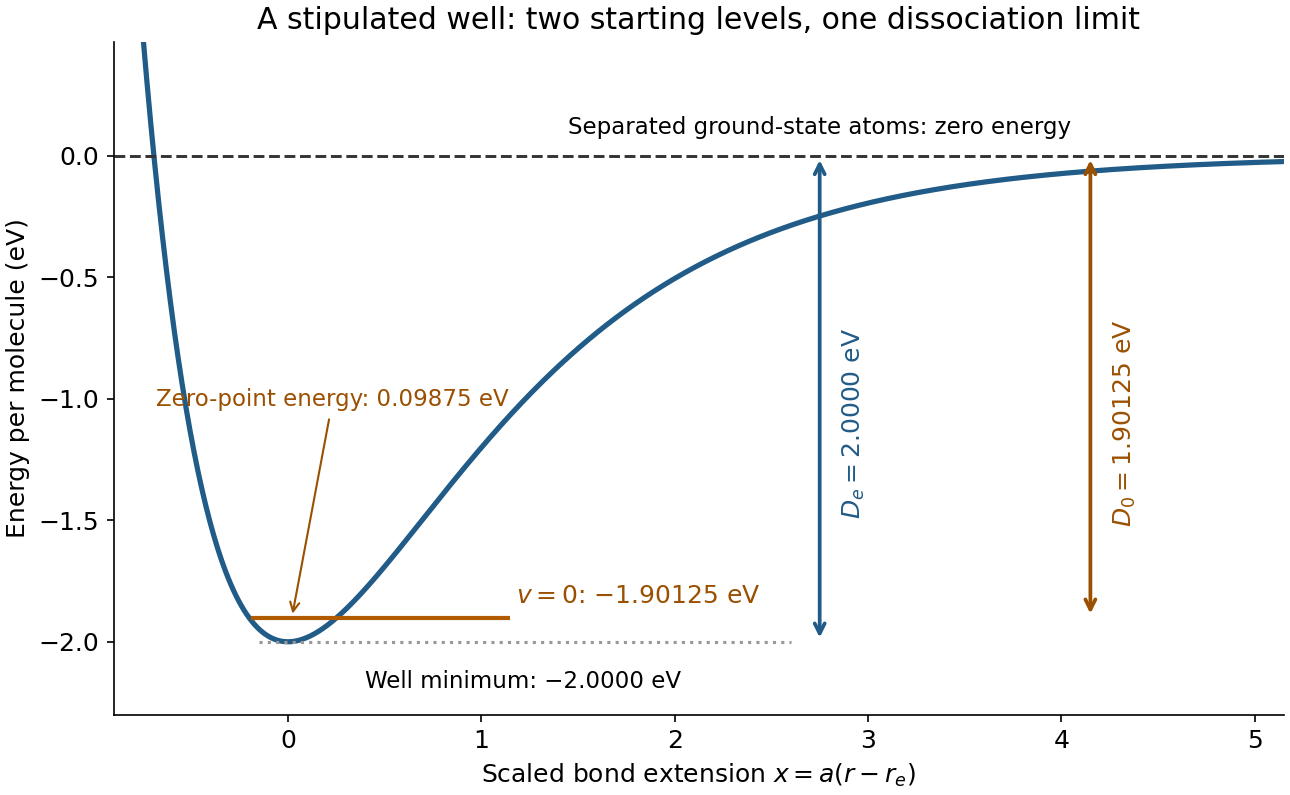
Bond potential-well depth and ground-state dissociation energy reach the same separated-atom limit from different starting energies
. Original stipulated Morse potential with and . The horizontal coordinate is ; the horizontal line is an energy eigenvalue, not a classical trajectory or a measured spectrum. Details.For a separate thermal illustration using this same stipulated , assume an ideal gas, fully active molecular rotation of the parent, negligible thermal molecular vibration, and negligible electronic excitation for all species. Each monatomic product contributes ; the diatomic molecule contributes . Thus the net increment is , with molar gas constant . At ,This last result follows from the stated thermal model, not a universal correction for every chemical bond. Frozen rotations, accessible excited states, different fragment composition, or a condensed phase change the thermal increments.
Equivalent chemical bonds in an intact molecule need not have equal successive bond-dissociation enthalpies. Once one chemical bond is removed, the next reactant has a different electronic quantum state and may relax to a different molecular geometry. The successive steps compare different species. This distinction also explains why a tabulated average chemical bond strength is not necessarily the cost of the first cleavage.[ref]
7.5 Strengths of Ionic and Covalent Bonds. “Bond Strength: Covalent Bonds”, methane paragraph: equivalent initial bonds and unequal sequential breaking costs
For an invented species , stipulate the following gas-phase steps, with all enthalpies at the same temperature and the same standard states:The symbols stand for hypothetical species with consistently chosen electronic states. They are not values for water or another measured molecule. By Hess's law, the total enthalpy of atomization for is ; the arithmetic mean per broken chemical bond is . Neither individual step equals that mean. Nor must the second step be cheaper: here it is deliberately more expensive. An exact sequence sums exactly; substituting averages taken from other molecules generally gives only an estimate.
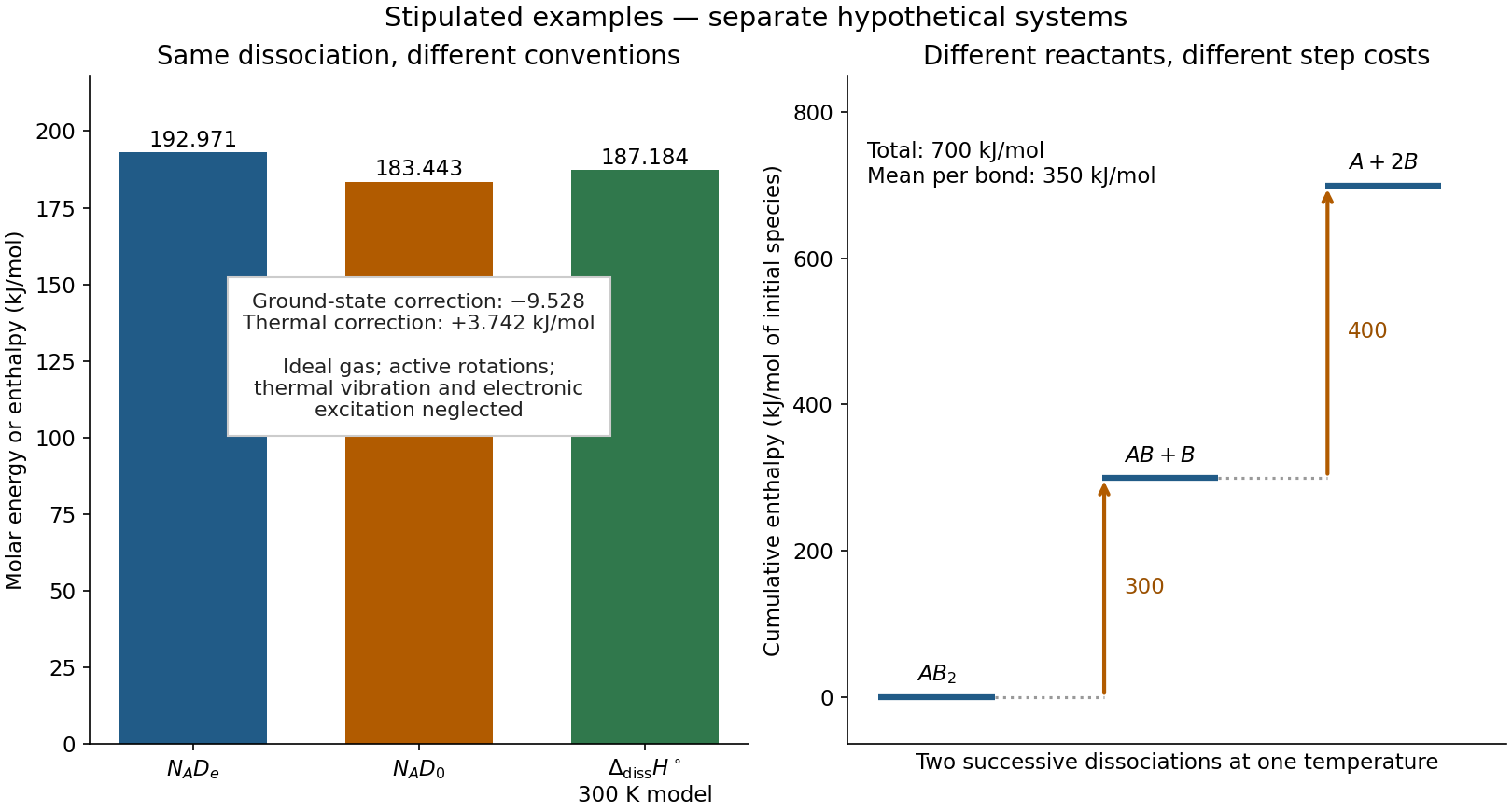
Two stipulated examples: changing the energy convention for one dissociation, and changing the reactant during sequential cleavage
. Left: , , and the model bond-dissociation enthalpy at . Right: cumulative enthalpy levels for two successive steps, with costs and and mean . The panels are separate hypothetical systems; neither contains molecular measurements. Details. Articles by others on the same topic



Bond-dissociation energy (BDE) is defined as the energy required to break a specific bond in a molecule in its gaseous state, leading to the formation of two separate, neutral radical fragments. It is a measure of the strength of a chemical bond; the higher the bond-dissociation energy, the stronger the bond. BDE is typically reported in units of kilojoules per mole (kJ/mol) or kilocalories per mole (kcal/mol).