In , the tridentate ligand contains one anionic phenoxide ligand, a neutral secondary amine with its N–H bond intact, and a neutral phosphine ligand. The three chloride ligands contribute another three negative charges. Consequently the neutral complex has Ti(IV), , and 12 valence electrons:The N–H label is essential: counting this nitrogen as an anionic amido ligand would give the wrong oxidation state. A six-coordinate early-metal complex need not obey the 18-electron rule.
In , the substituted cyclopentadienyl ligand is and anionic, while the three-carbon bent ligand is an anionic allyl ligand, a four-electron donor in ionic counting. The pendant pyridine nitrogen is uncoordinated. Therefore Mo(II), , 18 electrons follows fromThe curved delocalization mark across the three-carbon ligand must not be read as a separate alkene or alkyne.
A formal two-electron reductive elimination couples two anionic, mutually cis donors and reduces Ti(IV) to Ti(II). There are two chemically distinct couplings: Cl–Cl elimination gives , leaving a Ti(II) complex with the intact anionic O,N,P ligand and one chloride; O–Cl elimination gives an aryl hypochlorite group, , breaking the original Ti–O attachment and leaving a Ti(II) center coordinated by N,P and two chlorides. The latter product can remain tethered through the N,P part of the same ligand; it is not necessarily a free small molecule. The starting facial arrangement supplies cis pairs of both kinds.
Cl–Cl coupling is the more plausible of these formal alternatives, because it retains the particularly strong early-metal Ti–O interaction and makes the stronger Cl–Cl rather than relatively weak O–Cl bond. Both alternatives reduce the valence count by two, from 12 to 10, so the 18-electron rule does not choose between them. Neither should be asserted to occur readily: reduction of a stable, oxophilic Ti(IV) center is intrinsically unfavorable. Coupling a chloride to the neutral amine or phosphine is not the ordinary elimination of two X-type ligands. proton transfer between N–H and oxygen, if it occurred, would instead be acid-base chemistry, not automatically a two-electron reductive elimination.
The mirror-image facial complex and the meridional complex provide the two requested stereoisomers. Let O, N and P denote the three attached atoms of the same unsymmetrical chelate. The original has these atoms on one octahedral face and the three chlorides on the opposite face. Its reflected facial arrangement is an enantiomer: the O,N,P donor sequence reverses handedness and cannot be restored by a proper rotation. In the meridional arrangement, O and P are trans, and the two adjacent chelate links O–N and N–P remain cis. The following original coordination diagrams specify the ligand positions; lines joining donor labels represent the ligand's connectivity, with its organic backbone suppressed.
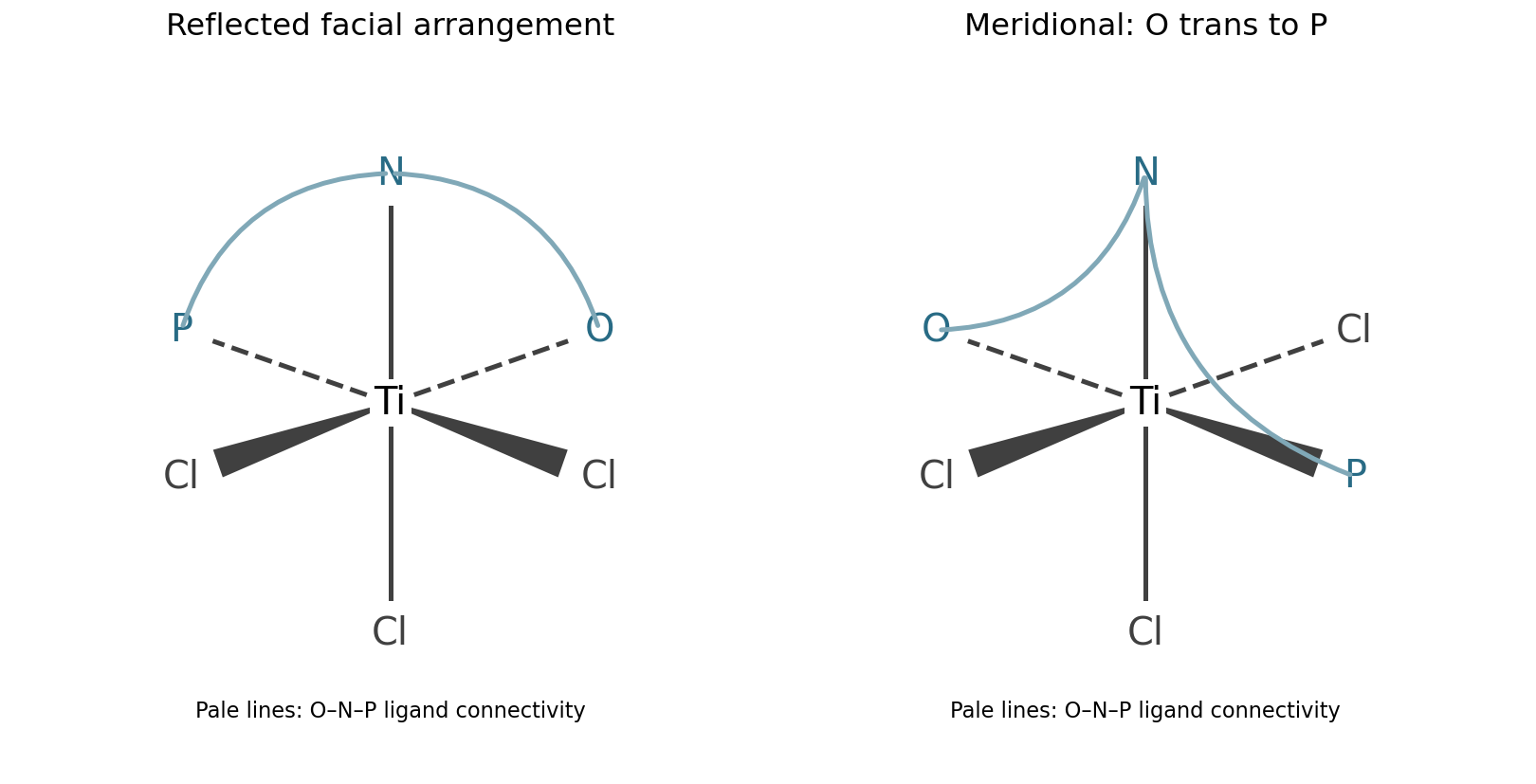

The meridional structure is a geometric isomer, not the reflected facial structure. Distorting chelate rings without changing these donor positions does not by itself supply a new coordination stereoisomer.
Write for the cyclopentadienyl ligand bearing its –2-pyridyl arm; means that its ring and pyridyl nitrogen both bind the same metal. . The base removes the pyridinium N–H proton in , restoring a pyridine lone pair. Intramolecular nitrogen coordination then replaces one acetonitrile ligand and closes a chelate ring. Both CO ligands are retained; the molybdenum remains Mo(II), .
This is an proton transfer followed by chelation, with metal electron count . The chelate effect, favorable formation of the Mo–N bond, and release of a solvent molecule explain the driving force. Merely invoking a 16-to-18-electron change would be misleading because is already 18-electron. In the preceding acid treatment, protonation of the allyl ligand allows release of propene; the other proton resides on the pendant pyridine, accounting for 's overall charge. One proton is removed here; the cyclopentadienyl tether is not deprotonated or detached.
, with chloride replacing the remaining acetonitrile. The pendant pyridine remains attached. The substitution removes the positive electric charge on but does not change the Mo(II) oxidation state. In ionic electron counting, both neutral acetonitrile and anionic chloride ligand donate two electrons, giving in .
acetonitrile is the remaining weak, exchangeable monodentate donor. Its displacement forms a favorable Mo–Cl bond at a cationic center, retains the intramolecular Mo–N bond, and restores an 18-electron product after substitution. The following formulas specify the coordination changes directly:Tetramethylammonium is a spectator counterion; it is not a carbon donor to Mo.
The readily displaced acetonitrile sites have both been exhausted. A second chloride would have to displace a strongly bound carbonyl ligand, open the chelate ring, or associate to an already 18-electron center to make an unfavorable crowded 20-electron species. The product is neutral, so further chloride uptake also lacks the charge-neutralization advantage of and would generate an anionic complex if substitution occurred. The chelate effect disfavors loss of the tethered pyridine, while strong pi backbonding helps retain CO under the stated conditions. These combined kinetic and bonding arguments explain the absence of further reaction. The 18-electron rule alone would not forbid replacing CO by chloride, since that replacement is isoelectronic; it therefore cannot be the whole explanation.
For an intact complex in the usual fast-conformational-averaging regime, counting distinct chemical shifts rather than individual split lines gives , , signals.
In , the uncoordinated pyridinium arm permits the paired positions of a monosubstituted cyclopentadienyl ligand to average: its four ring hydrogens give two sets, . The linker gives one set, the four inequivalent pyridinium C–H positions give four, its N–H gives one, and the two symmetry-related bound acetonitrile methyl groups give one. Hence . The exchangeable N–H resonance may be broadened or absent experimentally; nine is the structural count before exchange removes it.
In the rigid cis-dicarbonyl chelates and , the different pyridyl-N and fourth-leg donors destroy the operation that related the two sides of the substituted ring. Each of the four Cp hydrogens is distinct, and the two linker hydrogens are diastereotopic. Together with four pyridine C–H sites, this gives . The remaining bound acetonitrile adds one methyl signal to , giving 11; has none, giving 10. The two enantiomers of a racemate have identical spectra in an achiral solvent and do not double these counts. This prediction assumes resolved resonances and no rapid chelate opening that averages inequivalent sites; variable-temperature proton nuclear magnetic resonance would test that assumption.
Articles by others on the same topic
There are currently no matching articles.