Acid-base chemistry studies how chemical acids and chemical bases exchange protons or electron pairs. Here the focus is transfer of protons in water: a chemical acid donates a proton, and a chemical base accepts it. The resulting chemical equilibrium determines pH, while a buffer solution can resist changes in pH. This connects microscopic chemical reactions with a compact, measurable description of a chemical solution.
The important distinction is between how much chemical acid is present and how readily it transfers a proton. A weak acid and a strong acid at the same total concentration need not have the same pH. Conversely, two buffer solutions can have the same pH while containing very different total quantities of their chemical acids and chemical bases.
A chemical solution with basic rather than acidic character; in aqueous conditions its pH is above the neutral value at the stated temperature.
A chemical reaction involving acid and base partners; in the aqueous proton-transfer account, a chemical acid supplies a proton to a chemical base.
A methylene group whose hydrogens are made relatively acidic by adjacent electron-withdrawing groups, especially two carbonyl-derived groups.
A Lewis base donates an electron pair to a Lewis acid, forming a coordinate covalent bond in an adduct.
A qualitative matching framework for Lewis acids and bases. Hard species favour interactions with compact, less polarizable partners, whereas soft species favour more polarizable partners. It is not an ordering based solely on atomic electronegativity.
A Lewis acid whose acceptor interaction favours small, weakly polarizable donor atoms. High charge density favours hard character; Eu(III) typically favours oxygen and nitrogen donors over a softer sulfur donor.
A Lewis acid-base adduct forms when an electron-pair donor binds an acceptor through a coordinate covalent bond. A ring nitrogen can bind without displacement of a chlorine substituent from phosphorus.
A Lewis acid and Lewis base whose direct neutralization is inhibited, allowing cooperative reaction with another molecule.
Deprotonation removes a proton from a chemical species, changing its electric charge by . It can expose a donor lone pair or change donor charge without changing the metal oxidation state.
Transfer of a hydrogen nucleus from a donor to an acceptor. Electron-pair bookkeeping distinguishes transfer of from transfer of a hydride equivalent.
A proton relay transfers a proton through a sequence of neighboring donors and acceptors, often including water. The full catalytic sequence must regenerate the relay groups; a static hydrogen-bond diagram does not determine its direction or timing.
The isoelectric point is the pH at which a specified molecule's mean net electric charge is zero. Different protonation states can still carry nonzero electric charges; their contributions cancel in the average. For the two-step glycine speciation model, this gives . Additional ionizable amino acid side chains require their own chemical equilibrium calculations; averaging every pKa is not a general rule. [ref]
Organic Chemistry by John McMurry. §26.2, discussion following Figure 26.2: isoelectric points and the dissociations surrounding the neutral form
Below its isoelectric point, free glycine has positive mean electric charge and an electric field drives it toward the negative electrode; above its isoelectric point, the mean electric charge is negative and the direction reverses. At its isoelectric point the charge-driven contribution vanishes. Diffusion and bulk movement of the chemical solution can still move the sample. Gel electrophoresis applies this charge dependence to separation, although protein size, shape and interactions also affect migration. The pKa values of free glycine do not determine a protein's isoelectric point: its free N-terminus, C-terminus and ionizable amino acid side chains supply a different inventory. [ref]
A chemical acid can donate a proton, or accept an electron pair to form a covalent bond. The pH and buffer solution examples below use the former meaning. See IUPAC Gold Book, acid.
In water, a strong acid transfers its available proton essentially completely to water under the dilute conditions considered here. For the pH example, each initial chemical acid unit supplies one hydronium ion. “Strong” describes this conversion, rather than a high concentration. See 14.3 Relative Strengths of Acids and Bases.
Hydrochloric acid is an aqueous chemical solution of hydrogen chloride. The glycine titration model treats its dissociation into hydronium and chloride as complete, retaining both ions in the electric charge balance.
A weak acid establishes a chemical equilibrium between its proton-donating form and its conjugate base in water. For a neutral monoprotic acid , the aqueous chemical equation isWater accepts a proton to become hydronium; is the conjugate base. The double arrow denotes reversible exchange at chemical equilibrium, not equal populations. The acid dissociation constant and composition determine the hydronium concentration; substituting total chemical acid concentration into the pH formula is generally incorrect.
“Weak” describes the tendency to transfer a proton in a specified solvent, rather than how much chemical acid was dissolved. A weak acid can be concentrated, and a strong acid can be dilute. Even the same weak acid can have a large weak acid dissociation fraction after sufficient dilution, while its acid dissociation constant stays fixed at the same temperature and standard state conventions.[ref]
14.3 Relative Strengths of Acids and Bases. Chemistry 2e by Paul Flowers and others; §14.3, acid ionization and concentration-dependent percent ionization
A monoprotic acid supplies one proton per acid unit in the acid-base chemistry model under consideration. Acetic acid is an example. Several successive proton transfers require several acid dissociation constants and a larger set of chemical species.
For a monoprotic acid with analytical concentration , define the dimensionless weak acid dissociation fractionThis counts acid units in the conjugate base form. Identifying it with additionally requires negligible self-ionization of water and no other sources of electric charge. In the ideal dilute chemical solution model, with , the acid dissociation constant gives . Thus lowering hydronium thermodynamic activity favors the conjugate base.
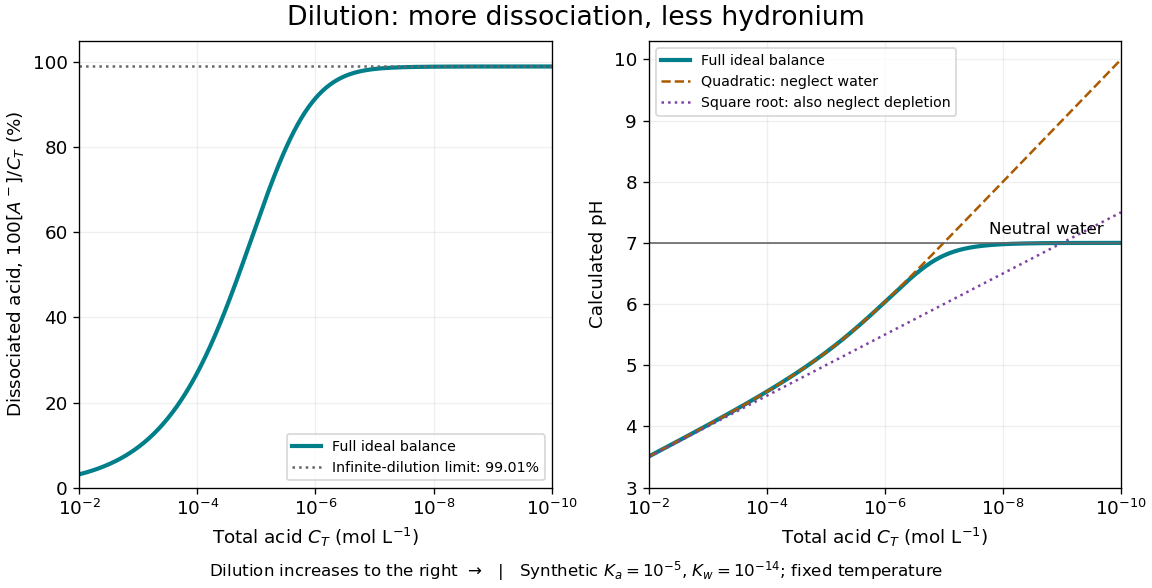
Dilution increases the weak acid dissociation fraction while raising pH in a synthetic aqueous chemical equilibrium
. Details. 
The diagram uses stipulated dimensionless acid dissociation constant and self-ionization of water ion product at fixed temperature; these are model inputs, not measurements of a named substance. It solves the weak acid mass and charge balances. At , the calculated weak acid dissociation fraction is about and pH about ; at , they are about and . More acid units are dissociated as a fraction of the total, yet fewer hydronium ions occur per volume.
At extreme dilution, self-ionization of water makes approach , so pH approaches for the chosen model. The limiting weak acid dissociation fraction is , rather than exactly one. The calculation assumes pure added water, a neutral monoprotic acid, and no competing chemical reactions; actual contamination becomes increasingly important as falls.
Consider only neutral added to pure water, at fixed temperature, with ideal dilute thermodynamic activities, water thermodynamic activity approximated by one, and no added salts or other chemical species. Normalize every concentration by :Conservation of acid units and zero net electric charge, respectively, requireThe second equation balances positive hydronium against negative conjugate base and hydroxide. It would need all additional ions if salts or a chemical base were added. Together with acid dissociation constant and the self-ionization of water relation , these giveThis is exact within the stated ideal model, including depletion and self-ionization of water. Multiplication by yields the cubic equationFor positive , the unmultiplied left-hand side increases strictly from negative to positive values as increases from zero to infinity; its derivative is . There is therefore exactly one positive root of a polynomial. A bisection method can find it without choosing an unphysical root of a polynomial.
If , neglect hydroxide, so and the quadratic equation retaining acid depletion givesThe last form avoids subtracting nearly equal numbers. If also , neglect depletion to obtainCheck both conditions after computing: measures the fraction lost from the initial undissociated weak acid inventory, while measures the omitted hydroxide contribution to electric charge balance. A depletion criterion is a chosen tolerance, not a universal boundary. Keeping depletion does not cure the neglect of self-ionization of water. These weak acid mass and charge balances also explain why the square root estimate cannot be extended to arbitrarily dilute chemical solutions.
An analytical concentration records the total conserved inventory of a specified component per volume of chemical solution, summed over its relevant chemical species. Here ; it is not generally the chemical equilibrium concentration of the undissociated weak acid.
A pH measurement becomes evidence for a weak acid chemical equilibrium when paired with a known analytical concentration and a calibrated glass electrode. For the pure-weak acid model, measured pH estimates only in the ideal thermodynamic activity approximation. Then , , , and . Require ; values outside that range signal inconsistent measurements or an inadequate model. Repeating this reconstruction across a dilution series tests whether one acid dissociation constant describes the data, rather than merely fitting one point.
The Analytical Sciences Digital Library's Potentiometric Titration of an Unknown Weak Monoprotic Acid provides a complementary acid-base titration experiment. Its apparatus includes a glass electrode and meter, a stirring magnet, a volumetric flask, pipettes, and a burette containing standardized sodium hydroxide. Prepare an aqueous acid stock of known analytical concentration, transfer a measured portion, and stir gently with the glass electrode clear of the magnet. Record added volume and stable pH after each addition; use a preliminary run to locate the steep region and smaller additions there on a fresh portion. The readout is the pH versus added volume curve, not a visual count of dissociated molecules.
Calibrate with fresh standard buffer solutions bracketing the pH range being interpreted. Use their assigned values at the actual temperature; a pair near pH and can cover the midpoint of many weak acid examples, but does not cover an entire alkaline endpoint region. Rinse between standards and samples to limit carryover, keep the sensing bulb and reference electrode junction immersed, and wait for a stable reading. These instrument practices are documented in HI5221 & HI5222 Instruction Manual: pH and mV and ISE and Temperature Bench Meters by Hanna Instruments (pp. 45–47, 49–50 and 73–74: calibration, measurement, rinsing and electrode conditioning).
Locate the acid-base titration equivalence region from the steepest change of pH with added volume. For one-to-one neutralization, standardized sodium hydroxide concentration times equivalence volume estimates the initial amount of substance of acid. Half that volume gives approximately equal and only when subsequent chemical equilibrium redistribution is small. The Henderson-Hasselbalch equation then gives . Unequal activity coefficients or appreciable hydronium or hydroxide inventories can shift this estimate. The full chemical equilibrium curve supplies a stronger consistency check than its midpoint alone.
Useful controls for this model test are a fresh independently prepared acid portion, a water blank, a check standard after measurement to detect instrument drift, and fixed recorded temperature. A blank diagnoses contamination but should not be subtracted directly from pH, which is a logarithm. Keep exposure to atmospheric carbon dioxide comparable, especially at high dilution, and record any background salt that changes ionic strength. These are experimental-design controls suggested by the model's assumptions. The observed curve and its uncertainty determine whether the model is adequate; the diagrams here contain no experimental readouts. An aqueous acid dissociation constant cannot be inferred unchanged from a sample requiring a different solvent mixture, and a nearly neutral dilute sample makes the difference particularly sensitive to pH error.
A glass electrode is an electrode whose glass membrane responds to hydrogen ion thermodynamic activity. A meter measures its electric potential difference against a reference electrode; calibration with standard buffer solutions converts this response to operational pH.
A reference electrode supplies the comparison electric potential for the glass electrode measurement. A combination probe incorporates both electrodes; changes at its junction can contribute measurement error.
The conventional zero of standard electrode potentials, based on hydrogen oxidation/reduction at specified standard hydrogen fugacity and proton activity.
A silver electrode in contact with silver sulfate and a solution of controlled sulfate activity. The reduction is .
An acid-base titration adds measured quantities of a standardized chemical acid or chemical base to determine an initially unknown acid or base inventory through neutralization. Monitoring pH also constrains chemical equilibrium parameters such as the acid dissociation constant.
The added reagent is the titrant; a pipette selects an aliquot of the sample and a burette measures the added volume. Known stoichiometry converts this volume into amount of substance. This separates two questions that a single pH reading cannot answer: how much chemical acid is present, and how readily it donates a proton. A large inventory of weak acid can consume more titrant than a small inventory of strong acid despite having a higher initial pH.
The equivalence point is the composition at which added titrant and the initial sample inventory match the specified chemical reaction's stoichiometry. It is a theoretical inventory condition; the titration endpoint is an observed stopping criterion. For a monoprotic acid consuming one hydroxide per acid unit, initial acid molar concentration , sample volume , and base titrant molar concentration giveThe proof is amount of substance conservation with one-to-one neutralization; a different stoichiometry requires its coefficients. All volumes must use compatible units. Since , , not .
An equivalence point does not prescribe pH . A weak acid titrated with a strong base leaves its conjugate base, which reacts with water; the corresponding chemical equilibrium can make the chemical solution alkaline. The neutral strong acid/strong base case additionally depends on temperature, through self-ionization of water.[ref]
A titration endpoint is the experimentally assigned point indicated by a specified signal: for example, a persistent color of a pH indicator, or a feature extracted from a potentiometric titration. An equivalence point is defined by stoichiometry; an endpoint estimates its location. State the signal rule and its repeatability. A fleeting local color where a drop enters an unmixed sample need not satisfy the rule for the mixed sample.
Define the endpoint offset . For one-to-one neutralization, using the endpoint without correction gives inferred acid inventory andThus an illustrative overshoot at overestimates the inventory by . Repeatedly reaching the same color can reduce scatter while retaining this systematic offset. This example stipulates an offset; it is not a measured drop size.
A pH indicator changes color as its protonation distribution changes. In a simple weak acid/conjugate base model, its two forms have different colors and their ratio depends on pH through the acid dissociation constant. The visible transition spans a range of pH; it is not a direct signal that the sample has reached an equivalence point. An indicator is useful when its transition lies in a steep part of the titration curve, so a modest range of pH corresponds to a small added volume.[ref]
14.7 Acid-Base Titrations. Chemistry 2e, §14.7, Acid-Base Indicators, Figures 14.19–14.21: indicator equilibrium, transition ranges, and selection
Bromothymol blue is a pH indicator used to assign a color-based titration endpoint in the inspected solubility product measurement by titration.
A titration curve plots a measured or calculated property against added titrant volume or amount of substance. In an acid-base titration, plotting pH exposes gradual changes and a steep endpoint region. A potentiometric titration uses an electrode electric potential difference; a calibrated glass electrode and reference electrode provide operational pH. Finite additions bracket a transition rather than measuring a continuous curve. A chemical equilibrium fit can estimate the equivalence point; identifying the steepest sampled interval alone has a resolution set by the dose spacing and instrument response.
A potentiometric titration monitors an electrode electric potential difference as titrant is added. A calibrated glass electrode can report pH during an acid-base titration.
Consider an original ideal model: of hydrochloric acid at , titrated with sodium hydroxide at . Treat these numbers as exact model inputs. Assume complete dissociation of an ionic compound, complete strong acid ionization, additive volumes, uniform mixing, and activity coefficients equal to one. Use stipulated , approximately appropriate near . These are calculated pH values, not measurements of these materials.
The chemical equation for neutralization isInitial acid inventory is , so the equivalence point is . Added water does not change this inventory. But the final volume , including the titrant, determines all concentrations.
Keep self-ionization of water even at the equivalence point. With , define the dimensionless acid excess , hydronium level , and hydroxide level byThe sodium cation and chloride anion inventories fix the electric charge balance , while chemical equilibrium gives . Eliminating yields a quadratic equation with exactly one positive root. For stable calculation on either side, writeThe second expression follows by multiplying by ; it avoids subtracting two nearly equal large quantities on the alkaline side. A logarithm acts on the dimensionless , as required by the pH definition.
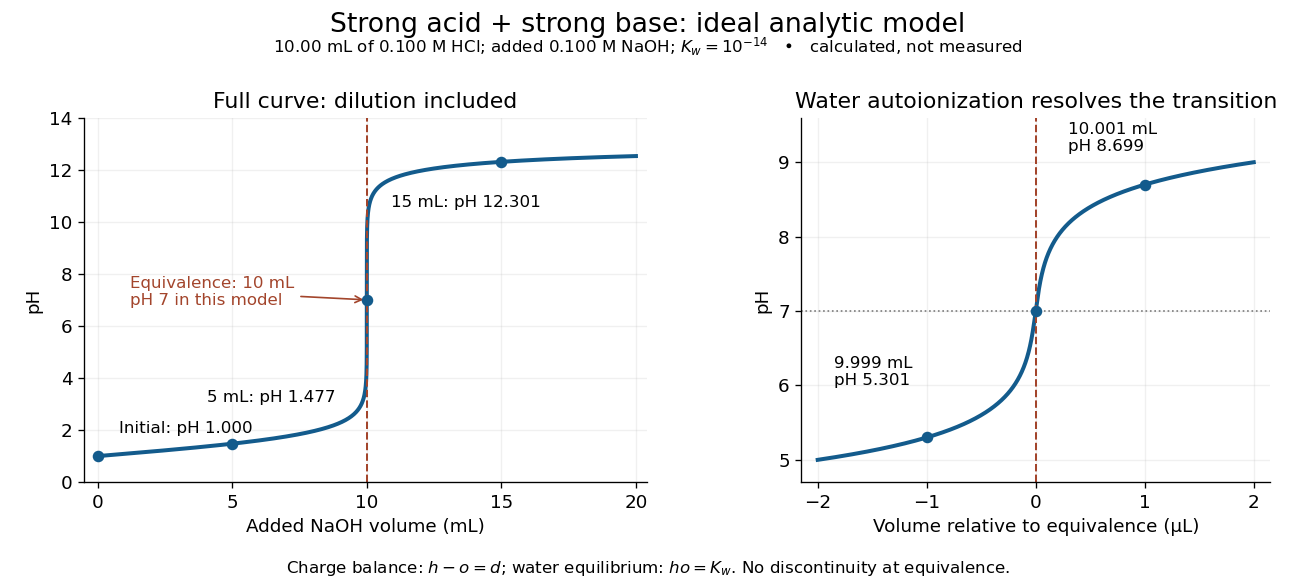
An ideal strong acid titration curve stays smooth through its equivalence point because of self-ionization of water
. Original analytic model for of hydrochloric acid and sodium hydroxide, with . Both panels use the complete electric charge balance and ideal chemical equilibrium. The right panel resolves microlitre additions around the equivalence point. The marked points are calculated, not measured. Details.
At , the excess is in , giving and pH . At , excess hydroxide is in , giving and pH . Neglecting dilution would give the wrong values even far from the equivalence point.
Exactly at , and , giving pH in this model. At and , the same smooth expression gives pH and . The familiar excess-only formulas would predict zero hydronium or zero hydroxide at the equivalence point; retaining self-ionization of water removes that failure. A steep curve is still continuous.
The sensitivity is especially revealing. Differentiating giveswhen . At this model's equivalence point, the derivative is about pH units per millilitre. This is a local derivative, not a linear prediction over a whole drop. Real endpoint accuracy also depends on dosing, mixing, measurement uncertainty, temperature, extra reacting chemical species, and nonideal thermodynamic activities.
The institutional experiment The Potentiometric Titration of an Acid Mixture, from Massachusetts Institute of Technology's 5.310 Laboratory Chemistry, determines hydrochloric acid and phosphoric acid inventories. Dried potassium hydrogen phthalate standardizes sodium hydroxide. A volumetric pipette selects an acid aliquot, diluted with water in a beaker. A burette feeds a stirred sample beside a glass electrode; the apparatus isolates the sample from stirrer warming. The burette is conditioned with titrant and its tip freed of bubbles. Stable pH and added volume are recorded, with smaller additions near the transition. Controls include replicate standardizations, a consistent pale-pink phenolphthalein endpoint, and a standard buffer solution check between sample runs. The readout supports inventory estimates through known stoichiometry; it does not directly count molecules.[ref]
The same protocol requires drainage time for burette readings and warns that an undelivered hanging drop spoils the association between volume and pH. Its color-persistence wording differs between the main paragraph and footnote, so a reproducible titration endpoint needs an explicitly chosen criterion. Its acid mixture is not the single-strong acid ideal model above.[ref]
The Potentiometric Titration of an Acid Mixture (MIT 5.310 laboratory handout). Printed Titration-6, main endpoint paragraph and footnote 6; Titration-8, hanging-drop warning
A distinct control appears in Process Measurement Procedures: Sulfuric Acid Emissions, §1.4.4.2: the phenolphthalein standardization is repeated with water replacing the acid, matching the sample aliquot and indicator quantity. The volume needed for the same pink endpoint is subtracted from the sample reading.[ref]
Process Measurement Procedures: Sulfuric Acid Emissions by R. Maddalone and N. Garner. Process Measurement Procedures: Sulfuric Acid Emissions, printed pp. 26–27, §1.4.4.2, indicator-blank paragraph, NOTE, and procedure steps 1–3
The independent bookkeeping for such a matched blank is , assuming one-to-one neutralization and equal background consumption. A blank cannot correct an unmatched chemical reaction or guarantee exact coincidence of endpoint and equivalence point. Subtracting pH readings would not give this inventory correction, because pH is a logarithm. Repeatability constrains scatter; an independently known check sample also tests systematic bias. Carbon dioxide uptake, incomplete mixing, electrode drift, and uncertain titrant concentration limit the inference.
Titrant standardization determines the actual titrant concentration by reaction with a known inventory, often a primary standard. It is distinct from calibrating the delivered volume or a glass electrode's response. For a known monoprotic acid inventory and a suitable blank-corrected endpoint,An original illustrative standard of requiring , with matched blank , gives . The measured quantities here are stipulated examples. Independent solution preparation and volumetric calibration tests the pipette, burette, and volumetric flask; titrant standardization tests the reacting inventory per delivered volume.
The useful chain is known mass, known composition, known amount of substance, and then a measured titre through a specified stoichiometry. If each standard unit consumes units of titrant, the general inventory equation is , where is the corrected titre. The one-to-one formula above has . A titration endpoint supplies an observable stopping rule; whether it represents the equivalence point accurately remains a separate question. Standardization endpoint and blank bias makes the direction of the resulting error explicit.
A primary standard supplies a reliably known reacting inventory from which a titrant concentration can be determined.
The defining advantage is known high purity: the weighed portion can be assigned a known amount of substance. A titrant whose concentration is established against that inventory is a secondary standard solution in IUPAC terminology.[ref]
standard solution. IUPAC Compendium of Chemical Terminology, fifth edition (Gold Book) by International Union of Pure and Applied Chemistry; Gold Book, standard solution, S05924; definitions of primary standard and secondary standard solution; underlying source Orange Book, second edition, p. 48
An accurate balance determines total mass, including any unwanted water or other material. To infer reacting inventory, one also needs known composition, stability during storage and weighing, complete transfer and dissolution, and a sufficiently complete chemical reaction of known stoichiometry. A finely resolved balance cannot establish these chemical facts. Potassium hydrogen phthalate is useful because a suitably prepared portion provides a known acid inventory for sodium hydroxide titrant standardization; the KHP standardization protocol below shows how that claim is put into practice.
Preparation belongs to the particular material and method. For example, the MIT handout specifies drying potassium hydrogen phthalate at for hours or overnight, cooling in a desiccator, and weighing by difference; its footnote identifies removal of superficial moisture as the purpose. This is a condition of that potassium hydrogen phthalate procedure, not a universal instruction to heat every primary standard in the same way.[ref]
The Potentiometric Titration of an Acid Mixture (MIT 5.310 laboratory handout). Printed Titration-5, §IV.2 and footnote 5: drying, cooling, weighing by difference, and superficial moisture
Let be the transferred sample mass, the known mass fraction of the intended chemical compound, and its molar mass. In a model with complete dissolution and chemically inactive impurities,The purity fraction is dimensionless: would mean , not . These equations assume that the impurity contributes no titrant demand; an impurity that also reacts needs its own inventory equation. The value of must refer to the same preparation state as , for example the specified dry material. A mass fraction assigned before unaccounted uptake of water cannot simply be used after it.
For an original worked example, stipulate pure potassium hydrogen phthalate, abbreviated KHP, so , a selected mass , and rounded molar mass . The NIST Chemistry WebBook lists formula and molecular weight , consistent with the rounded molar mass used here.[ref]
potassium hydrogen phthalate. NIST Chemistry WebBook, SRD 69, potassium hydrogen phthalate, CAS 877-24-7; Formula and Molecular weight fields
The selected mass, purity assumption and volumes in this example are chosen inputs, not measured results or a claim about a real batch's purity.The acid-bearing anion of potassium hydrogen phthalate loses one proton to hydroxide. The net chemical equation isThus sodium hydroxide has one-to-one stoichiometry with potassium hydrogen phthalate in this neutralization, givingChoose a delivered endpoint titre of and matched titration blank of . ThenThe extra displayed digits show the arithmetic of the stipulated model; they do not establish experimental accuracy. A compact rounded result is .
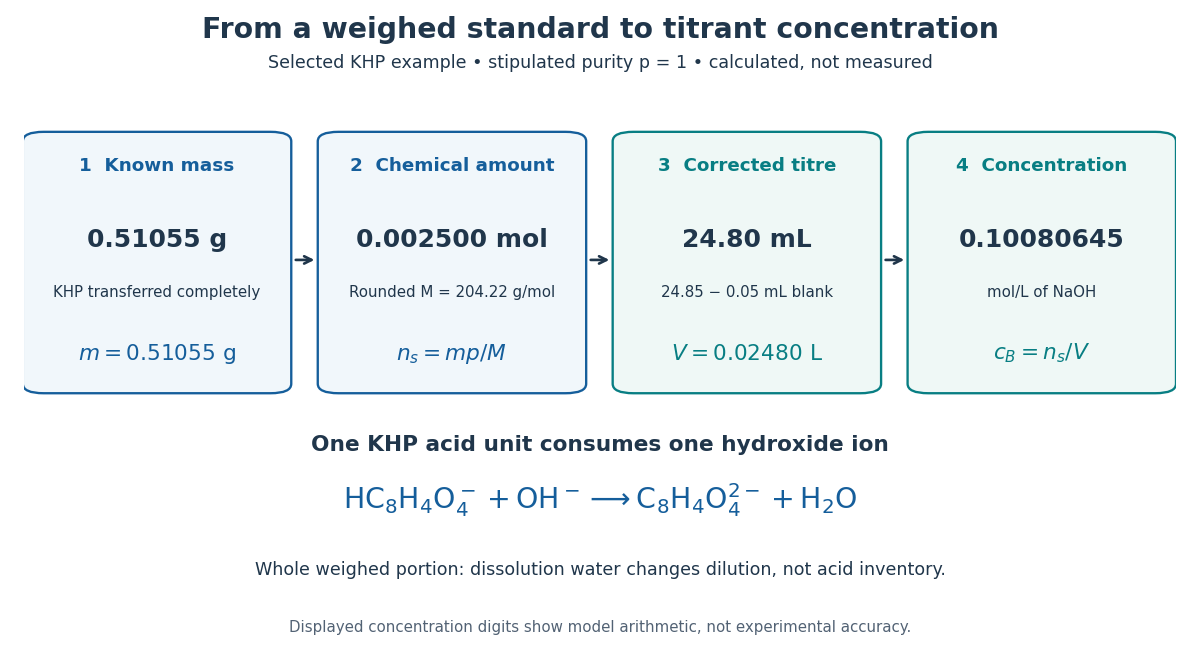
A primary standard connects known mass to amount of substance, corrected titre, and titrant concentration
. Original calculated inventory diagram for selected potassium hydrogen phthalate, stipulated , rounded molar mass , and one-to-one sodium hydroxide neutralization. The endpoint and matched titration blank are chosen examples, not observations. Details.
When the entire weighed portion is titrated, added water changes concentration and the pH path but preserves the initial acid inventory. The dissolution volume therefore does not appear in . If instead a volumetric flask prepares a stock and a volumetric pipette selects an aliquot, the selected inventory is for homogeneous stock, with delivered aliquot volume and final stock volume . The same bookkeeping explains why complete transfer matters even when the amount of dissolution water is approximate.
Columbia University's institutional laboratory manual, Experiment 1, Glassware Calibration, Primary and Secondary Standards, and Manual Titrations, Part 3, specifies two weighed – portions of potassium hydrogen phthalate, transferred completely into separate Erlenmeyer flasks. Dissolve each in approximately distilled water; any warmed sample cools to room temperature before titration. Add two or three drops of phenolphthalein. Rinse and condition a clamped burette with the diluted sodium hydroxide, then titrate while swirling to faint pink lasting about seconds. Calculate concentration from each portion's own mass and delivered titre; repeat if results scatter. Part 1 identifies a Mettler balance, and Part 2 includes paired weighings of exposed sodium hydroxide and potassium hydrogen phthalate. These are prescribed procedures, not reported measurements.[ref]
The same manual directs keeping the diluted sodium hydroxide covered and limiting air exposure after titrant standardization.[ref]
Glassware Calibration, Primary and Secondary Standards, and Manual Titrations, Columbia University Experiment 1. Experiment 1, Part 3, introductory paragraph and step 1
The MIT handout explains the associated carbon dioxide problem: carbonate contamination of sodium hydroxide is controlled during preparation, bottles are promptly capped, and atmospheric carbon dioxide makes the pink phenolphthalein endpoint fade.[ref]The Potentiometric Titration of an Acid Mixture (MIT 5.310 laboratory handout). Printed Titration-5, §IV.1 and footnote 3; Titration-6, footnote 6
Consequently, a standardized concentration applies to the stored chemical solution under its handling conditions; continued uptake of carbon dioxide can change the reacting inventory per delivered volume.The color is the readout, and stoichiometry supplies the inference. Phenolphthalein indicates a pH range, so its first reproducible pale pink is an operational titration endpoint, rather than a direct observation of equal reacting inventories. A potentiometric titration can locate an endpoint from a pH versus volume curve, but glass electrode calibration alone still does not determine sodium hydroxide concentration. Repeat portions test scatter; incomplete dissolution, an unmatched titration blank, or a shared endpoint error can bias all repeats together.
Here a titre means the delivered titrant volume needed to reach the specified titration endpoint, obtained from final minus initial burette readings. Report explicitly whether a quoted titre includes or excludes a titration blank. This volume convention is distinct from uses of titre to express a solution's reacting strength.
A titration blank runs the background procedure without the intended reacting sample, matching relevant water, indicator quantity and titration endpoint conditions. Its titrant demand estimates a background contribution to subtract. The inspected EPA procedure uses such a phenolphthalein blank; this is a distinct control, rather than an instruction present in Columbia's Part 3.[ref]
Process Measurement Procedures: Sulfuric Acid Emissions by R. Maddalone and N. Garner. Printed pp. 26–27, §1.4.4.2, indicator-blank paragraph and steps 1–3: water replaces acid, indicator quantity matches, blank volume is subtracted
A blank must match the relevant background to justify subtraction; it does not remove sample-specific side reactions or a mismatch between titration endpoint and equivalence point.Hold the known primary standard inventory fixed, and let be the correct blank-subtracted titre. In the following model, any remaining endpoint offset has been removed from this reference. If a titration endpoint overshoot adds , the inferred titrant concentration is too small:The denominator grows while the numerator stays fixed. For , the relative effect is approximately , but the displayed fraction is exact for this additive model. An unremoved positive titration blank has the same mathematical effect: replace by . If both remain, replace it by . This analogy concerns their effects on the denominator; it does not mean a blank measures endpoint overshoot.
For the chosen reference titre, an extra gives and relative error . Leaving both a blank and a overshoot gives denominator and relative error .
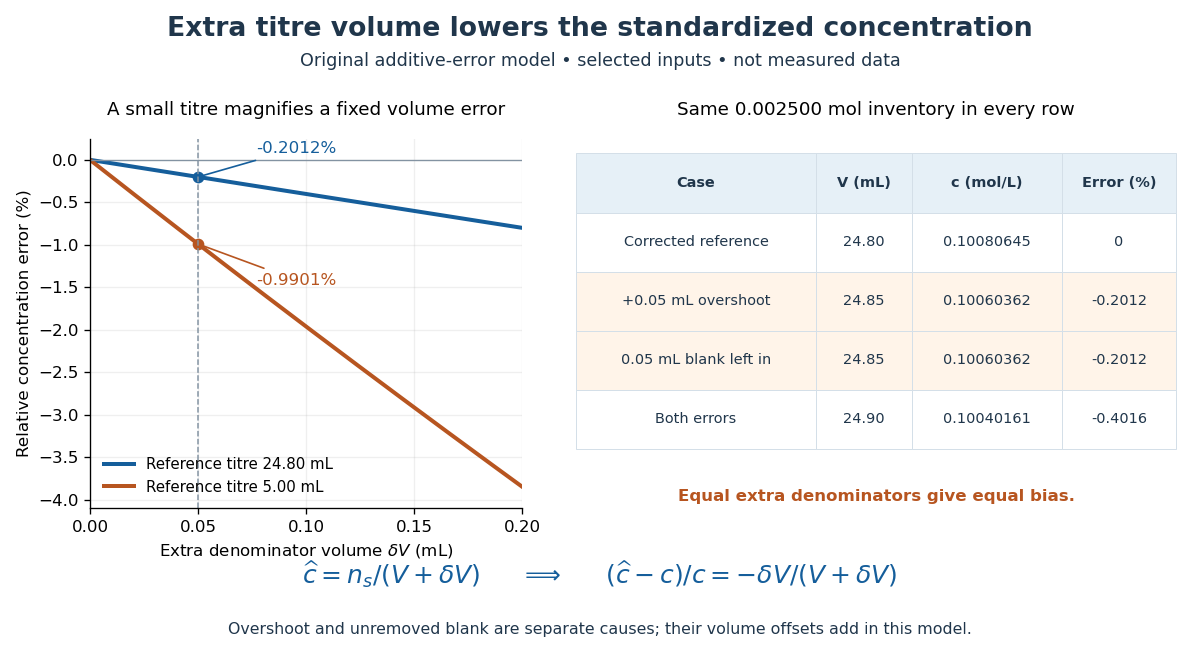
Endpoint overshoot and an unremoved positive titration blank both lower the inferred titrant concentration
. Original additive-error model, not measured data. The curves compare reference titres of and . The table uses the selected inventory and reference. Equal extra denominator volumes give equal bias, whether caused by overshoot or an unremoved blank. Details.
For comparison, the same extra on a reference titre gives . The ratio of these error magnitudes is , while the small-error approximation would give . A larger titre reduces the fractional effect of a fixed extra volume; it does not fix unknown purity, incomplete transfer, or an incorrect stoichiometry.
A titrant is the reagent added in measured quantities during a titration; its known concentration and delivered volume determine the added amount of substance.
A volumetric flask prepares a chemical solution at a specified total volume, using a calibration mark.
Its mark specifies contained volume under its calibration conditions. In contrast, a volumetric pipette specifies a delivered portion. The narrow neck makes a small change of volume visible as a larger change of liquid height. The final chemical solution volume includes the solute; “dilute to ” does not mean “add of water”.[ref]
Calibration of Volumetric Glassware (Buffalo State laboratory handout). Laboratory Experiment 1. Calibration of Volumetric Glassware, p. 1, distinction between contained and delivered volumes and flask calibration principle
For an original dilution example, a fully transferred aliquot of acid contains . Making the final total gives analytical concentration . A subsequent aliquot contains and needs of base for one-to-one neutralization. The entire diluted flask still needs of that base: dilution preserves the selected inventory but sampling selects a fraction of it.
Overfilling lowers the intended molar concentration. Removing some well-mixed chemical solution to restore the mark also removes solute, so it does not recover the intended inventory. Full transfer, known final volume, and mixing are separate requirements.
For an acid-base titration, a volumetric pipette selects an aliquot whose amount of substance is from a homogeneous sample. The delivered volume depends on the instrument's calibration and drainage convention; the residual liquid of a gravity-draining volumetric pipette is allowed for in that calibration. Its mark is read using the liquid meniscus. A volume calibration alone does not establish that the sampled chemical solution has the intended concentration.[ref]
Calibration of Volumetric Glassware (Buffalo State laboratory handout). Laboratory Experiment 1. Calibration of Volumetric Glassware, pp. 1–2, Calibrating 25 mL pipette: eye-level meniscus, gravity drainage, retained liquid
An aliquot is a measured portion taken from a larger sample. For a homogeneous chemical solution, it contains the corresponding fraction of each conserved component inventory. Representative sampling requires mixing; knowing only the portion's volume is insufficient if the sample is not homogeneous.
A volumetric pipette transfers one nominal volume of chemical solution according to its marked calibration and drainage convention.
A burette delivers an adjustable measured volume of a chemical solution; the change in its reading gives the delivered volume in an acid-base titration.
Its downward-increasing scale measures a change in reading, not the initial liquid inventory. For initial reading and final reading without refilling, the nominal delivered volume is . An illustrative to reading therefore represents . There is no requirement to start at zero. An air bubble disappearing from the tip uses part of the apparent delivery to fill the tip, and a hanging drop has not yet entered the sample; both break the intended volume account.
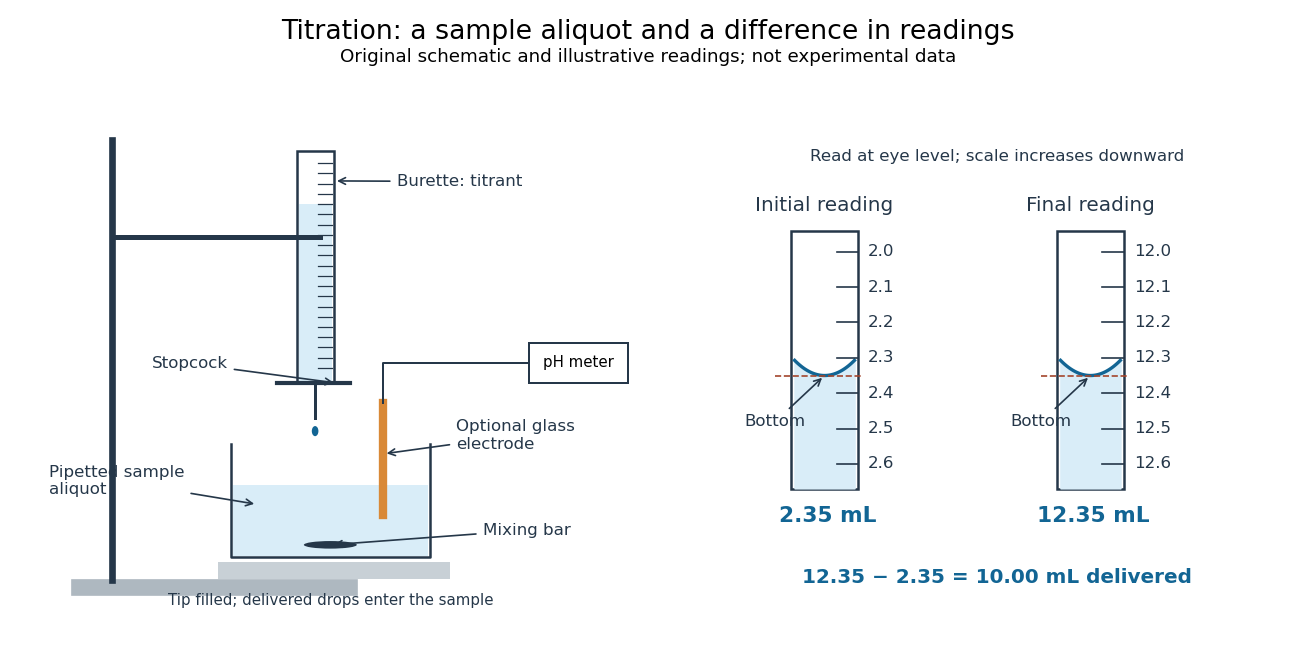

For transparent aqueous samples, read the bottom of the liquid meniscus at eye level; viewing from above or below shifts its apparent alignment. The mark is a comparison between a curved liquid surface and a scale, not a direct measure of amount of substance. Eye-level reading and the distinction between contained and delivered volumes are part of solution preparation and volumetric calibration.[ref]
Calibration of Volumetric Glassware (Buffalo State laboratory handout). Laboratory Experiment 1. Calibration of Volumetric Glassware, p. 1, eye-level bottom-of-meniscus reading
Both readings contribute measurement uncertainty. If each has independent standard deviation , their difference has standard deviation ; a common additive reading offset cancels, while a scale-factor error remains. For the inventory , uncertainty in titrant concentration remains even with perfect readings. This is why repeat delivery, independent volume calibration, and titrant standardization answer different questions.
The acid dissociation constant quantifies the chemical equilibrium for loss of one proton from a chemical acid. In water, write the actual proton transfer as . Its full dimensionless equilibrium constant isThe usual aqueous acid dissociation constant uses the solvent convention with water thermodynamic activity approximated by one:Here hydrated hydrogen ions are understood; is shorthand, not an isolated bare proton in the chemical solution. All thermodynamic activities and are dimensionless quantities, using consistent standard states. If water thermodynamic activity differs appreciably from one, retain it in the full equilibrium constant instead of silently mixing conventions.
With activity coefficients and reference concentration , put for each solute. ThenThe last expression is the dilute ideal concentration approximation, not the definition in a nonideal chemical solution. Omitting instead produces a quotient with units of concentration; its numerical value depends on the chosen units. Do not take a logarithm of that dimensional quotient. Conditional concentration quotients can change with ionic strength even at fixed temperature, whereas the thermodynamic acid dissociation constant retains the activity coefficient corrections. The acid dissociation constant entry distinguishes these conventions.
At the same temperature, solvent and standard states, a larger acid dissociation constant, equivalently a smaller pKa, indicates a stronger tendency to donate a proton. It does not specify an analytical concentration, a pH, or a reaction rate. Composition and the weak acid mass and charge balances are needed to predict pH; chemical kinetics addresses how quickly the chemical equilibrium is approached.
The pKa is the negative base-ten logarithm of the dimensionless acid dissociation constant. A lower pKa means a larger acid dissociation constant and a stronger tendency to donate a proton under the same standard state, solvent, and temperature conventions. The Henderson-Hasselbalch equation places equal weak acid and conjugate base thermodynamic activities at pH equal to pKa. See Flowers et al., Chemistry 2e, the Henderson-Hasselbalch equation.
A chemical base can accept a proton, using an available electron pair to form a covalent bond; more generally it can donate an electron pair to form a covalent bond with another species. See IUPAC Gold Book, base.
A bicyclic amidine commonly used as a relatively non-nucleophilic organic base. Its conjugate acid is stabilized by charge delocalization.
A conjugate base is what remains after a chemical acid donates one proton. In the conjugate acid-base pair , is the conjugate acid of ; accepting a proton reverses the conversion. For example, acetic acid loses a proton to give its conjugate base . Partners differ by one proton and one unit of electric charge; they need not always be neutral and negative. Hydronium/water and water/hydroxide are also conjugate acid-base pairs.
At a prescribed pH, the ideal dilute acid dissociation constant determines the partition of a monoprotic acid inventory between its chemical species:These dimensionless fractions sum to one. They are the weak acid dissociation fraction and its complement when the only acid-bearing chemical species are and . Equal fractions occur at in this ideal approximation. For nonideal chemical solutions, equality of thermodynamic activities need not mean equality of concentrations.
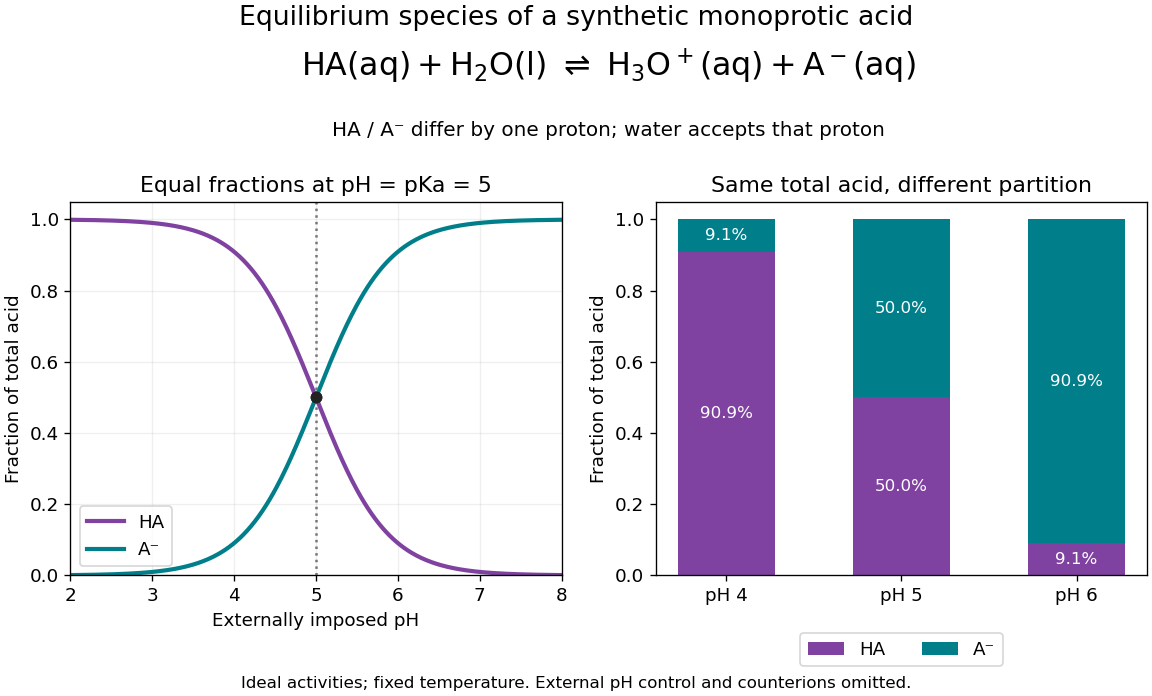
A synthetic monoprotic acid partitions between conjugate acid and conjugate base as imposed pH changes
. Details. 
For stipulated pKa , the conjugate base fractions at pH , and are , and . Here an external reservoir sets pH; its ions must supply the additional electric charge balance. The diagram omits those ions and water populations. It does not represent three pure samples at identical analytical concentration with freely chosen pH. In the latter experiment, the weak acid mass and charge balances determine pH as well as the partition.
The conjugate acid of a chemical base is the chemical species formed when it accepts one proton. This is a relationship between partners, rather than a claim that the partner is a strong acid.
A conjugate acid-base pair consists of two chemical species related by transfer of one proton. The conjugate acid has one more proton and one more positive unit of electric charge than the conjugate base.
For the conjugate base accepting a proton from water,This base dissociation constant uses the same water thermodynamic activity approximation and standard state conventions as the acid dissociation constant. Multiplying the two relations cancels the partner thermodynamic activities:Here is the aqueous ion product associated with self-ionization of water. At fixed temperature, a larger acid dissociation constant gives a smaller base dissociation constant for its own conjugate base; this reciprocal rule compares matching conjugate acid-base pairs. A weak acid does not necessarily have a conjugate base that reacts almost completely with water. For example, stipulated and give .[ref]
14.3 Relative Strengths of Acids and Bases. Chemistry 2e by Paul Flowers and others; §14.3, Relative Strengths of Conjugate Acid-Base Pairs, cancellation giving Ka Kb = Kw
The value of changes with temperature; is the familiar approximate value near , not a universal constant. If water is retained explicitly in both full equilibrium constants, their product instead equals , the full equilibrium constant for . The acid dissociation constant, base dissociation constant and self-ionization of water convention must agree.
In the aqueous model here, a strong base supplies hydroxide essentially completely under the conditions considered. Strength and concentration are different properties.
The pH of a chemical solution is the negative base-ten logarithm of its hydrogen ion thermodynamic activity:The thermodynamic activity is a dimensionless quantity, so the logarithm has a dimensionless argument. The definition uses thermodynamic activity, rather than total chemical acid concentration. Single-ion thermodynamic activities require a convention; practical pH measurements are tied to calibrated standards. See IUPAC Gold Book, pH.
In a dilute ideal chemical solution in water, a useful approximation isSquare brackets denote concentration in moles per litre. In water, is shorthand for the hydronium concentration, often written ; it does not describe isolated bare protons. Departures from ideal behavior need activity coefficients. The concentration formula approximates the thermodynamic activity definition.
For an ideal strong acid supplying one proton per initial unit, stipulate a total concentration of and negligible self-ionization of water. Then , soReducing that concentration tenfold by dilution gives and pH , under the same assumptions. More generally, dividing the hydrogen ion thermodynamic activity by ten raises pH by one. This is why the scale compresses an enormous range: equal steps of pH represent multiplicative changes, rather than equal differences in concentration. These are model calculations, rather than measured samples.
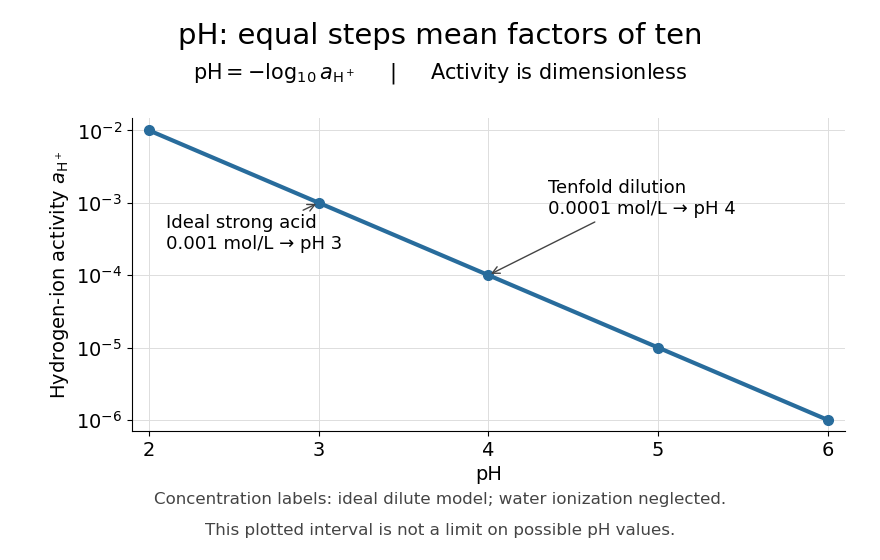

Neutrality depends on temperature. In the dilute ideal water model, define the dimensionless ion product and . Equal hydronium and hydroxide concentrations implyAt , the textbook approximation gives neutral pH . Since varies with temperature, neutrality need not mean pH . Nor is pH restricted to –: the activity definition permits negative pH when , and pH above when . High concentrations can invalidate the dilute ideal approximation. See Flowers et al., Chemistry 2e, pH and pOH.
S. P. L. Sørensen introduced pH at the Carlsberg Laboratory in 1909, as recorded in the Carlsberg Foundation historical timeline.
A buffer solution contains appreciable quantities of a weak acid and its conjugate base, and resists changes in pH caused by small quantities of added chemical acid or chemical base. The conjugate base accepts added protons; the weak acid supplies protons when a chemical base consumes them. Consuming most of either partner undermines the buffering action. See Flowers et al., Chemistry 2e, buffers.
For a separate toy calculation, stipulate pKa for a weak acid ; this is an input, not measured material data. Initially of buffer solution contains of and of its conjugate base . In the ideal concentration approximation, the Henderson-Hasselbalch equation gives initial pH . Add of hydroxide with negligible volume change. The dominant neutralization has one-to-one stoichiometry:Each mole of consumed hydroxide removes one mole of weak acid and forms one mole of conjugate base and water. Thus the inventories after neutralization areThe shared volume cancels from the concentration ratio. The Henderson-Hasselbalch equation therefore predictsThis small increase illustrates how conversion between abundant partners absorbs added chemical base. The calculation neglects the tiny free hydronium and hydroxide inventories, changes during re-establishment of chemical equilibrium, self-ionization of water, and activity coefficient corrections. The displayed inventories approximate the final chemical species distribution; they are not an exact solution of all chemical equilibrium conditions.
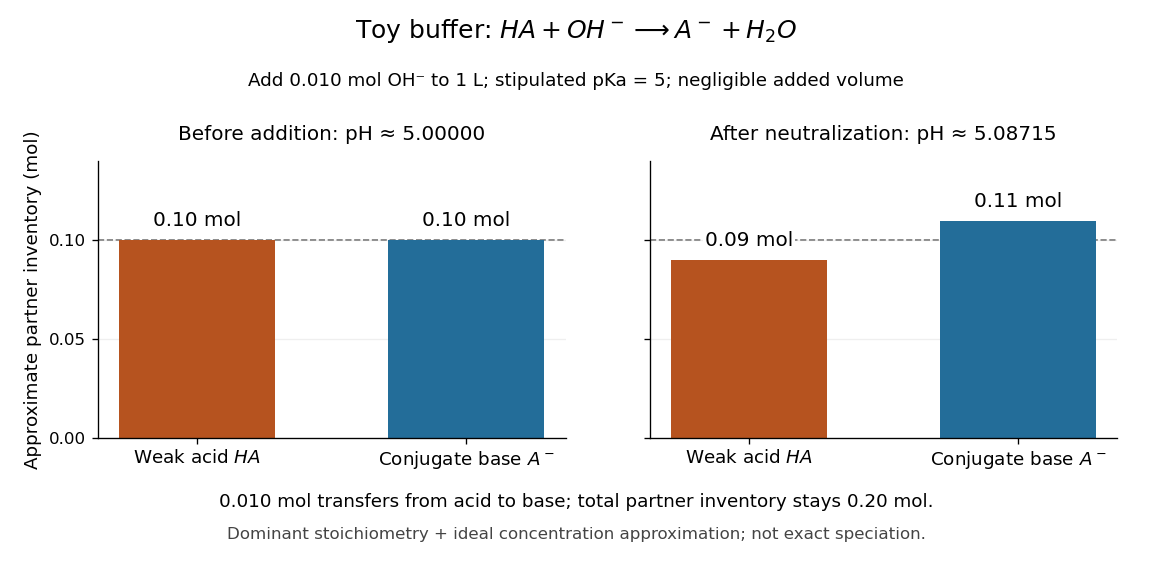

A buffer solution has a finite buffer capacity: its weak acid inventory supplies protection against added chemical base, and its conjugate base inventory supplies protection against added chemical acid. Here an addition approaching of hydroxide uses up the available in the dominant stoichiometry calculation. Close to that limit, the neglected chemical equilibrium contributions matter; once is exhausted, inserting a zero denominator into the Henderson-Hasselbalch equation cannot predict the actual pH. Excess hydroxide and the remaining chemical species require a fresh chemical equilibrium calculation. This is why a buffer solution stabilizes conditions for chemical reactions over a finite range of additions. See Flowers et al., Chemistry 2e, buffer capacity and added base.
For the pair , rearranging the acid dissociation constant gives the activity relationWith thermodynamic activity of water approximated by one and ideal dilute thermodynamic activities for both partners, this yields the familiar Henderson-Hasselbalch equation:The concentrations are at chemical equilibrium; using initial values requires negligible equilibration changes. Below, also neglect self-ionization of water and competing chemical reactions.
Stipulate for an illustrative weak acid, without identifying it with a measured substance. A conjugate base to weak acid concentration ratio of two givesEqual concentrations give a ratio of one, whose logarithm is zero, hence pH . Multiplying the ratio by ten raises pH by one: ratios , , and give pH values , , and . The ratio controls the ideal prediction, while the absolute quantities control how much added chemical acid or chemical base the buffer solution can accommodate.
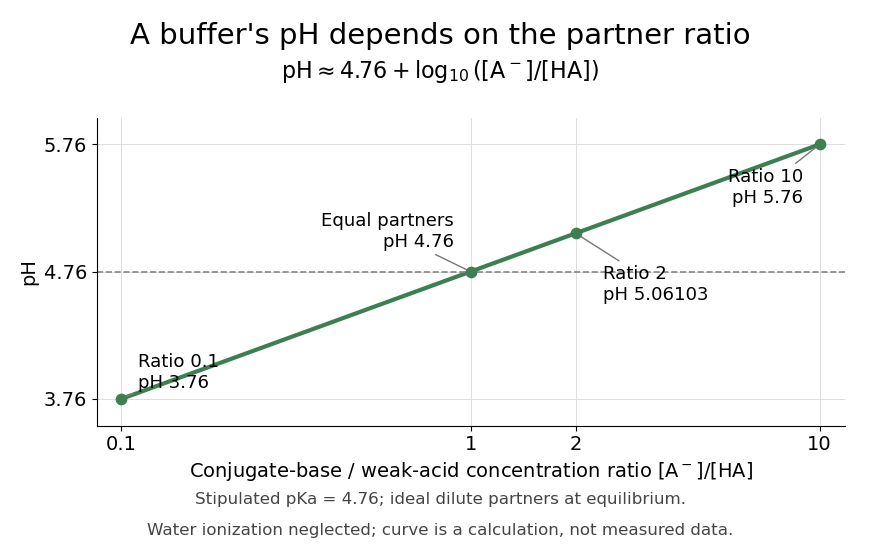

The Henderson-Hasselbalch equation estimates buffer solution pH using a weak acid's acid dissociation constant and the conjugate base to weak acid concentration ratio.
Its activity form is an exact rearrangement of the chosen chemical equilibrium relation. Write the acid dissociation step as , with hydrated hydrogen ions understood in water and the solvent convention incorporated into the acid dissociation constant. For consistent standard states,Here each is a dimensionless thermodynamic activity at chemical equilibrium. Exactness refers to this specified acid dissociation constant relation and the chosen single-ion thermodynamic activity convention, not to identifying the ratio with quantities initially mixed. If water is instead written explicitly as a reactant, its thermodynamic activity must be treated consistently. See Hippler and Metcalfe, Using activities to correct the Henderson-Hasselbalch equation (2020), equations 3–4.
For a toy weak acid with stipulated pKa , use the ideal dilute concentration approximation and put . The Henderson-Hasselbalch equation becomes :More conjugate base relative to weak acid means higher pH. Each tenfold increase in the ratio contributes exactly one to the calculated pH. The stipulated pKa is not a tabulated value for an identified substance.
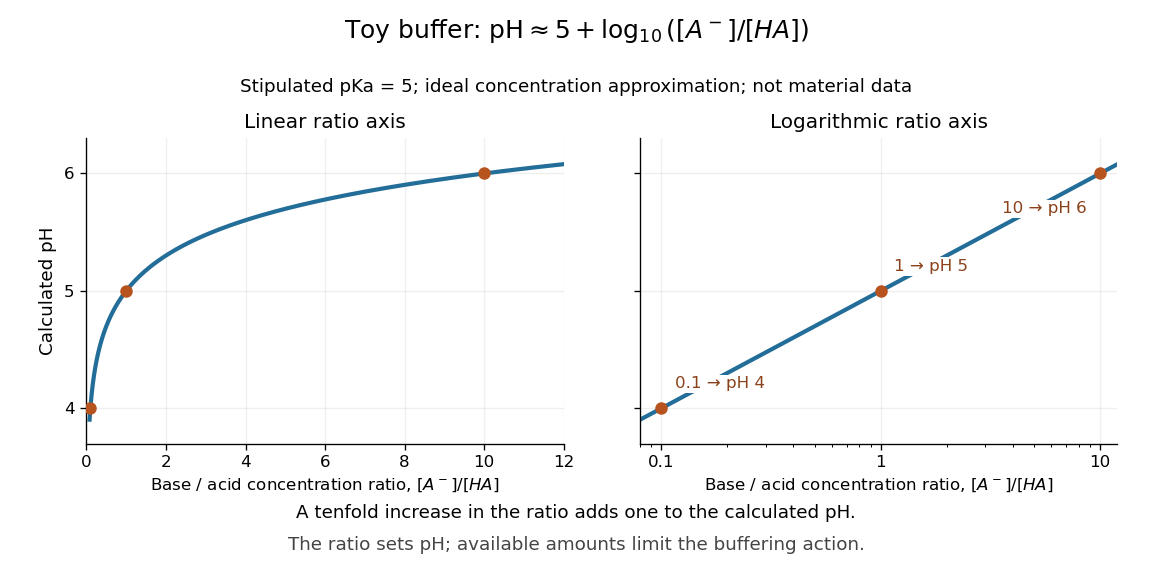

The distinction between thermodynamic activity and concentration is explicit when , where is an activity coefficient and is the reference concentration:Neglecting the final term gives the usual approximate Henderson-Hasselbalch equation. It is justified when the ratio of activity coefficients is sufficiently close to one, as in a suitable dilute ideal approximation. Ionic strength, including contributions from other dissolved ions, affects activity coefficients; a nominally dilute weak acid alone does not establish that all corrections are small. The ratio must use chemical equilibrium concentrations. Replacing these by prepared amounts or post-neutralization inventories is a further approximation, suitable only when subsequent redistribution is small. See Hippler and Metcalfe, concentration, activity, and analytical-concentration approximations.
The short derivation is to solve the acid dissociation constant relation for , take a negative base-ten logarithm, and use the definitions of pH and pKa. Its useful beauty is that a chemical equilibrium becomes a simple rule about a ratio: select a weak acid with pKa near the desired pH, then adjust the partner ratio. Scaling both partner concentrations equally leaves the ideal pH prediction unchanged, while changing buffer capacity. In practical buffer solutions, temperature, ionic strength, and the available inventories still matter.
Buffer capacity measures resistance to a change in pH: how much additional chemical acid or chemical base a chemical solution accommodates per small change in pH. Its differential form is a local derivative, rather than the total inventory available before a buffer solution is exhausted. Two buffer solutions can have identical pH and very different buffer capacities.
Choose a constant volume and fixed temperature. Let count added moles of fully dissociated, monovalent chemical base supplying hydroxide, and added moles of fully dissociated, monovalent strong acid supplying hydrogen ions. Neither addition supplies the weak acid component itself. The signed addition is , with units , andThe last two forms describe separate base-only and acid-only additions. The buffer capacity is positive for the stable chemical equilibrium model below and is reported in per unit of pH. Since pH is dimensionless, the dimensional unit is just ; stating “per pH” makes the measurement convention clear. Here constant volume is an idealization, realized approximately by small additions of concentrated reagent.
For a sufficiently small addition, . A large buffer capacity means a small local change of pH for a given addition. Over a finite interval, use the changing buffer capacity instead:This integral gives a finite dose in ; it need not equal the initial buffer capacity times the eventual change in pH.
Assume an ideal dilute aqueous chemical solution with just one monoprotic acid pair , self-ionization of water, and other ions that balance electric charge without undergoing further chemical reactions. Hold the analytical concentration constant. Keep the acid dissociation constant and the self-ionization of water constant dimensionless, consistently with pH:Thus denotes normalized hydrogen ion concentration, not a dimensional concentration. The chemical equilibrium and conserved analytical concentration giveAdding chemical base converts weak acid to conjugate base, increases free hydroxide, and decreases free hydrogen ion concentration. Balancing electric charge, including the added reagent's accompanying ions, gives the signed dose relative to any initial chemical equilibrium at :Differentiate with respect to pH, using . The result isThe first term is the monoprotic acid pair's contribution, ; the remaining terms are the free hydrogen ion and hydroxide contributions, . Each has units per pH. Equivalently, with dimensional , and , the expression is . Mixing the dimensional and dimensionless conventions would give incorrect units.
For ,because . Equality occurs at : equal weak acid and conjugate base concentrations, or pH equal to pKa. This is the exact maximum of the pair contribution in this model. The full buffer capacity need not have its maximum there: free hydrogen ions and hydroxide make it grow toward the acidic and alkaline extremes. When these contributions are small, the central peak lies close to pKa.
Stipulate pKa and ; these are model inputs, not measurements of an identified substance. At pH the pair contribution is . For analytical concentrations and , respectively, it isThe free hydrogen ion and hydroxide contribution is the same at this pH, per pH. The full buffer capacities are therefore approximately and per pH. Identical pH fixes the free hydrogen ion thermodynamic activity; it does not fix the inventory of weak acid and conjugate base available for neutralization.
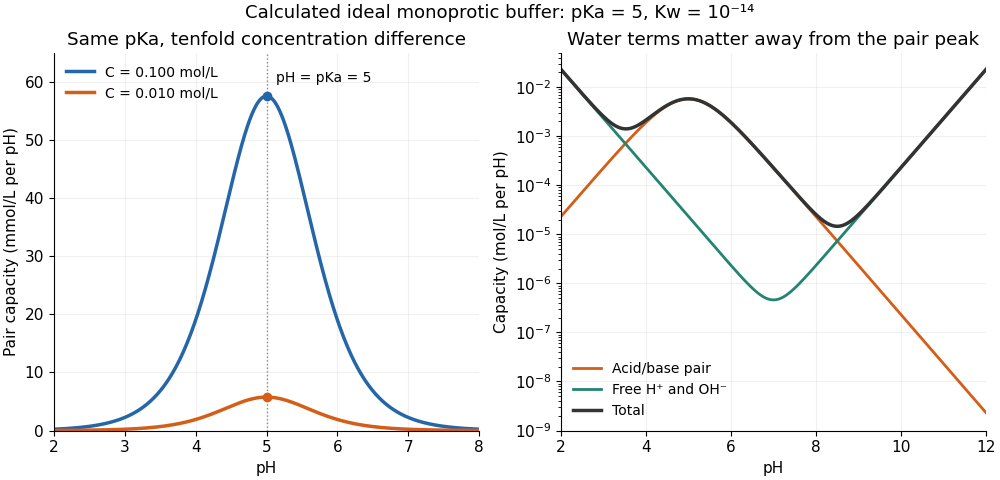

At one unit of pH on either side of pKa, or , giving . The partners still form a buffer solution, but its local resistance is only about one third of the maximum for that analytical concentration. At fixed pH, the pair contribution scales exactly with ; the full buffer capacity contains the additional -independent water contribution. Consequently, extreme dilution does not justify dropping self-ionization of water.
Prepare the same ideal monoprotic acid model at initial pH , with appropriate accompanying ions to balance electric charge. To predict the new pH after a finite signed addition , solve using the chemical equilibrium expression above. For of added chemical base, the calculated final pH is at , but at . The initial local approximation gives changes of about and , respectively; its accuracy decreases as the partner balance changes appreciably.
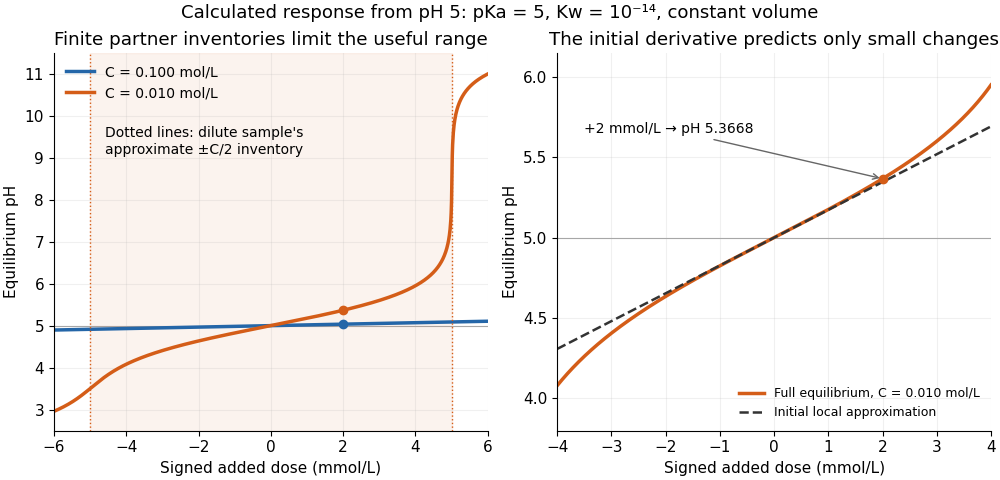

For the dilute example, additions beyond approximately in either direction exceed the initial inventory of one partner. The full chemical equilibrium calculation still produces a finite pH; an inventory-only Henderson-Hasselbalch equation calculation would attempt to use a negative partner quantity. At the dilute example reaches pH , whereas the concentrated example reaches only . This demonstrates a finite operating range, not an abrupt cessation of all buffer capacity.
A proposed modern measurement extends the weak acid dissociation measurement by estimating the local slope of an acid-base titration. Transfer a measured sample with a pipette into a stirred vessel; clamp a combination glass electrode/reference electrode clear of the stirring magnet and place a temperature probe nearby. A calibrated burette delivers a chemical base of independently standardized concentration , such as sodium hydroxide. Record the initial sample volume , cumulative delivered volume , stable pH, and temperature after each small addition. Use a separate fresh portion for an acidward series. These are proposed measurement conditions, not reported experimental results.
For the instrument calibration, use fresh standard buffer solutions bracketing the measured pH range, with values appropriate to the actual temperature. The Hanna manual specifies separate rinse and calibration portions, gentle stirring, and approximately immersion of the probe tip. It calls for stable readings; the sensing bulb and reference electrode junction must remain immersed. Rinse between standards and samples and avoid carrying rinse water into the measured portion.[ref]
HI5221 & HI5222 Instruction Manual: pH and mV and ISE and Temperature Bench Meters by Hanna Instruments. pp. 45–47: calibration portions, bracketing standards, temperature and immersion; pp. 49–50 and 74–75: stable readings, rinsing, junction immersion and drift
The readout pairs each added amount of substance with the measured pH. With negligible added volume, neighboring readings give the finite difference estimateassigned to the interval's midpoint. High buffer capacity appears as a small change of pH for a measured reagent dose. Choose increments small enough to resolve changing buffer capacity, but large enough that the change of pH exceeds measurement noise. Repeat with a fresh portion and different increment sizes; remeasure a standard afterward to check drift. A water blank can reveal contamination, but its pH must not be subtracted from the sample pH. These controls are proposed tests of the measurement and model assumptions.
If additions appreciably increase volume, even the analytical concentration changes: . Merely dividing the added moles by the current volume does not restore the constant-volume derivative. One alternative is explicitly to report a changing-volume convention. For , defineThis definition includes the reagent's changing concentration and differs from the constant-volume buffer capacity defined above.[ref]
Dynamic Buffer Capacity in Acid–Base Systems by Anna M. Michałowska-Kaczmarczyk and Tadeusz Michałowski. §2, Definition of Dynamic Buffer Capacity, equations (1)–(3): reagent concentration in the combined volume and its derivative
To compare with the constant-volume theory, fit the changing-volume chemical equilibrium model instead of treating the observed slope as . In the same ideal monoprotic acid system, define . For baseward additions, the electric charge balance at each reading isUse a minus sign before for the corresponding acidward series. From the model parameters, evaluate the constant-volume buffer capacity at the chosen analytical concentration and pH. The fit also tests whether one acid dissociation constant describes the observations.
Limitations include incomplete mixing, slow glass electrode response, uncertain reagent concentration, and changes in temperature or ionic strength. Dissolved atmospheric carbon dioxide introduces an additional chemical acid system; comparable exposure and freshly prepared samples help distinguish it from the intended monoprotic acid response. Additional reacting chemical species and nonideal activity coefficients invalidate the simple formula. Especially when pH increments are tiny, measurement noise can dominate the inferred derivative; reporting the dose, pH interval, volume convention, and repeatability is part of reporting a meaningful buffer capacity.
A buffer solution used as a running medium in DNA gel electrophoresis; it maintains pH while allowing electric current through the apparatus.
A neutralization is a chemical reaction between a chemical acid and a chemical base. In the buffer solution example, hydroxide takes a proton from the weak acid to form water and the conjugate base. The stoichiometry updates the partner inventories before the approximate chemical equilibrium calculation. The name does not require the resulting pH to be .
Articles by others on the same topic
There are currently no matching articles.