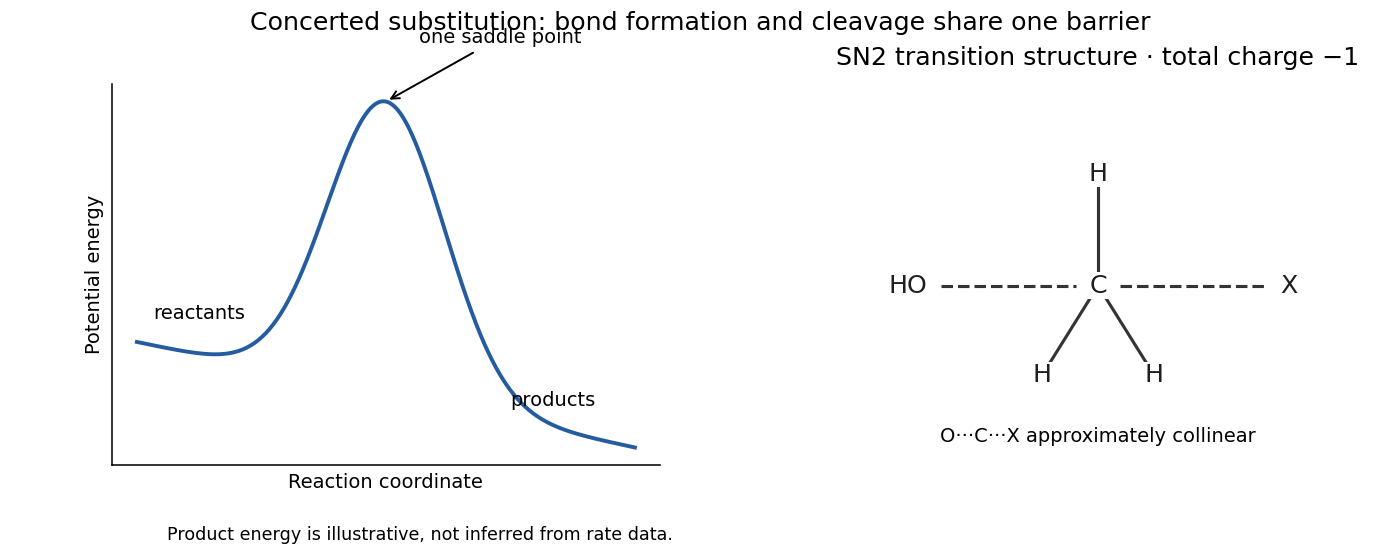
Single-barrier substitution profile and the trigonal-bipyramidal SN2 transition structure
. Details. 
Draw one maximum for the concerted SN2 reaction step, with no intermediate minimum. Its transition structure iswith O-C forming and C-X breaking, both shown as partial bonds. O-C-X is approximately linear, and the three C-H bonds lie in the equatorial plane. The overall charge is , distributed over the entering and leaving groups.
The sketch illustrates an exergonic case; the elementary-step description alone does not supply a numerical reaction energy or determine the product-reactant energy difference for every possible X.
A transition structure is a saddle point on the potential-energy surface: motion along the reaction coordinate lowers energy in either direction. It has one unstable vibrational direction and no intermediate residence basin.
An intermediate is a local minimum, separated from neighboring states by barriers, with a finite lifetime. It may be short-lived, but that does not make it a transition structure. The elementary SN2 reaction step has a transition structure and no distinct bonded intermediate.
Articles by others on the same topic
There are currently no matching articles.